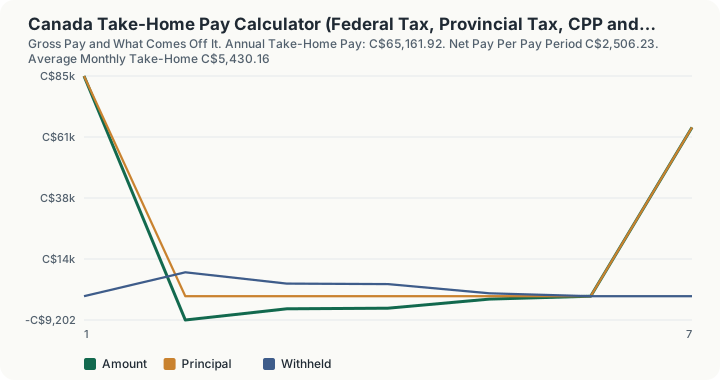
Quick Answer: A C$85,000 salary in Ontario with a C$5,000 RRSP deduction takes home C$65,161.92 in 2026, or C$2,506.23 per biweekly cheque. Total withheld is C$19,838.08: C$9,201.60 of federal tax, C$4,866.96 of Ontario tax including the C$750 Ontario Health Premium, C$4,646.45 of CPP including C$416.00 of CPP2, and C$1,123.07 of EI premiums. That keeps 76.66% of gross. All figures are in Canadian dollars, for the 2026 tax year.
What does this calculator do?
Four separate deductions come off a Canadian pay cheque, and they behave in three different ways. Federal and provincial income tax are progressive, so each extra dollar costs more than the last. CPP contributions are flat until a ceiling and then flat again at a second rate up to a second ceiling. EI premiums are flat until a ceiling and then stop entirely.
Pick your province or territory and the calculator applies that jurisdiction's own 2026 tax brackets and basic personal amount, every one read from the Canada Revenue Agency's 2026 rate tables and its T4127 payroll formulas, or from Revenu Quebec for Quebec. The same C$85,000 salary with a C$5,000 RRSP deduction takes home C$65,161.92 in Ontario, C$65,558.50 in Alberta, C$66,013.36 in British Columbia, C$61,590.06 in Quebec and C$61,313.19 in Nova Scotia. The gap is almost entirely the provincial layer.
Quebec is handled as its own case, because it is one. A Quebec employee pays into the Quebec Pension Plan at 6.30% instead of the CPP's 5.95%, pays Quebec Parental Insurance Plan premiums, pays EI at a lower 1.30% rate, and has federal tax cut by the 16.5% Quebec abatement.
The most important structural fact this calculator makes visible is that an RRSP contribution reduces income tax and nothing else. CPP and EI are charged on gross employment income, so contributing to an RRSP never reduces them by a cent. At the defaults, dropping the C$5,000 RRSP contribution leaves CPP and EI exactly unchanged and costs C$1,482.50 in extra tax, which is C$5,000 at the 29.65% combined marginal rate.
How is this calculated?
The steps follow the CRA's T4127 payroll formulas, worked on a whole year rather than one pay period.
- CPP or QPP, on gross pay. Base and first additional contributions apply to earnings between the C$3,500 basic exemption and the C$74,600 Year's Maximum Pensionable Earnings, at 5.95% (CPP) or 6.30% (QPP in Quebec). The second additional contribution applies at 4% to earnings between C$74,600 and the C$85,000 YAMPE.
- EI, and QPIP in Quebec, on gross pay. EI is 1.63% of earnings up to C$68,900, or 1.30% in Quebec. Quebec employees also pay 0.43% QPIP premiums on earnings up to C$103,000.
- Taxable income. Gross pay less your RRSP and other deductions, and less the enhanced part of CPP or QPP. The 1% first additional contribution and all of CPP2 are deducted from income; only the base part earns a credit.
- Federal tax. Taxable income runs through the 2026 federal ladder (14%, 20.5%, 26%, 29%, 33%, with thresholds at C$58,523, C$117,045, C$181,440 and C$258,482). The basic personal amount, the Canada employment amount, base CPP or QPP, EI and QPIP each earn a credit at 14%. Quebec residents then subtract the 16.5% abatement.
- Provincial or territorial tax. Taxable income runs through your jurisdiction's own 2026 ladder. The provincial basic personal amount, base CPP and EI earn a credit at that jurisdiction's lowest rate, and Yukon adds its own Canada employment amount. Ontario then adds its surtax and the Ontario Health Premium; Ontario and British Columbia subtract their low-income tax reductions; Alberta applies its supplemental credit.
- Net pay. Gross less income tax and every payroll contribution, then divided by your pay periods.
Net Pay = G − T_fed − T_prov − CPP − EI − QPIP
Worked Example
Using the page defaults: C$85,000 gross in Ontario, C$5,000 of RRSP deductions, 26 pay periods.
Step 1: CPP contribution. C$74,600 less the C$3,500 exemption is C$71,100, at 5.95%. C$4,230.45
Step 2: CPP2. C$85,000 less C$74,600 is C$10,400, at 4%. C$416.00
Step 3: split the CPP. The base part, C$4,230.45 times 4.95/5.95, earns the credit; the C$711.00 first additional part plus the C$416.00 of CPP2 is deducted from income. C$3,519.45 credited, C$1,127.00 deducted
Step 4: EI. C$68,900 at 1.63%. C$1,123.07
Step 5: taxable income. C$85,000 less the C$5,000 RRSP and the C$1,127 enhanced CPP. C$78,873
Step 6: federal tax before credits. C$58,523 at 14% is C$8,193.22; the next C$20,350 at 20.5% is C$4,171.75. C$12,364.97
Step 7: federal credits. 14% of C$16,452 basic personal amount, C$1,501 Canada employment amount, C$3,519.45 base CPP and C$1,123.07 EI. C$3,163.37
Step 8: federal tax. C$9,201.60
Step 9: Ontario tax before credits. C$53,891 at 5.05% is C$2,721.50; the next C$24,982 at 9.15% is C$2,285.85. C$5,007.35
Step 10: Ontario credits. 5.05% of C$12,989 plus base CPP plus EI. C$890.39
Step 11: basic Ontario tax. C$4,116.96, below the C$5,818 surtax threshold, and far too high for the Ontario tax reduction. C$4,116.96
Step 12: Ontario Health Premium. Taxable income between C$72,000 and C$200,000 pays the lesser of C$750 and C$600 plus 25% of the excess over C$72,000. C$750.00
Step 13: total withheld. C$9,201.60 plus C$4,866.96 plus C$4,646.45 plus C$1,123.07. C$19,838.08
Step 14: annual take-home pay. C$65,161.92
Step 15: per biweekly cheque. Divided by 26. C$2,506.23
What does this calculator not account for?
- Only the basic credits. The calculator applies the basic personal amount, the Canada employment amount, and the CPP or QPP, EI and QPIP credits, which is what the CRA payroll formulas apply for someone who files the default TD1. Spousal, dependant, age, pension, disability, tuition, medical and donation credits are not modelled.
- Low-income reductions outside Ontario and British Columbia. Ontario's and BC's tax reductions are applied because they sit in the CRA payroll formulas. The low-income reductions that Nova Scotia, Newfoundland and Labrador, Prince Edward Island, New Brunswick and Manitoba grant on the return are not, so tax at modest incomes in those provinces can be overstated.
- Quebec's own deductions. Quebec tax is computed from Revenu Quebec's 2026 brackets less the Quebec basic personal amount credit at 14%. Quebec's deduction for workers and its other credits are not modelled.
- Net income is taken to equal taxable income for the federal, Manitoba and Yukon basic personal amount phase-outs.
- No employer-side costs. Your employer matches your CPP and pays 1.4 times your EI premium. None of that appears in your take-home pay and none appears here.
- Withholding is not the same as tax owed. This is the annual tax on a full year's salary. Your actual withholding can differ by pay period, and a mid-year change of rate in your province is spread across the remaining cheques.
What mistakes do people make with this?
- Expecting an RRSP contribution to reduce CPP or EI. It cannot. Both are levied on gross employment income before any deduction, which is why an RRSP contribution is worth exactly your marginal tax rate and no more.
- Being surprised when a cheque suddenly gets bigger mid-year. Once you have paid the maximum CPP and EI for the year, those deductions stop and net pay jumps. Nothing has changed about your salary.
- Reading the average rate as the marginal rate. At the defaults 23.34% of gross is withheld in total, but the next dollar of salary costs 29.65% in income tax alone.
- Forgetting the Ontario Health Premium. It is collected through your tax withholding, so it shows up as income tax rather than as a separate line on your pay stub. At C$85,000 it is C$750 a year.
- Comparing provinces on the top rate alone. The basic personal amount and the lowest bracket rate matter more than the top rate for most salaries, which is why Alberta's C$22,769 provincial basic personal amount narrows the gap with lower-rate provinces.
Frequently Asked Questions
Why is CPP charged on my gross pay rather than my taxable income?
What is CPP2 and why is it a separate line?
How much is C$85,000 after tax in Ontario?
Does this calculator handle Quebec?
Which province has the highest take-home pay?
Sources
- Canada Revenue Agency, Current year tax rates and income brackets (2026), page dated 2026-06-25, read 2026-10-14. canada.ca/en/revenue-agency/services/tax/individuals/tax-rates-brackets/current-year.html
- Canada Revenue Agency, T4127 Payroll Deductions Formulas, 122nd Edition, effective January 1, 2026: the federal and provincial basic personal amounts, the Ontario surtax and health premium, the Ontario and BC tax reductions, the Alberta supplemental credit, the Quebec abatement, and the 2026 CPP, QPP, EI and QPIP rates and ceilings (Tables 8.1 to 8.8). Read 2026-10-14. canada.ca/en/revenue-agency/services/forms-publications/payroll/t4127-payroll-deductions-formulas/t4127-jan/t4127-jan-payroll-deductions-formulas-computer-programs.html
- Canada Revenue Agency, T4127 Payroll Deductions Formulas, 123rd Edition, effective July 1, 2026: British Columbia's 5.60% lowest rate and C$690 tax reduction, Newfoundland and Labrador's C$13,094 basic personal amount, and Prince Edward Island's 20% bracket over C$200,000, all as annual 2026 figures. Read 2026-10-14. canada.ca/en/revenue-agency/services/forms-publications/payroll/t4127-payroll-deductions-formulas/t4127-jul/t4127-jul-payroll-deductions-formulas.html
- Revenu Quebec, Income Tax Rates (2026), and Employers: Principal Changes for 2026 (basic personal amount, QPP and QPIP). Read 2026-10-14. revenuquebec.ca/en/citizens/income-tax-return/completing-your-income-tax-return/income-tax-rates
- Manitoba Finance, Personal Income Taxes: indexation of Manitoba's bracket thresholds paused from the 2025 tax year. Read 2026-10-14. gov.mb.ca/finance/personal/ptaxes.html
- Income Tax Act, R.S.C. 1985, c. 1 (5th Supp.), s. 117(2) and s. 118, the federal rates and the basic personal amount as a credit at the lowest rate. Justice Laws Website, read 2026-08-31. laws-lois.justice.gc.ca/eng/acts/I-3.3/section-117.html