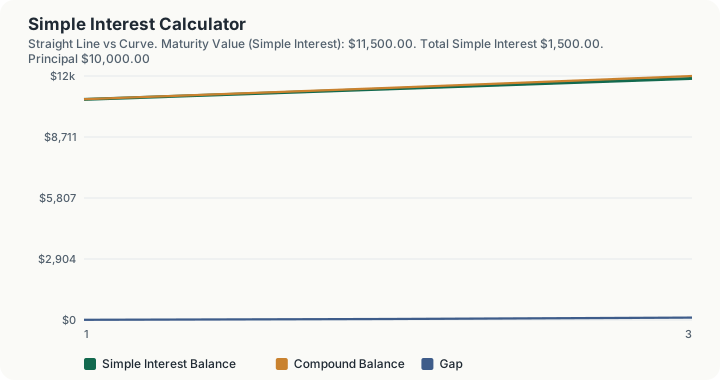
Quick Answer: $10,000 at 5% for 3 years earns $1,500 in simple interest and matures at $11,500.00. The same money compounded monthly would reach $11,614.72, so choosing simple interest costs $114.72 over three years. Stretch the term to thirty years and that gap stops being a rounding difference and becomes most of the money.
What does this calculator do?
Simple interest accrues on the original principal and never on interest already earned. That single restriction is the whole idea, and it is what separates this calculator from a compound interest calculator: here the balance grows in a straight line, and there it grows along a curve.
The straight line is not a teaching abstraction. It is the actual convention on short promissory notes, seller-financed notes, many auto loans in the United States, statutory judgment and prejudgment interest, most bridge and hard-money loans, and any deposit that pays interest out to you rather than crediting it back into the balance.
Because the accrual is flat, this calculator can tell you something a compound calculator cannot state so cleanly: the interest per year, per month and per day are the same in every period of the loan. Year one and year twenty are identical. That is why simple interest is used where the term is short, the accrual has to be provable to a court, or the interest is physically paid away each period and so has no opportunity to earn anything.
The tool computes both methods side by side because the only interesting question about simple interest is what it costs you relative to compounding, and the answer depends far more on the term and the rate than most people expect.
How is this calculated?
I = P × r × t; A = P × (1 + r × t)
Where $P$ is principal, $r$ is the annual rate as a decimal, $t$ is time in years, $I$ is total interest and $A$ is the maturity value. The comparison figure uses the compound formula:
A_compound = P × (1 + r/m)^(mt)
with $m$ the periods per year you select. The steps the engine performs, in order:
Step 1: Convert the stated rate to a decimal. $5\% \div 100 = 0.05$
Step 2: Multiply principal by the rate to get one year of interest. $10,000 \times 0.05 = \$500.00$
Step 3: Multiply by the term in years to get total interest. $500.00 \times 3 = \$1,500.00$
Step 4: Add the interest back to the principal for the maturity value. $10,000 + 1,500 = \$11,500.00$
Step 5: Divide the annual interest by 12 and by 365 for the periodic figures. $500 \div 12 = \$41.67$ per month, and $500 \div 365 = \$1.37$ per day.
Step 6: Compute the same principal under compounding. $10,000 \times (1 + 0.05 \div 12)^{36} = 10,000 \times 1.16147223 = \$11,614.72$
Step 7: Subtract to isolate the cost of not compounding. $11,614.72 - 11,500.00 = \$114.72$
Step 8: Express that gap against the simple interest earned. $114.72 \div 1,500 = 7.6\%$
The year-by-year table repeats steps 2 through 7 at each whole year of the term, which is what produces the widening gap between the straight line and the curve.
Worked Example
A contractor lends $10,000 on a three-year note at 5% simple interest, paid at maturity.
- One year of interest: $10,000 x 0.05 = $500.00
- Three years of interest: $500 x 3 = $1,500.00
- Amount due at maturity: $11,500.00
- Monthly accrual, unchanging across all 36 months: $41.67
Now hold the same note for thirty years instead of three. Simple interest pays $500 x 30 = $15,000, for a maturity value of $25,000. Compounded monthly at the identical 5%, the balance reaches roughly $44,677, a gap near $19,677. The rate did not change. Only the time over which interest was denied the chance to earn interest.
Raise the rate to 18% over the original three years. Simple interest gives $10,000 x 0.18 x 3 = $5,400 and a maturity of $15,400. Monthly compounding gives about $17,091. A high rate widens the gap much faster than a long term at a low rate does, because the compounding effect is driven by the per-period rate.
A six-month note for $25,000 at 8%: $25,000 x 0.08 x 0.5 = $1,000, maturing at $26,000. Over a term this short the two methods differ by a few dollars, which is exactly why short paper is written on simple interest in the first place. Nobody is giving up anything material.
Watching the Gap Open, Year by Year
Step 1: End of year one. Simple balance $10,500.00, the same money compounded monthly $10,511.62, gap $11.62
Step 2: End of year two. Simple $11,000.00, compound $11,049.41, gap $49.41
Step 3: End of year three, maturity. Simple $11,500.00, compound $11,614.72, gap $114.72
The simple column advances by exactly $500.00 a year and always will. The gap column does not: it is $11.62 after one year and $114.72 after three, nearly ten times larger over a term only three times as long. That accelerating third column is the whole difference between the two conventions, and on a three-year note it is worth $114.72, which is why nobody argues about it on short paper and everybody argues about it on long paper.
What does this calculator not account for?
- Day-count conventions. The engine treats a year as a year and converts to a daily figure by dividing by 365. Real notes specify 30/360, actual/360 or actual/365, and actual/360 quietly charges about 1.4% more interest than the stated rate implies.
- Payments during the term. This models a single lump repaid at maturity. An amortising simple-interest loan recomputes interest on the declining balance every payment date, which the amortization calculators handle.
- Taxes. Interest income is generally taxable in the year it accrues or is received, and no tax is deducted here.
- Default, late fees and penalty rates. Many notes step up to a penalty rate on default.
- Compounding on unpaid interest. Some notes convert accrued but unpaid interest into principal, at which point the loan is no longer simple interest at all.
- Fees and points. Origination costs raise the effective rate above the stated rate. Use the APR calculator for that.
- Inflation. All figures are nominal.
What mistakes do people make with this?
- Assuming a bank savings account uses simple interest. Almost none do. A quoted APY is by definition a compounded figure.
- Reading the annual rate as the periodic rate. A 5% annual rate on a six-month note earns 2.5%, not 5%.
- Comparing a simple-interest rate to a compound rate at face value. They are different units. Compare maturity values, or convert both to an effective annual rate.
- Forgetting that actual/360 exists. A 6% actual/360 loan accrues 6% x 365/360 = 6.083% over a real year.
- Believing simple interest is always worse for the borrower. It is better for the borrower and worse for the lender. On a loan you are paying, simple interest is the favourable side of the table.
- Assuming the gap is negligible because it looks small. It is small over three years and dominant over thirty. Check your own term before dismissing it.
Frequently Asked Questions
What is simple interest?
How is it different from compound interest?
Which loans actually use simple interest?
Can I enter a term shorter than a year?
Why is my daily interest figure not exactly the bank's?
Is simple interest better for me?
Sources
- Regulation Z (Truth in Lending), 12 CFR Part 1026, including the Appendix J annual percentage rate computation. ecfr.gov/current/title-12/chapter-X/part-1026
- U.S. Securities and Exchange Commission, Investor.gov compound interest reference. investor.gov/financial-tools-calculators/calculators/compound-interest-calculator
There is no statutory or regulatory source for these formulas. I = P x r x t and A = P(1 + rt) are the standard algebraic definitions of simple interest, and the comparison figure uses the standard compound formula A = P(1 + r/m)^(mt). Both are implemented in engine/primitives/simple-interest.ts and proven against hand-derived vectors in engine/vectors/simple-interest.test.ts.
Where a real standard governs a related figure it is cited on the page that uses it: the APR calculator cites Regulation Z (12 CFR 1026.22) for the annual percentage rate, and the interest rate calculator cites Regulation DD (12 CFR 1030) for the annual percentage yield. Neither governs simple interest itself, and no source is invented here to suggest otherwise. Day-count conventions are matters of contract between the parties rather than of statute.