Quick Answer: The IRS charges daily-compounded interest, currently 7% per year, on any quarter where your withholding and estimated payments fell short of the required installment, unless you qualify for a safe harbor by paying at least 90% of this year's tax or 100% (110% if you are a high earner) of last year's tax.
Overview
The United States runs on a pay-as-you-go tax system. If you are an employee, withholding generally handles this automatically. If you have significant self-employment income, investment gains, rental income, or any other income without withholding, you are expected to send the IRS quarterly estimated payments throughout the year, not just settle up when you file. Fall short in any quarter and the IRS does not wait for your tax return to notice. It charges what is functionally an interest penalty, computed separately for each of the four quarters, running from that quarter's due date until the shortfall is paid.
This is a real and commonly underestimated cost. Taxpayers who have a big income year, sell a business, exercise stock options, or simply forget to adjust their withholding after a raise routinely discover an underpayment penalty on Form 2210 when they file, often to their genuine surprise since the penalty was never disclosed anywhere during the year. The penalty is not enormous compared to the underlying tax bill, but it compounds daily and it is entirely avoidable with basic planning, which is exactly why the IRS expects taxpayers to know the safe harbor rules.
The calculator itself walks through the actual Form 2210 mechanics: the two safe harbor tests, the quarter-by-quarter required installment, and a daily-compounded interest calculation using the IRS's currently published underpayment rate.
How This Is Calculated
Step 1: Determine the safe harbor amount. You owe no penalty at all if your total withholding and estimated payments for the year meet or exceed the smaller of: - 90% of your current-year total tax, or - 100% of your prior-year total tax, increased to 110% if your prior-year adjusted gross income exceeded $150,000 ($75,000 if you are married filing separately).
The calculator takes the smaller of these two figures as your required annual payment. If your total payments meet or beat it, the tool reports "Safe Harbor Met" and the penalty is zero, full stop, regardless of how the payments were spread across the year.
Step 2: Split the requirement into quarters. If the safe harbor was not met, the required annual payment is divided evenly into four quarterly installments (the "regular method"; taxpayers with sharply uneven income across the year can instead use the IRS's annualized income installment method, which this calculator does not model). Withholding is treated as paid in four equal shares regardless of when it actually happened, which is an IRS rule, not a simplification: withholding is always deemed to be paid evenly across the year unless you specifically elect otherwise on Form 2210.
Step 3: Compute each quarter's shortfall. For each of the four quarters, the calculator compares the required installment against your withholding share plus that quarter's actual estimated payment. Any deficit is that quarter's shortfall.
Step 4: Apply daily-compounded interest. For each quarter with a shortfall, the calculator counts the actual calendar days from that installment's due date (April 15, June 15, September 15, or January 15 of the following year) to the date you tell it the balance was paid, using a standard actualDaysBetween function. It then compounds the current IRS underpayment rate daily over that exact day count: penalty = shortfall × ((1 + dailyRate)^days − 1), where dailyRate is the annual rate divided by 365, matching the IRS's own daily-compounding rule under Internal Revenue Code § 6622.
Step 5: Apply the January 31 waiver. If you pay your full remaining balance and file your return by January 31 of the following year, the IRS waives the fourth (January 15) required installment entirely. The calculator checks for this automatically.
Current IRS underpayment rate used: 7% per year, compounded daily. This is the published rate for individual underpayments for the calendar quarter beginning July 1, 2026 through September 30, 2026 (Q3 2026), set under IRC § 6621 as the federal short-term rate plus three percentage points. Source: IRS, Internal Revenue Bulletin 2026-22 (published May 26, 2026), and the IRS Quarterly Interest Rates table at irs.gov/payments/quarterly-interest-rates. This rate changes every quarter; the Q4 2026 rate had not yet been published as of this writing, so always confirm the current figure before relying on this tool for an actual filing.
Worked Example
A freelance consultant expects $24,000 in total tax for the current year. Last year their total tax was $16,000 on an AGI of $140,000, comfortably under the $150,000 high-earner threshold. They have $9,000 withheld from a part-time W-2 job and make four equal $1,000 estimated payments, one each quarter. They do not pay off any shortfall until they file on April 15 of the following year.
Step 1, safe harbor amount: the smaller of 90% × $24,000 = $21,600, or 100% × $16,000 = $16,000 (AGI is under $150,000, so no 110% bump). Required annual payment: $16,000.
Step 2, total paid: $9,000 withholding + $4,000 in estimated payments ($1,000 × 4) = $13,000. Since $13,000 is less than the $16,000 safe harbor, the penalty applies.
Step 3, per-quarter shortfall: required installment per quarter = $16,000 ÷ 4 = $4,000. Withholding per quarter = $9,000 ÷ 4 = $2,250. Paid per quarter = $2,250 + $1,000 = $3,250. Shortfall per quarter = $4,000 − $3,250 = $750, in all four quarters, for a total shortfall of $3,000.
Step 4, days late and interest, with the balance paid April 15 of the following year: - Q1 (due April 15): 365 days late → penalty $54.38 - Q2 (due June 15): 304 days late → penalty $45.02 - Q3 (due September 15): 212 days late → penalty $31.12 - Q4 (due January 15): 90 days late → penalty $13.06
Total estimated penalty: $143.58 on a $3,000 shortfall, an effective cost of roughly 4.8% of the underpaid amount, reflecting the mix of quarters that were outstanding for nearly a full year versus just a few months.
Carrying the Penalty Quarter by Quarter
Step 5 -- Q1, due April 15. Required installment $4,000, shortfall $750, penalty accrued $54.38. Running total $54.38
Step 6 -- Q2, due June 15. Penalty accrued $45.02. Running total $99.40
Step 7 -- Q3, due September 15. Penalty accrued $31.12. Running total $130.52
Step 8 -- Q4, due January 15. Penalty accrued $13.06. Running total $143.58
The four quarters carry identical $750 shortfalls and produce wildly different penalties, because the clock is what is being charged, not the amount. Q1 alone accounts for more than a third of the total. That is the practical lesson: a missed first installment is roughly four times as expensive as a missed fourth, so if only one quarter can be funded, fund April.
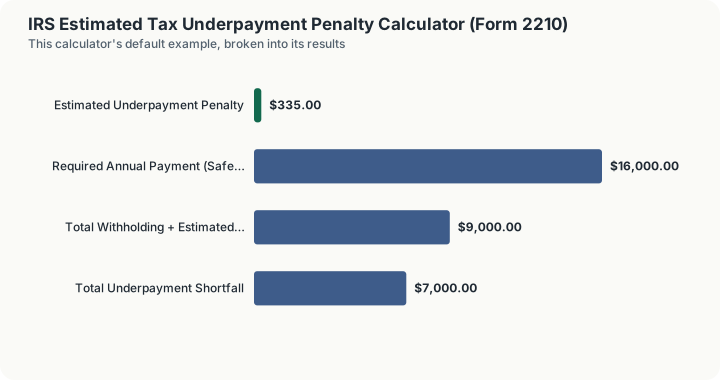
For contrast, running the calculator's own defaults with no estimated payments at all lifts the quarterly shortfall from $750 to $1,750 and the penalty from $143.58 to $335, with the Q1 quarter alone accruing $126.88.
What This Does Not Account For
- The annualized income installment method. If your income arrived unevenly during the year (for example, a large capital gain in December), you may owe a smaller penalty, or none, by annualizing income quarter by quarter instead of splitting your total tax evenly. This is Schedule AI of Form 2210 and is not modeled here.
- Partial payments during the year. This calculator assumes each quarter's shortfall sits unpaid until a single balance-paid date you specify. In reality, a payment made mid-year can reduce a later quarter's accrued interest before it compounds further; a fully partial-payment-aware calculation requires tracking every payment date individually.
- Corporate, trust, and large-corporate underpayment rules. Corporations use a different (and currently higher) underpayment rate structure, particularly for "large corporate underpayments." This tool is built for individual taxpayers only.
- State estimated tax penalties. Nearly every state with an income tax has its own, separate estimated tax and underpayment penalty regime with different rates and safe harbor rules. This calculator addresses federal Form 2210 only.
- Changes to the IRS rate mid-lookback. The IRS rate can and does change every quarter. This calculator applies the single most recently published rate across the entire lookback window as a simplifying approximation; a fully precise calculation would apply each quarter's own historical rate to the days that fell within it.
- The $1,000 de minimis exception. If your total tax minus withholding is under $1,000, no penalty applies regardless of the safe harbor math. This calculator does not separately check for that floor; verify it before assuming a nonzero result here is final.
Common Pitfalls
- Assuming withholding increases late in the year cannot help. Because withholding is deemed paid evenly across all four quarters no matter when it was actually withheld, a lump-sum withholding increase in December can retroactively cover earlier quarters' shortfalls. Estimated payments do not get this treatment; a late estimated payment only counts from the quarter it was actually made.
- Confusing the 100% and 110% prior-year tests. The 110% threshold applies based on your prior-year AGI, not your current-year AGI, and the $150,000/$75,000 breakpoint is not indexed for inflation in the way many other tax thresholds are.
- Believing safe harbor status is fixed at the start of the year. If your income changes significantly, so does your required annual payment. Revisit the calculation whenever a major income event occurs, not just once in January.
- Ignoring the penalty because it looks small in dollar terms. The penalty on a modest shortfall can look trivial, but the same underlying miscalculation on a much larger shortfall, common after a stock sale or a large bonus, scales linearly and can be a genuinely material number.
- Missing the January 31 waiver. Taxpayers who owe money for the fourth quarter but plan to file early sometimes fail to realize that paying the full balance and filing by January 31 eliminates that installment's penalty entirely, a rule that costs nothing to use if you were filing early anyway.
Frequently Asked Questions
What if I pay exactly the safe harbor amount but all of it in December?
Does this calculator tell me if I owe the actual $1,000 de minimis exception?
Why does the penalty use daily compounding instead of a simple flat percentage?
Can the estimated tax penalty be waived?
How often does the IRS underpayment rate change, and where do I find the current one?
Sources
- Internal Revenue Service, Form 2210, Underpayment of Estimated Tax by Individuals, Estates, and Trusts, and its instructions. irs.gov
- Internal Revenue Service, Internal Revenue Bulletin 2026-22 (published May 26, 2026), quarterly interest rate determination under IRC § 6621. law.cornell.edu/uscode/text/26/6621
- Internal Revenue Service, Publication 505, Tax Withholding and Estimated Tax. irs.gov/publications/p505
Also consulted: Internal Revenue Service, "Quarterly Interest Rates," irs.gov/payments/quarterly-interest-rates; Internal Revenue Code § 6621 (determination of interest rate) and § 6622 (daily compounding of interest).