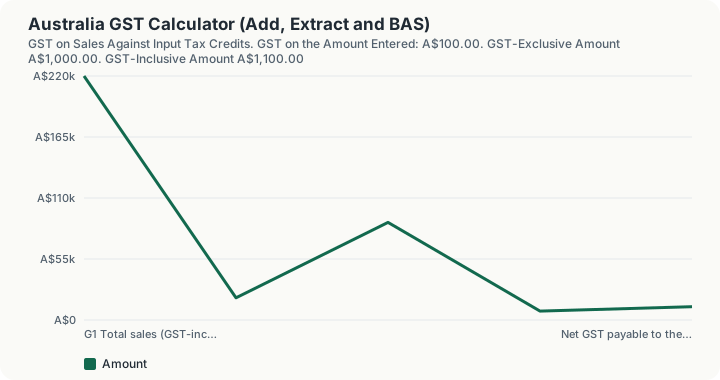
Quick Answer: An A$1,100 GST-inclusive price contains A$100.00 of GST, leaving a GST-exclusive amount of A$1,000.00. The BAS period shown here reports A$20,000.00 at label 1A, A$8,000.00 at label 1B, and A$12,000.00 of net GST payable to the ATO.
What does this calculator do?
The phrase everyone uses for Australian GST, "it is one eleventh of the GST-inclusive price", appears in no provision of the GST Act. What the Act contains is two separate rules. Section 9-70 says the amount of GST on a taxable supply is 10% of the value of the supply. Section 9-75(1) says the value of a taxable supply is the price multiplied by 10/11. One eleventh is the arithmetic consequence of composing those two rules, not a statutory phrase:
GST = 10% × (price × 10/11) = price × 1/11
This calculator takes the statutory route rather than the shortcut. gstFromInclusivePrice in engine/primitives/australia-gst.ts computes the s 9-75 value first, then applies the s 9-70 rate to it. The answer is identical to the shortcut, which the test vectors confirm against A$22,000 / 11, but the code path matches the legislative path term for term, so anyone auditing it can read the two provisions against the two lines.
The second thing worth knowing is that the famous A$75,000 registration turnover threshold is not in the Act either. Section 23-15(1) states A$50,000 "or such higher amount as the regulations specify", and reg 23-15.01 of the GST Regulations 2019 specifies A$75,000. For a non-profit body, s 23-15(2) states A$100,000 and reg 23-15.02 specifies A$150,000. Neither regulated figure is indexed by any provision in the Act or the Regulations, which is why the threshold has not moved since 2007. The calculator holds both figures as regulation-sourced constants and tests projected annual turnover against whichever one applies.
How is this calculated?
Working through the defaults: an A$1,100 GST-inclusive amount, A$220,000 of taxable sales, A$88,000 of purchases, and A$400,000 of projected annual turnover.
- Step 1: Reduce the price to the statutory value (s 9-75(1)). A$1,100 x 10 / 11 = A$1,000.00
- Step 2: Apply the 10% rate to the value (s 9-70). A$1,000.00 x 10% = A$100.00
- Step 3: Back out the GST-exclusive amount. A$1,100 - A$100.00 = A$1,000.00
- Step 4: Compute BAS label 1A, GST on taxable sales. The same two provisions are applied to the period's GST-inclusive taxable sales. A$220,000 x 10 / 11 x 10% = A$20,000.00
- Step 5: Compute the gross input tax credits on purchases. A$88,000 x 10 / 11 x 10% = A$8,000.00
- Step 6: Deny credits to the extent purchases relate to input taxed supplies. The denied proportion defaults to zero. A$8,000.00 x (1 - 0) = A$8,000.00 at label 1B
- Step 7: Net the period (Division 17). A$20,000.00 - A$8,000.00 = A$12,000.00 payable
- Step 8: Total the sales figure reported at G1. Taxable, GST-free and input taxed sales are added together. A$220,000 + A$0 + A$0 = A$220,000.00
- Step 9: Test registration (s 23-5). Projected annual GST turnover is compared with the threshold from reg 23-15.01, or reg 23-15.02 for a non-profit body. A$400,000 >= A$75,000, so registration is required
Worked Example
A consultancy issues A$220,000 of GST-inclusive invoices in a quarter and buys A$88,000 of GST-inclusive supplies. Label 1A is A$20,000. Label 1B is A$8,000. The net A$12,000 is remitted with the BAS. Nothing in that turns on profit: GST is a tax on transactions, so a business making a loss can still owe a substantial net amount.
Change one thing and the result inverts. A business in a capital-heavy quarter with A$55,000 of sales and A$165,000 of purchases reports A$5,000 at 1A and A$15,000 at 1B, and the net figure is negative A$10,000. That is a refund from the ATO, not a reduced payment.
Now the case people get wrong. A residential landlord makes input taxed supplies under Division 40. Set taxable sales to nil, input taxed sales to A$120,000, purchases to A$33,000 and the input taxed share of purchases to 100%. Label 1A is nil, which is expected. But label 1B is also nil: the A$3,000 of GST embedded in those purchases is not creditable and stays with the landlord as a real cost.
Compare that with a Division 38 GST-free supplier: most basic food, health, education and exports. GST-free sales also carry no GST at label 1A. The difference is entirely on the purchase side: a GST-free supplier keeps the input tax credits on related acquisitions, and an input taxed supplier does not. That single asymmetry is the whole distinction between the two divisions, and it is why "no GST on my sales" is an ambiguous statement that can mean either a full refund position or an unrecoverable cost.
What does this calculator not account for?
- Attribution and accounting basis. The calculator nets one period's figures as entered. It does not apply the Division 29 attribution rules that determine which tax period a supply or acquisition falls into, and it does not distinguish cash from accruals accounting.
- Whether an acquisition is creditable at all. Beyond the input taxed proportion slider, the calculator assumes every purchase entered is a creditable acquisition. It does not test the Division 11 conditions, and it does not apply apportionment for private or non-deductible use.
- Special rules and margin schemes. No margin scheme, no reverse charge, no GST grouping, no going-concern or farmland concessions, and no adjustment events under Division 19.
- Imports and the low value threshold. GST on taxable importations is not modelled.
- Instalments and PAYG. The BAS section computes net GST only. It does not compute the GST instalment option, PAYG withholding, PAYG instalments, fuel tax credits or any other BAS label.
- Registration timing. The registration test compares the turnover figure entered against the threshold. It does not apply the current-versus-projected turnover tests in Division 188, nor the 21-day registration deadline.
Every figure the calculator uses is drawn from the Act or the Regulations. There are no estimated or benchmarked values in it.
What mistakes do people make with this?
- Multiplying a GST-exclusive amount by 10% and then treating that answer as one eleventh of something. Adding GST uses 10%; extracting it uses 1/11. Using 10% in both directions overstates the GST extracted from an inclusive price by 10%.
- Assuming GST-free and input taxed are interchangeable. They differ only on credits, and that difference is often the larger number.
- Reading the A$75,000 threshold out of the Act. It is in reg 23-15.01. Citing s 23-15 alone gives A$50,000.
- Treating registration as optional once turnover is close to the line. The test is met at exactly A$75,000, not above it, because s 23-5 applies where turnover meets or exceeds the threshold.
- Forgetting that GST-free and input taxed sales still belong at G1. They carry no GST but they are still reported sales.
Frequently Asked Questions
Why does the calculator show a "value of the supply" separate from the GST-exclusive amount?
Is the A$75,000 threshold indexed?
Does the non-profit threshold change how GST itself is calculated?
Why is my input tax credit smaller than one eleventh of my purchases?
Can the net figure be negative?
Sources
- A New Tax System (Goods and Services Tax) Act 1999 (No. 55, 1999), Compilation No. 96, compilation date 1 January 2026: ss 9-70, 9-75(1), 23-5, 23-15. legislation.gov.au/C2004A00446/latest/text
- A New Tax System (Goods and Services Tax) Regulations 2019, Compilation No. 5, compilation date 1 November 2025: regs 23-15.01 and 23-15.02. legislation.gov.au/F2019L00417/latest/text
Verification was carried out against the Federal Register of Legislation, which publishes the authoritative compilations.