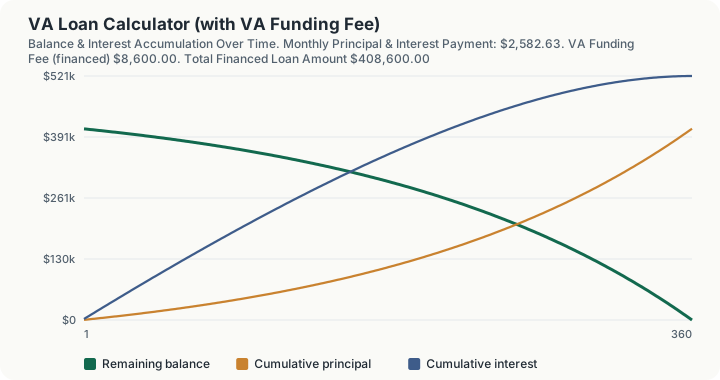
Quick Answer: A $400,000 VA loan with no down payment and a first-time use of your entitlement carries a 2.15% funding fee ($8,600), which is financed into the loan for a total balance of $408,600 and, at 6.5% over 30 years, a monthly principal and interest payment of about $2,582.63.
Overview
VA loans let eligible veterans, active-duty service members, and some surviving spouses buy a home with no down payment and no private mortgage insurance. That is the headline pitch, and it is true, but it leaves out the piece that actually shows up on the closing disclosure: the VA funding fee. This is a one-time charge, set by federal statute, that funds the loan guaranty program so it can keep operating without taxpayer subsidy. It is not optional and it is not small. On a $400,000 loan with zero down, it adds $8,600 to what you owe.
This calculator treats the funding fee as a first-class part of the loan, not an afterthought. You tell it the home price, your down payment, whether this is your first or a later use of VA entitlement, and whether the loan is a purchase, a cash-out refinance, or an Interest Rate Reduction Refinancing Loan (IRRRL). It looks up the correct fee percentage from the VA's own table, adds that fee to your loan balance (the way almost every borrower actually finances it), and then runs a full amortization schedule on the resulting balance so you can see exactly what you will pay every month for the life of the loan.
The reason this matters is that the funding fee tier swings the fee amount by nearly 3x depending on down payment and prior use. A first-time buyer putting nothing down pays 2.15%. Someone using their entitlement a second time with less than 5% down pays 3.3%, almost 50% more. Put down just 5% and both groups drop to 1.5%. Put down 10% and everyone, first use or not, pays the lowest tier of 1.25%. None of that is intuitive from a glance at a rate sheet, and a calculator that just multiplies "principal times rate" hides it entirely.
How This Is Calculated
The math happens in two steps.
Step 1: Determine the funding fee tier. The VA funding fee depends on three things: loan purpose, whether this is your first use of VA loan entitlement, and your down payment percentage.
- Purchase or new construction loans: less than 5% down uses 2.15% (first use) or 3.3% (subsequent use); 5% to 9.99% down uses 1.5% regardless of use history; 10% or more down uses 1.25% regardless of use history.
- Cash-out refinances: 2.15% for first use, 3.3% for subsequent use, with no down payment tiers because there typically is no new down payment in a refinance.
- IRRRLs (streamline refinances): a flat 0.5% regardless of prior use, because these loans do not require a new appraisal or underwriting package.
- Veterans receiving VA compensation for a service-connected disability, and certain surviving spouses, are fully exempt: the fee drops to zero.
Step 2: Amortize the financed balance. The dollar funding fee (base loan amount times the fee percentage) is added to the base loan amount to produce the financed loan amount. That financed amount, not the home price, is what actually amortizes. The calculator runs the standard fixed-rate mortgage formula on it:
where $i$ is the monthly interest rate (annual rate divided by 12) and $n$ is the total number of monthly payments (loan term in years times 12). The full month-by-month schedule, showing exactly how much of each payment goes to principal versus interest, is generated from this same formula and reconciled so the sum of every scheduled principal payment equals the financed loan amount to the cent.
Worked Example
Take a veteran buying a $400,000 home, using VA entitlement for the first time, putting no money down, at a 6.5% fixed rate on a 30-year term.
- Base loan amount: $400,000 minus $0 down payment = $400,000.
- Funding fee tier: first use, less than 5% down → 2.15%.
- Funding fee amount: $400,000 × 2.15% = $8,600.
- Financed loan amount: $400,000 + $8,600 = $408,600. This is the balance that actually amortizes.
- Monthly rate: 6.5% ÷ 12 = 0.5416667% per month.
- Monthly principal and interest payment: applying the amortization formula to $408,600 over 360 months at that monthly rate gives a payment of $2,582.63.
- Total interest over 30 years: roughly $521,146, on top of the $408,600 principal, for a total of all payments near $929,746.
Change only the down payment to 10% on that same $300,000 example used in our test suite and the fee tier drops to 1.25%: base loan $270,000, fee $3,375, financed amount $273,375, monthly payment $1,727.92. The lower tier and the smaller base loan both push the payment down.
What This Does Not Account For
This calculator isolates principal, interest, and the VA funding fee. Property taxes, homeowners insurance, and HOA dues aren't included; those are typically collected in an escrow account on top of principal and interest and vary enormously by location. VA loan limits and entitlement math go unmodeled too, for buyers with reduced remaining entitlement from a prior VA loan that has not been fully restored. Closing costs beyond the funding fee itself, such as the appraisal, title insurance, or origination charges, aren't accounted for either, though VA rules cap some of them without eliminating them. The rate is assumed fixed for the full term; adjustable-rate VA loans exist but are calculated differently. And finally, it does not model the case where a borrower pays the funding fee in cash at closing instead of financing it, which lowers the balance that amortizes but requires more cash upfront.
Common Pitfalls
Borrowers often assume "no down payment" means "no extra cost," and then are surprised the funding fee adds thousands of dollars to their loan balance. Others assume the fee is a flat percentage across the board and do not realize that a 5% down payment, not just 10% or 20%, meaningfully changes the tier. It is also easy to conflate "first use" with "first VA loan you have ever heard of a family member getting," when what actually matters is your own entitlement history as tracked by the VA, which is why a Certificate of Eligibility matters before you assume a fee tier. Disabled veterans sometimes pay the funding fee unnecessarily because the exemption was not properly documented with their lender before closing, and VA rules allow a refund but only if you catch it. Finally, borrowers refinancing with an IRRRL sometimes budget for a purchase-level funding fee when the actual IRRRL fee is a much smaller flat 0.5%.
Frequently Asked Questions
Do I have to finance the VA funding fee, or can I pay it in cash?
Why does my funding fee tier depend on whether this is my first VA loan?
Am I actually exempt from the funding fee?
Does a higher funding fee tier ever make sense to accept instead of a bigger down payment?
Is the VA funding fee the same as private mortgage insurance (PMI)?
Sources
- U.S. Department of Veterans Affairs, "VA funding fee and closing costs", rates effective April 7, 2023.
- U.S. Department of Veterans Affairs, VA Home Loans Handbook (VA Pamphlet 26-7), Chapter 8 (Loan Guaranty and Funding Fee). benefits.va.gov/homeloans
Also consulted: 38 U.S.C. § 3729 (statutory basis for the VA funding fee).