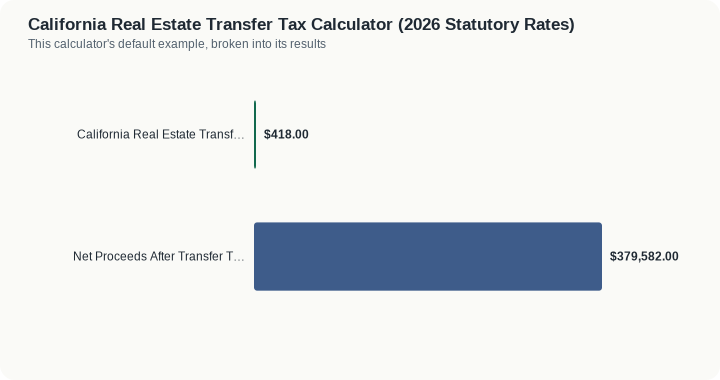
Quick Answer: A $380,000 home sale under California's statewide county documentary transfer tax owes $418.00, a flat 0.11% rate, though many charter cities including San Francisco, Los Angeles, and Oakland levy far higher city-level rates on top that this calculator does not include.
What does this calculator do?
California's baseline real estate transfer tax is the countywide documentary transfer tax set by Revenue and Taxation Code Section 11911 at $1.10 per $1,000 of value, just 0.11% of the sale price, one of the lowest statutory county rates in the country. That statutory floor, however, is not the whole story in much of urban California: charter cities including San Francisco, Los Angeles, Oakland, Berkeley, and Santa Monica layer their own separately legislated city transfer or mansion taxes on top, some reaching several percent on higher-value sales.
Under the statute, the county tax is imposed on the person who executes the deed, typically the seller, though California law also allows the parties to reallocate payment by contract, and local custom varies by county and city. This calculator applies the uniform statutory county rate as its baseline, which is the accurate figure for the large majority of California cities that have not enacted their own separate city-level transfer tax.
Who adds what to California's documentary transfer tax
California's transfer tax starts at the county. Under Revenue and Taxation Code sections 11911 through 11933, counties levy a documentary transfer tax of $0.55 per $500 of value, and some cities add their own on top. This calculator applies the county rate only.
For most of the state that is the whole tax. Inside a city with its own transfer tax, the city portion can be far larger than the county portion, and the City of Los Angeles is the clearest case. Its published schedule charges $2.25 per $500. From July 1, 2026, Measure ULA adds 4% on sales above $5,400,000 and 5.5% at $10,900,000 or more. Those Measure ULA charges are stated as percentage rates, not as amounts per $500, which is why they dominate the bill on the sales they reach.
None of the city layer is in the result here. If your property is inside the City of Los Angeles, the figure above is the county portion only. Add the city's $2.25 per $500 to it. If the price crosses either Measure ULA threshold, add the Measure ULA charge as well. For other cities, check whether the city levies its own documentary transfer tax before treating the county figure as the full bill.
On the settlement statement, the calculator's figure is one amount, and it does not decide which party bears it. Your purchase contract settles that. Recording fees and title charges are separate lines and are not estimated here.
How is this calculated?
California's statewide figure is the county documentary transfer tax, and it is deliberately the floor rather than the full picture: charter cities add their own, and some of those dwarf it.
Transfer Tax = Sale Price × 0.0011
The engine applies the uniform county rate of $1.10 per $1,000 set by Revenue and Taxation Code 11911. City transfer taxes are not included, because they range from nothing in a city with no ordinance to multi-percent tiered schedules in San Francisco, Los Angeles, Oakland, Berkeley and Santa Monica. In those cities the number above is a small fraction of what closing will actually cost, and the city rate has to be looked up separately.
Worked Example
A Sacramento County sale at the calculator's baseline, run through the statutory county documentary transfer tax that applies uniformly across California.
Step 1: The consideration. Contract sale price = $380,000
Step 2: The statutory rate. Rev. and Tax Code 11911, $1.10 per $1,000 of consideration = 0.11%
Step 3: Apply the rate. $380,000 x 0.0011 = $418.00
Step 4: Net proceeds after the documentary transfer tax. $380,000.00 - $418.00 = $379,582.00
Step 5: The effective rate. $418.00 / $380,000 = 0.110%
Now the calculator's $1,500,000 scenario, which is where the gap between this baseline and a real San Francisco or Los Angeles closing opens up.
Step 6: The luxury sale at the county rate. $1,500,000 x 0.0011 = $1,650.00
Step 7: The effective rate, unchanged. $1,650.00 / $1,500,000 = 0.110%
Read Step 6 carefully: $1,650 is what the county documentary transfer tax costs on a $1,500,000 sale, and in most of California that is the entire transfer tax bill. It is emphatically not the bill in a charter city. San Francisco, Los Angeles, Oakland, Berkeley and Santa Monica each levy their own tiered city transfer taxes on top of this figure, and at $1,500,000 those city rates can multiply the total many times over. This calculator deliberately models the uniform statutory county rate rather than guessing at which of California's charter cities a transaction sits in, so treat Steps 3 and 6 as the floor and check the city schedule separately.
What does this calculator not account for?
- Charter city transfer taxes. San Francisco, Los Angeles, Oakland, Berkeley, and Santa Monica each impose their own tiered city transfer tax on top of the county rate, and these can be many times larger than the county documentary transfer tax modeled here. Any property inside these city limits should be checked against the specific city's published tax schedule.
- County variation for charter counties. A small number of California counties are themselves charter counties with some latitude on transfer tax administration, though the $1.10 per $1,000 base rate is applied consistently in practice statewide.
- Recording fees and title insurance. California county recorders charge separate flat recording fees, and title insurance premiums (often a meaningful percentage of sale price in California) are entirely separate from the documentary transfer tax.
- Exemptions for certain transfer types. California exempts transfers between spouses, transfers securing debt, and certain trust transfers from the documentary transfer tax. This calculator assumes a standard taxable arm's-length sale.
What mistakes do people make with this?
- Assuming the county rate is the total tax bill in a major city. This is the single biggest source of underestimation in California. A San Francisco sale above $10 million can face a combined city and county transfer tax rate well above 6%, dramatically more than the 0.11% county baseline this calculator reports.
- Confusing California's documentary transfer tax with property tax reassessment. The transfer tax is a one-time charge at the point of sale; California's separate Proposition 13 property tax reassessment triggered by a change in ownership is an ongoing annual cost and is not related to the transfer tax at all.
- Overlooking that the rate applies to consideration, not assessed value. The 0.11% county rate applies to the actual sale price (consideration) paid, not the county assessor's prior assessed value, which can differ substantially in a rising market.
- Assuming a uniform statewide rate exists for cities. Unlike Alabama or Georgia's genuinely flat statewide rates, California's real effective rate varies enormously by city; treating 0.11% as a universal California number is a common and costly mistake for anyone transacting in San Francisco, Los Angeles, or similar charter cities.
Frequently Asked Questions
What is California's real estate transfer tax rate?
Why doesn't this calculator include San Francisco or Los Angeles city transfer tax?
Who pays the transfer tax in California?
Is California's transfer tax higher in Los Angeles or San Francisco?
Does California's transfer tax apply to refinancing?
Sources
- California Franchise Tax Board, the official state tax authority for California rates, rules and forms. ftb.ca.gov
- Los Angeles County Registrar-Recorder/County Clerk, City documentary transfer tax historical rates. content.lavote.gov/docs/rrcc/documents/citydtt_historicalrates_202060401.pdf
Also consulted: California Revenue and Taxation Code Section 11911, Documentary Transfer Tax Act.