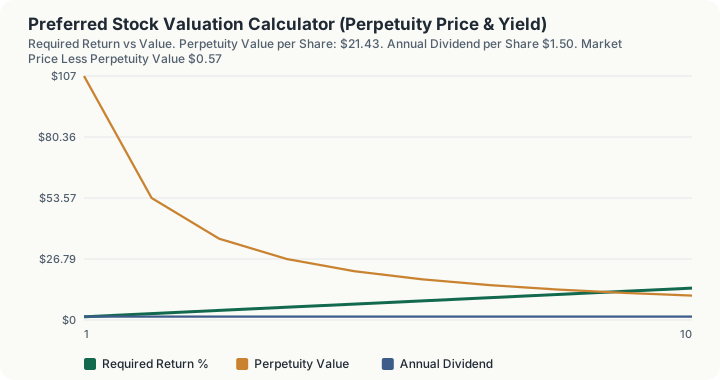
Quick Answer: A $25 par preferred paying a 6.00% stated dividend delivers $1.50 a year forever. Discounted at a 7.00% required return, that stream is worth $21.43 per share. Against a $22.00 market price the share trades $0.57 above the perpetuity value, which means the market is accepting a 6.82% return where you demand 7.00%.
What does this calculator do?
Ordinary fixed-rate preferred stock is the cleanest valuation problem in finance, because it has no maturity, no growth and no ambiguity about the cash flow. A fixed dividend paid forever is a flat perpetuity, and a flat perpetuity has a one-line price: the annual payment divided by the required return.
That simplicity is exactly what makes preferred stock behave the way it does. There is no maturity date pulling the price back toward par as time passes. If required returns rise, the price falls and simply stays down. A bond that fell 20% recovers to par by holding it to maturity; a perpetual preferred that fell 20% recovers only if rates come back.
This calculator prices the share from the perpetuity relation, compares that value to the market price, and backs out the return the market is actually accepting. It also sweeps a range of required returns so the interest-rate sensitivity of a perpetual instrument is visible rather than asserted.
How is this calculated?
P₀ = D/r
where $D$ is the annual dividend in dollars and $r$ is the required return as a decimal. When a growth rate is supplied and it is strictly below the required return, the same family gives the growing perpetuity P₀ = D/(r − g). At the defaults growth is zero, so the flat form is the one used.
Step 1: Turn the stated rate into dollars. The dividend rate is a coupon on par, not on market price. $25.00 x 6.00% = $1.50 per year
Step 2: Convert the required return to a decimal. 7.00% / 100 = 0.07
Step 3: Divide. $1.50 / 0.07 = $21.43 per share
Step 4: Compare against the market price. $22.00 - $21.43 = $0.57
The share trades above the perpetuity value, which is the same statement as saying the market accepts a lower return than you require.
Step 5: Compute the current yield at the market price. $1.50 / $22.00 = 0.068182 = 6.82%
Step 6: Compute the yield on par for contrast. This is just the stated rate: 6.00%. It equals the current yield only when the share trades exactly at par.
Step 7: Back out the return the market is accepting. With no growth, the implied required return is the current yield itself, since inverting $P = D/r$ gives $r = D/P$. $1.50 / $22.00 = 6.82%
Step 8: Test the interest-rate sensitivity upward. $1.50 / 0.08 = $18.75, a fall of $2.68 or 12.5% for 100 basis points
Step 9: Test it downward. $1.50 / 0.06 = $25.00, a rise of $3.57 or 16.7% for the same 100 basis points
The asymmetry is not an error. Value is proportional to $1/r$, a convex function, so a fall in the required return helps more than an equal rise hurts.
Worked Example
A retail preferred issue, $25 par, 6.00% stated, quoted at $22.00. You want 7.00% to hold it.
Step 1: The annual cash. $25.00 x 0.06 = $1.50
Step 2: Your value. $1.50 / 0.07 = $21.43
Step 3: The verdict. The market wants $22.00. That is $0.57 more than your number, so on your own required return this is not a buy.
Step 4: Restate the same fact as a yield. Rather than arguing about $0.57, ask what return the price offers. $1.50 / $22.00 = 6.82%
You require 7.00%. The market offers 6.82%. The gap is 18 basis points, which is a more useful way to frame the decision than a 57 cent price difference.
Step 5: Find the price that clears your hurdle. $1.50 / 0.07 = $21.43. That is your limit price, and it is the same figure as the valuation. For a flat perpetuity the fair value and the price at which your required return is met are by construction the same number.
Step 6: Notice what happens at a 6.00% required return. $1.50 / 0.06 = $25.00, exactly par. Dividend over rate returns par whenever the required return equals the stated rate. This is an identity, not a coincidence, and it is the fastest sanity check on any preferred valuation.
What does this calculator not account for?
- Call provisions. Almost every preferred issue is callable at par after five years, and that call caps the upside. When rates fall, the issuer refinances and you do not get to hold a $25.00 valuation on a share you paid $22.00 for. This calculator prices a genuine perpetuity, so it systematically overstates the value of a callable issue trading above its call price. Yield to call, not the perpetuity value, is the relevant number in that case.
- Credit risk and dividend suspension. Preferred dividends are declared, not owed. Non-cumulative preferred that skips a dividend never pays it. Nothing here discounts for the probability of suspension; the risk belongs inside your required return, and there is no guidance on how much to add.
- Cumulative versus non-cumulative terms, and arrears. Unpaid dividends on a cumulative issue accumulate as a claim. That claim has value and is not modelled.
- Floating and fixed-to-floating structures. The dividend is fixed. Issues that reset off a reference rate after a fixed period are not this instrument.
- Tax treatment. No withholding, no qualified dividend rate, no corporate dividends-received deduction. All figures are pre-tax.
- Liquidity and bid-ask spread. Preferred issues frequently trade thinly, and the quoted price may not be an executable one.
- Accrued dividends. The value is a clean figure between record dates. It does not adjust for a dividend about to be paid.
- Where the required return comes from. The 7.00% default is illustrative. Nothing here derives a discount rate from the issuer's credit, the capital stack, or any market observation.
What mistakes do people make with this?
- Confusing the dividend rate with the yield. The stated 6.00% is a coupon on the $25 par, not the return on your money. At $22.00 the actual yield is 6.82%. The two coincide only at par.
- Ignoring the call. This is the single largest error in preferred investing. Buying a callable issue well above its $25 call price on the strength of a perpetuity valuation is buying an upside the issuer has already reserved the right to take away.
- Expecting a pull to par. There is none. A perpetual has no maturity date, so the price recovers only if required returns fall back.
- Treating preferred as a bond. It sits below all debt in the capital stack and above common. In a restructuring that position matters enormously, and the flat coupon disguises it.
- Using a required return that does not reflect the credit. Discounting a speculative-grade preferred at a rate appropriate to an investment-grade one produces a large, precise and wrong number.
- Turning on the growth field for an ordinary issue. Fixed-rate preferred has no dividend growth. The field exists for participating or step-up structures, and a nonzero value on a plain issue quietly inflates the valuation.
Frequently Asked Questions
Why does the price fall so much for one percentage point of yield?
What required return should I use for preferred stock?
How is this different from a bond calculator?
The share trades above my valuation. Is it overvalued?
Does a $1,000 par institutional issue work differently?
What if the required return equals or falls below the growth rate?
Sources
- U.S. Securities and Exchange Commission, Investor.gov, the official authority for the investing this calculator relates to. investor.gov
Also consulted: The flat perpetuity relation $P = D/r$ and the growing form $P = D/(r-g)$ are standard results; the engine implements both in its shared annuity primitive, with the growing case guarded to require a discount rate strictly above the growth rate; Williams, J.B., "The Theory of Investment Value," 1938. The origin of the dividend discount framework the perpetuity is the simplest case of; Gordon, M.J., "Dividends, Earnings and Stock Prices," Review of Economics and Statistics, 1959. The growing perpetuity form.