Quick Answer: A GLWB rider guarantees you a fixed percentage of a stepped-up "benefit base" for life, even if your actual variable annuity account value is fully depleted by withdrawals and market losses.
Overview
A variable annuity invests your premium in market-linked subaccounts, similar to mutual funds, meaning the account value can rise or fall with the market. That alone makes it a risky vehicle for guaranteed retirement income. Insurance companies address that risk by selling an optional rider, most commonly called a Guaranteed Minimum Withdrawal Benefit (GMWB) or, in its lifetime form, a Guaranteed Lifetime Withdrawal Benefit (GLWB). A GMWB promises to return your original investment through withdrawals over a defined period even if the account value hits zero. A GLWB goes further and promises income for as long as you live, regardless of market performance or how long you live.
The mechanism behind both riders is the same. The insurer tracks a separate number called the "benefit base," which usually starts equal to your premium and is often locked to the highest value your account reaches on any policy anniversary during the years you defer taking withdrawals. When you decide to start taking income, a guaranteed withdrawal percentage, set by your age at that time, is applied to the benefit base to produce your guaranteed annual income. That income keeps flowing for life under a GLWB, even after your actual account value, which experiences real market gains and losses and absorbs withdrawals and fees, is fully drawn down to zero.
How This Is Calculated
Accumulation phase. Starting from your initial premium, the calculator grows the account value each year at your assumed rate of return, then deducts an annual rider fee calculated as a percentage of the benefit base (the fee is charged against the benefit base, not the account value, which is standard for most GLWB riders). After the fee, if the resulting account value is higher than the current benefit base, the benefit base steps up ("ratchets") to match it. This step-up mechanism is what allows the benefit base to lock in market gains during good years while never stepping back down during bad ones.
Determining the guaranteed withdrawal percentage. At the point you begin withdrawals, your age determines the guaranteed withdrawal percentage from an age-banded schedule: roughly 3.5% below age 60, rising through 4.0%, 5.0%, 5.5%, 6.0%, and 6.5% as you move through successive age bands up to 80 and above. Older ages at first withdrawal receive a higher percentage because the insurer expects to pay that income for fewer years, mirroring the same actuarial logic used in reverse mortgage pricing and immediate annuity payout rates. This is a representative, industry-typical schedule; the exact contractual percentages differ by insurer and rider generation, so always confirm your own contract's schedule.
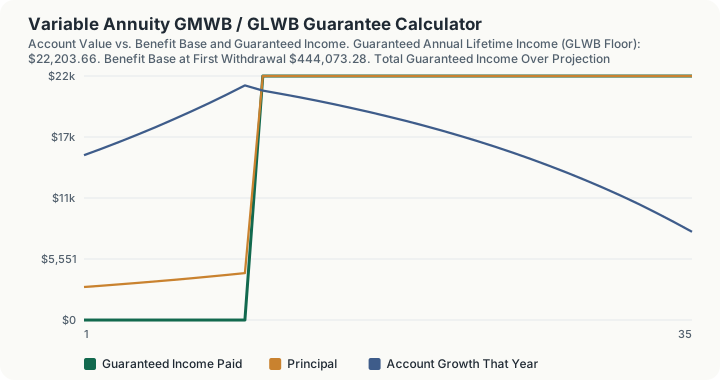
Withdrawal phase. The guaranteed annual income is fixed at the point withdrawals begin: benefit base multiplied by the guaranteed withdrawal percentage. Each year after that, the calculator subtracts the guaranteed income from the actual account value, deducts the ongoing rider fee (still calculated on the now-locked benefit base), and grows whatever remains at your assumed return. If the account value is driven to zero, the guaranteed income keeps being paid in full; the calculator tracks how many projected years fall into this insurer-funded state, where you are effectively drawing on the insurance company's general account rather than your own invested assets.
Worked Example
A $300,000 premium, a 10-year deferral, 5.0% assumed annual account growth, a 1.0% rider fee, first withdrawal at 65 and 25 years of income projected.
Accumulation, year by year
Step 1 -- Year 1 growth. $300,000 x 1.05 = $315,000.00, so growth of $15,000.00
Step 2 -- Year 1 rider fee, charged on the benefit base. $300,000 x 1.0% = $3,000.00
Step 3 -- Year 1 account value, and the step-up. $315,000.00 - $3,000.00 = $312,000.00, which exceeds the $300,000 benefit base, so the base ratchets up to $312,000.00
Step 4 -- Year 2. $312,000 x 1.05 = $327,600.00 less a fee of $312,000 x 1.0% = $3,120.00 gives $324,480.00, and the base steps up again
Step 5 -- Year 10, the end of the deferral. Account value and benefit base both reach $444,073.28, after a year-10 fee of $4,269.94
Because 5% growth comfortably exceeds the 1% fee every year, the base and the account value move in lockstep here and the ratchet never has to hold a high-water mark against a fall. The net compounding rate is roughly 4% a year, which is what turns $300,000 into $444,073.28 rather than the $488,668 that 5% alone would have produced.
The guarantee
Step 6 -- The age band. First withdrawal at 65 falls in the 5.0% band
Step 7 -- Guaranteed annual income. $444,073.28 x 5.0% = $22,203.66
Step 8 -- Total over 25 years of withdrawals. $22,203.66 x 25 = $555,091.50
Step 9 -- Present value of that stream at the 5% assumed rate. $312,937.15
Step 9 is the sobering one. The guaranteed income stream is worth $312,937.15 today against a $300,000 premium, so at the assumed 5% return the rider adds about 4% of value over twenty-five years -- and the entire case for it rests on what happens when the assumption is wrong.
The withdrawal years
Step 10 -- Year 11, the first withdrawal. $444,073.28 - $22,203.66 income - $4,440.73 fee, grown at 5%, leaves $438,300.33
Step 11 -- Year 12. $432,238.74
Step 12 -- Year 25. $319,501.41
Step 13 -- Year 35, the last projected year. $168,547.33, and the account never depletes: 0 insurer-funded years
At 5% growth the guarantee is decorative. Income of $22,203.66 plus a $4,440.73 fee against a portfolio earning 5% draws the balance down slowly but never exhausts it, and the annuitant has paid $4,440.73 a year for twenty-five withdrawal years -- $111,018.25 of rider fees in that phase alone -- for a promise that never had to be honoured.
The case the rider actually exists for
Rerun the identical contract at 1.0% growth.
Step 14 -- Accumulation at 1%. Growth of $3,000 a year exactly offsets the $3,000 fee, so the account value and benefit base sit at $300,000.00 throughout the deferral and never step up
Step 15 -- Guaranteed income. $300,000 x 5.0% = $15,000.00
Step 16 -- The account runs out. Depletion arrives in year 29, leaving 7 projected years the insurer funds entirely from its general account
Step 17 -- What those 7 years are worth. 7 x $15,000.00 = $105,000.00 of income paid after the annuitant's own money is gone
Steps 13 and 16 are the same product under two assumptions. In the good scenario the rider is a 1% drag that bought nothing; in the bad one it pays $105,000 the account could not. That is what a guarantee is, and the honest way to read this calculator is as a price for insurance rather than as a projection of returns.
Step 18 -- Deferring to 75 instead. Twenty years of accumulation lifts the benefit base to $657,336.94, and the 75-and-over band pays 6.0%, giving guaranteed income of $39,440.22
Waiting ten more years raised the guaranteed income by 78%, from two compounding effects at once: a bigger base and a higher percentage against it. The cost is ten more years of rider fees and ten fewer years of income, which is a trade only worth making for someone who expects to need the floor late rather than early.
What This Does Not Account For
- It does not model a separately guaranteed roll-up rate. Some GLWB riders, in addition to or instead of the step-up mechanism modeled here, guarantee the benefit base will compound at a fixed rate (commonly cited historically in the 5%-7% range) regardless of actual account performance. This calculator uses only the step-up-to-actual-value mechanism because roll-up rates vary enormously by product and are frequently discontinued or reduced across product generations; including a specific figure risked presenting an unverifiable number as fact.
- It does not model mortality or actual life expectancy. The "lifetime" nature of a GLWB is a genuine insurance guarantee, but this calculator only projects a fixed number of years you choose; it does not calculate the probability you will actually live to benefit from the insurer-funded years.
- It does not include annuity contract surrender charges, which can apply if you withdraw more than the guaranteed amount or surrender the contract entirely during an early surrender charge period, typically 5 to 10 years.
- It does not model excess withdrawals. Taking out more than the guaranteed annual amount in any year typically reduces the benefit base proportionally, sometimes more than proportionally, which can permanently and disproportionately shrink your future guaranteed income. This calculator assumes withdrawals exactly equal to the guaranteed amount every year.
- It does not account for the tax treatment of annuity withdrawals, which are generally taxed as ordinary income to the extent of gain under last-in-first-out rules, plus a potential 10% early withdrawal penalty before age 59 and a half.
Common Pitfalls
- Confusing the benefit base with money you can withdraw as a lump sum. The benefit base is a phantom, calculation-only number used solely to determine your guaranteed income stream. You cannot surrender the contract and receive the benefit base in cash; you would receive the actual, and typically much lower, account value.
- Assuming the rider fee is trivial. A 1% annual fee charged against a benefit base that is larger than the actual account value effectively represents a higher percentage drag on your real investment than the headline rate suggests, especially in years where the account value has fallen behind the benefit base.
- Believing the guarantee protects against inflation. A GLWB guarantees a fixed dollar amount (or a fixed percentage of a fixed benefit base) for life; it does not adjust for inflation unless you have specifically purchased and are paying for a separate inflation-adjustment rider.
- Withdrawing more than the guaranteed amount without understanding the consequences. Many riders treat any excess withdrawal as proportionally reducing both the benefit base and the future guaranteed income, a penalty that compounds badly if repeated.
- Not distinguishing between a GMWB and a GLWB when shopping for a rider. A GMWB typically only guarantees the return of your original premium over a set period; only a GLWB, or a GMWB later converted to lifetime payments, guarantees income you cannot outlive.
Frequently Asked Questions
What happens to my guaranteed income if the market crashes right after I start withdrawals?
Can my guaranteed income ever increase after withdrawals begin?
Is the guaranteed income taxed differently from a regular annuity payout?
Why would someone accept a rider fee at all instead of just investing directly?
Does deferring withdrawals always increase my guaranteed income?
Sources
- Internal Revenue Service, the official authority for the tax rules this calculator relates to. irs.gov
Also consulted: Annuity.org, "How Guaranteed Minimum Withdrawal Benefit (GMWB) Works" and "How Guaranteed Lifetime Withdrawal Benefits (GLWB) Work," for GMWB/GLWB structure, benefit base, and step-up mechanics; Thrivent, "What Is a GLWB, And How Does It Work?", for age-banded guaranteed withdrawal percentage structure; Institute of Business & Finance, "Variable Annuity Living Benefits: GMWB, GLWB, GMIB, and GMAB Explained," for the distinction between GMWB and GLWB guarantees; Financial Planning Association, "The Expected Value of a Guaranteed Minimum Withdrawal Benefit (GMWB) Annuity Rider," Journal of Financial Planning, for actuarial treatment of GMWB riders.