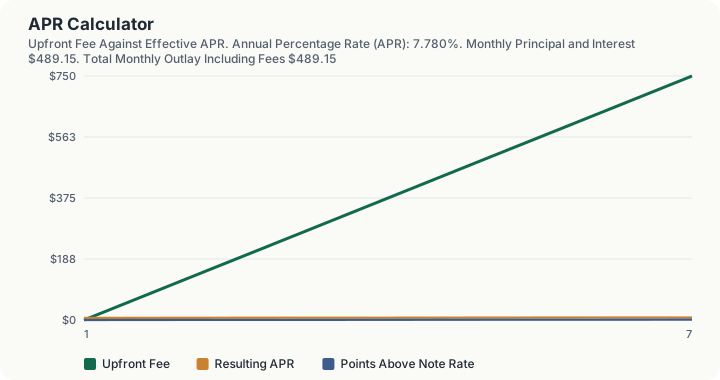
Quick Answer: A $25,000 loan quoted at 6.5% over 60 months with $750 in origination fees carries an APR of 7.780%. The fees add 1.280 percentage points to the advertised rate. The payment is $489.15, but you only receive $24,250, and that gap is the entire reason the two numbers differ.
What does this calculator do?
The interest rate sets your payment. The APR tells you what the loan actually costs. They are not the same number and they are not supposed to be.
APR exists because a lender can advertise almost any rate it likes if it is free to recover the difference in fees. United States law responds by requiring a single disclosed figure that folds the finance charges back into a rate, so two offers can be compared on one line. The mechanism is simple once stated: the APR is the interest rate that makes the payments you will make equal the money you actually receive.
This is the general APR tool. It handles any closed-end instalment loan: a personal loan, an auto loan, a mortgage with points, a home improvement loan. If you are looking at a single-payment payday advance quoted as a fee per hundred dollars, the payday loan APR calculator handles that shape directly, because a fourteen-day fee does not have an instalment stream to solve against.
The comparison worth internalising is not that fees raise the APR. It is how much depends on the term. The same $750 fee costs 1.280 APR points over five years and 5.749 points over one year, because a short loan has fewer payments over which to spread it.
How is this calculated?
The APR is defined by Regulation Z as the rate that equates the amount financed to the stream of payments. There is no closed form, so it is solved numerically:
Amount financed = ∑(k = 1 to n) Payment/((1 + r)ᵏ)
APR = 12 × r
Step 1: Convert the note rate to a monthly periodic rate. $6.5\% \div 100 \div 12 = 0.0054166667$
Step 2: Compute the payment from the full loan amount at the note rate. (1.0054166667)⁶⁰ = 1.38281732, so the payment is $25,000 \times 0.0054166667 \div (1 - 1 \div 1.38281732) = \$489.15$
Step 3: Add any monthly finance charge to the payment. $489.15 + 0.00 = \$489.15$ at the default of no monthly fee.
Step 4: Subtract the upfront finance charges from the loan to get the amount financed. $25,000 - 750 = \$24,250.00$
Step 5: Solve for the monthly rate that discounts 60 payments of $489.15 back to $24,250. The solved periodic rate is 0.0064833635.
Step 6: Annualise by multiplying by twelve. $0.0064833635 \times 12 = 7.780\%$
Step 7: Subtract the note rate to isolate the cost of the fees. $7.780 - 6.500 = 1.280 points$
Step 8: Restate the same periodic rate with compounding for the APY comparison. (1.0064833635)¹² − 1 = 8.064%
Step 6 is worth pausing on. Regulation Z annualises by simple multiplication, not by compounding. That is why an APR and an APY on the same underlying rate are different figures, and why a 5% savings APY and a 5% loan APR are not the same cost of money.
The table repeats steps 4 through 7 at upfront fees of 0% through 3% of the loan, holding the rate and term fixed.
Worked Example
The default loan. $25,000 at 6.5% for 60 months with a $750 origination fee.
- Payment: $489.15
- Total of payments: $489.15 x 60 = $29,349.22
- Interest: $4,349.22
- Plus the fee: total finance charge $5,099.22
- Amount financed: $24,250.00
- APR: 7.780%
Remove the fee. The amount financed becomes the full $25,000, the solve returns the note rate exactly, and the APR is 6.500% with a spread of zero. This is the only situation in which an advertised rate tells the whole story.
Compress the term to 12 months. The payment rises to $2,157.41 and the APR jumps to 12.249%, a spread of 5.749 points on the identical $750 fee. Nothing about the loan got more expensive in dollars. The fee simply has one fifth as long to be amortised.
A mortgage with points. $400,000 at 6.25% over 360 months with $8,000 in points gives a payment of $2,462.87, an amount financed of $392,000, and an APR of 6.442%, only 0.192 points above the note rate. A thirty-year term dilutes even a large fee.
Add a $100 monthly fee to the default loan. The monthly outlay becomes $589.15 and the APR rises to 15.957%. Recurring charges move the APR far more violently than upfront ones, which is why mortgage insurance dominates the APR on a low down payment loan.
What does this calculator not account for?
- Which charges belong in the APR. Regulation Z distinguishes finance charges from third-party costs you would incur regardless. This calculator counts whatever you enter; it does not classify your fees for you, and misclassifying a charge is the single most common way a hand-computed APR disagrees with a lender's.
- Prepayment. The disclosed APR assumes the loan runs to term. Paying off a loan early raises the effective cost of upfront fees, sometimes dramatically.
- Variable rates. An adjustable loan's APR depends on assumed future index levels. This models a fixed rate throughout.
- The Reg Z rounding and tolerance rules. Disclosed APRs may be rounded and are subject to accuracy tolerances, so a lender's figure may differ slightly.
- Non-US regimes. The EU quotes an APRC on a compounded basis, so a European figure is not comparable to this one.
What mistakes do people make with this?
- Shopping on the note rate. A 6.0% loan with heavy fees can cost more than a 6.5% loan with none. The APR is the comparison line.
- Assuming a lower APR is always better. If you will sell or refinance in three years, a low APR bought with large upfront points may never pay for itself.
- Comparing APR against APY. Regulation Z annualises without compounding; a deposit APY includes it. Here the same rate is 7.780% as an APR and 8.064% as an APY.
- Ignoring monthly finance charges. A $100 monthly fee moved the example APR from 7.780% to 15.957%. Upfront fees are visible; recurring ones are not.
- Comparing APRs across different terms. APR is only comparable between loans of the same term. The same fee produced 1.280 points over 60 months and 5.749 over 12.
Frequently Asked Questions
What is the difference between APR and interest rate?
Why is my APR higher than the rate I was quoted?
Can the APR ever equal the interest rate?
Does a lower APR always mean a cheaper loan?
Is APR the same as APY?
Which fees should I include?
Sources
- Regulation Z (Truth in Lending), 12 CFR Part 1026, including the Appendix J annual percentage rate computation. ecfr.gov/current/title-12/chapter-X/part-1026
- Consumer Financial Protection Bureau, "What is the difference between a mortgage interest rate and an APR?" consumerfinance.gov/ask-cfpb/what-is-the-difference-between-a-mortgage-interest-rate-and-an-apr-en-135
The APR definition and the requirement to disclose it come from the US Truth in Lending Act, implemented by Regulation Z, 12 CFR Part 1026. The computation rule, that the annual percentage rate is the nominal annual rate determined by multiplying the unit-period rate by the number of unit periods in a year, is at 12 CFR 1026.22 and its Appendix J. Regulation Z is administered by the Consumer Financial Protection Bureau and the text is published in the Electronic Code of Federal Regulations at ecfr.gov.
The annual percentage yield for deposits is defined separately under Regulation DD, 12 CFR Part 1030, on a compounded basis, which is why the two figures differ on the same underlying rate.
The solver is calculateMortgageAPR in engine/primitives/rate-conversion.ts, which finds the periodic rate equating the amount financed to the payment stream and annualises it by twelve. Its outputs are proven against hand-derived vectors in engine/vectors/rate-conversion.test.ts and in this calculator's own vectors.test.ts, where the default APR was independently bisected outside the engine before being asserted.