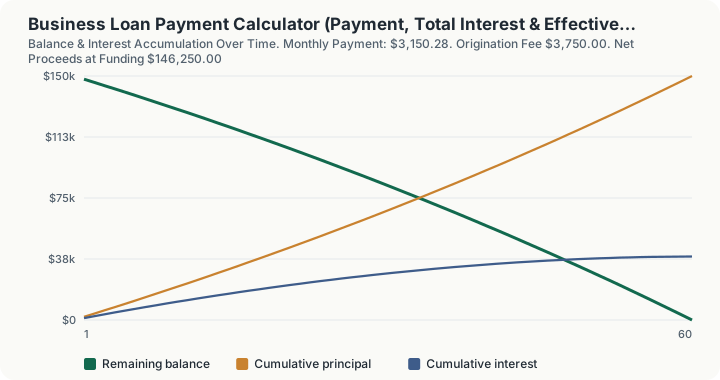
Quick Answer: A $150,000 general business term loan at a 9.5% note rate over 5 years, with a 2.5% origination fee ($3,750), carries a monthly payment of $3,150.28, $39,016.75 in total interest, and an effective APR of 10.59%, meaningfully higher than the stated 9.5% note rate once the fee is factored in.
Overview
This is a generic small-business term loan calculator, distinct from this platform's SBA 7(a) and SBA 504 calculators, which model government-guaranteed loan programs with their own guaranty fee schedules, guarantee percentages, and rate caps set by the Small Business Administration. Most small-business financing is not SBA-backed. Conventional bank term loans, online and fintech lender products, credit-union business loans, and equipment financing all typically carry a straightforward structure: a principal amount, a stated annual interest rate, a fixed term, and often a one-time origination fee taken out of the loan proceeds at funding.
That origination fee is where a lot of confusion happens. Lenders advertise a note rate, the interest rate written into the loan documents, but the fee means the borrower doesn't actually receive the full loan amount in cash, while still owing interest and principal payments on the entire face amount. The true cost of borrowing, the effective APR, is always at or above the note rate whenever a fee is charged, because you're paying interest on money you never fully received. This calculator computes both figures so you can see the gap between what the loan says it costs and what it actually costs.
How This Is Calculated
Step 1: Amortize the full loan amount. The monthly payment, total interest, and full amortization schedule are calculated on the entire stated loan amount at the note rate, using the standard fixed-payment amortization formula. This matches how the loan actually gets repaid: your payment is based on the full principal, not the amount net of fees.
where $P$ is the loan amount, $r$ is the monthly rate (annual rate divided by 12), and $n$ is the number of monthly payments.
Step 2: Calculate the origination fee and net proceeds.
This assumes the standard convention that the fee is deducted from proceeds at funding rather than added to the loan balance, which is how most business lenders structure it (unlike SBA loans, where the guaranty fee is more commonly financed into the balance).
Step 3: Solve for the effective APR. The effective APR is the internal rate that equates the net amount actually financed (loan amount minus the upfront fee) to the stream of scheduled monthly payments, the same method the Truth in Lending Act (Regulation Z) uses for consumer mortgage APR disclosures, adapted here to a general term loan:
Solving for the periodic rate $i$ that makes this equation true, then annualizing it ($i \times 12$), gives the effective APR. When the origination fee is $0, net proceeds equal the full loan amount and the effective APR converges exactly to the note rate.
Worked Example
A $150,000 loan at a 9.5% note rate, 5-year (60-month) term, with a 2.5% origination fee:
- Monthly payment: amortizing $150,000 at 9.5%/12 over 60 months gives $3,150.28.
- Total interest: 60 payments of $3,150.28 total $189,016.80 in payments against $150,000 of principal, for $39,016.75 in interest (small rounding differences from exact reconciliation of the final payment).
- Origination fee: $150,000 × 2.5% = $3,750.
- Net proceeds: $150,000 − $3,750 = $146,250 actually disbursed to the borrower.
- Effective APR: solving for the rate that equates $146,250 in net proceeds to the same 60-payment stream of $3,150.28 gives 10.59%, more than a full percentage point above the 9.5% note rate.
- Total cost of the loan: $189,016.80 in scheduled payments plus the $3,750 fee (already paid at funding, not amortized) totals $192,766.70.
Now compare a short-term case: a $100,000 loan at a 10% note rate over just 1 year (12 months), with a steeper 6% origination fee. The $6,000 fee gets amortized over only 12 payments instead of 60, which concentrates its cost. Effective APR jumps to roughly 21.86%, more than double the 10% note rate, illustrating a general principle: the shorter the term, the more a fixed-dollar fee distorts the effective APR relative to the note rate, because there are fewer payments to spread that fixed cost across.
Business Loan Rate and Fee Context
General small-business term loans from banks, credit unions, and online lenders typically carry higher note rates than SBA-guaranteed products, since there is no government guarantee reducing the lender's risk. Origination fees on non-SBA business loans commonly range from 1% to 6% of the loan amount, with fintech and online lenders often at the higher end of that range and traditional banks and credit unions typically lower, though actual pricing depends heavily on the borrower's credit profile, time in business, revenue, and collateral. Terms vary widely by loan purpose: working capital loans are often 1 to 5 years, equipment loans typically match the useful life of the equipment (3 to 10 years), and commercial real estate loans can run 10 to 25 years.
What This Does Not Account For
This calculator models a single, fixed-rate, fully amortizing term loan with one upfront fee. It does not model variable or floating-rate loans that reprice over the term (common with some bank and fintech products indexed to a benchmark rate); if your loan's rate is variable, this calculator's output reflects a snapshot at the current rate, not the full cost if rates move. It does not include additional common business loan fees, such as underwriting fees, application fees, UCC filing fees, or ongoing servicing or maintenance fees that some lenders charge separately from the origination fee, all of which would push the true effective APR higher than shown here if present. It does not model prepayment penalties or early-payoff fee structures, which some business loan products carry. It does not distinguish between different collateral or personal guarantee requirements, which affect approval and pricing but not the amortization math itself. It also does not model interest-only periods, balloon payments, or non-amortizing structures sometimes used in bridge or construction financing; it assumes a standard, fully amortizing schedule for the entire term.
Common Pitfalls
The single most common mistake is comparing loan offers purely on the stated note rate without factoring in fees; a lower note rate with a high origination fee can carry a higher effective APR than a slightly higher note rate with no fee, especially on shorter terms. It's also common to assume the fee reduces the loan balance you owe, when in the standard structure modeled here, the fee is deducted from proceeds at funding but you still owe and amortize the full stated loan amount, meaning the fee adds to your true cost without reducing what you repay. Borrowers on short-term loans (a year or less) sometimes badly underestimate the effective APR impact of a percentage-based fee, since the same fee percentage that looks modest on a 10-year loan can translate into a dramatically higher effective APR on a 1-year loan simply because there are far fewer payments to absorb the fixed cost. Finally, some lenders quote "factor rates" instead of APR, particularly for merchant cash advances and some short-term online products; a factor rate (like 1.15, meaning you repay 1.15 times what you borrowed) is not directly comparable to an APR figure without conversion, and this calculator assumes a standard amortizing interest rate and term structure, not a factor-rate product.
Frequently Asked Questions
Why is the effective APR always higher than the note rate when there's a fee?
Is this the same calculation as an SBA 7(a) loan calculator?
Should I always choose the loan with the lowest effective APR?
Why does a shorter loan term make the effective APR jump so much when there's a fee?
Does the total cost of the loan include the origination fee?
Sources
- Truth in Lending Act, Regulation Z (12 CFR Part 1026), the standard federal methodology for computing APR by equating net amount financed to the payment stream, adapted here to a general commercial term loan. ecfr.gov/current/title-12/chapter-X/part-1026
- Federal Reserve Bank small business lending surveys and industry rate/fee range reporting for conventional and online small-business term loans. federalreserve.gov
- U.S. Small Business Administration: general guidance distinguishing SBA-guaranteed loan programs from conventional (non-guaranteed) small-business financing. sba.gov