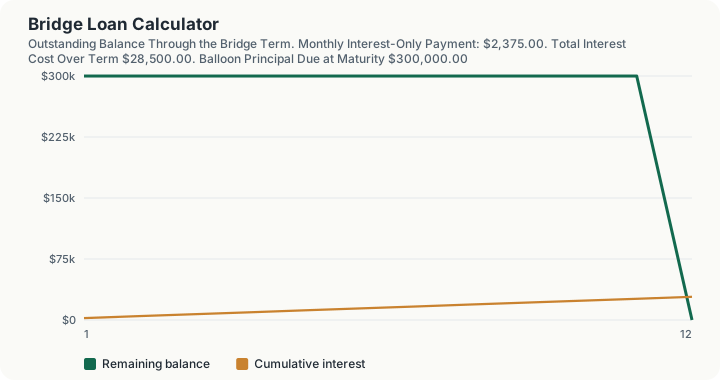
Quick Answer: A bridge loan on a $300,000 balance at 9.5% for 12 months costs $2,375.00 a month in interest-only payments, $28,500.00 in total interest, and the full $300,000 principal comes due as a single payoff at the end of the term.
Overview
A bridge loan is short-term financing that closes the gap between buying a new property and selling an existing one. Homeowners use it to make a non-contingent offer on a new house while their current home is still on the market. Developers and investors use a similar structure to close on a property quickly, then refinance into permanent debt once renovations are done or a longer-term loan is arranged.
The defining feature of a bridge loan is that it is almost always interest-only. You pay interest on the full balance every month, but none of that payment reduces the principal. The entire loan amount is due in one lump sum, called a payoff or balloon payment, when the term ends. Terms typically run 6 to 24 months, priced for speed and short duration rather than for a decades-long amortization curve.
Because a bridge loan is meant to be temporary, lenders price it differently than a standard mortgage. Rates run higher, often 1.5 to 3.0 percentage points above prevailing 30-year mortgage rates, since the lender is taking on more uncertainty about exactly when it gets repaid. In exchange, the borrower gets speed and flexibility: bridge lenders can often close in days rather than weeks, and underwriting focuses heavily on the equity in the departing property and the credibility of the exit plan (a pending sale, a signed listing agreement, or a refinance commitment).
How This Is Calculated
This calculator does not amortize the loan. Because it is interest-only, the math is a fixed monthly interest charge plus a payoff balance:
- Monthly rate. The annual interest rate is divided by 12 to get the periodic monthly rate.
- Monthly interest payment. The loan amount is multiplied by the monthly rate. This is the payment due every month of the term; it never changes because the principal balance never changes.
- Total interest cost. The monthly interest payment is multiplied by the number of months in the term (equivalently, principal times annual rate times the fraction of a year covered by the term).
- Payoff balance at maturity. Because no principal is repaid along the way, the full original loan amount is what's owed when the term ends. In practice this is paid off using proceeds from the sale of the departing property or a refinance into permanent financing.
The schedule table shows this month by month: every row before the last one is a pure interest charge with the balance unchanged, and the final row reflects the payoff, where the interest for that last month is paid together with the full principal balance.
Worked Example
Take a $300,000 bridge loan at 9.5% APR for a 12-month term.
- Monthly rate: 9.5% ÷ 12 = 0.7916667%
- Monthly interest payment: $300,000 × 0.7916667% = $2,375.00
- Total interest over the term: $300,000 × 9.5% × (12 ÷ 12) = $28,500.00
- Payoff balance at maturity: $300,000.00 (unchanged, since nothing amortizes)
- Final payoff payment: $300,000.00 + $2,375.00 = $302,375.00
Now compare a shorter, larger loan: $500,000 at 8% APR for a 6-month term. The monthly interest payment is $500,000 × (8% ÷ 12) = $3,333.33, and because the term only covers half a year, total interest comes to $500,000 × 8% × (6 ÷ 12) = $20,000.00. The monthly payment is higher on the larger loan, but the total interest cost is lower than the first example because the term is shorter and the rate is lower.
What This Does Not Account For
- Origination fees and points. Many bridge lenders charge 1 to 3 points at closing on top of the interest rate. Those fees are not included here and should be added to your total cost comparison.
- Cross-collateralization structures. Some bridge loans are secured against both the departing and target property, with different draw and payoff mechanics than the single-loan model used here.
- Extension fees. If your sale or refinance is delayed past the original term, extending a bridge loan usually carries a separate fee plus a possible rate bump, which this calculator does not model.
- Prepayment penalties. Some bridge loans include a minimum interest guarantee even if you pay off early; check your term sheet.
- Rate type. This assumes a fixed rate for the term. Some bridge products float with an index, which would change the monthly payment over time.
Common Pitfalls
- Assuming the payment includes principal reduction. Because bridge loans are interest-only, your balance never shrinks. Borrowers sometimes budget as if part of the payment builds equity, and it doesn't.
- Underestimating the exit timeline. If your current home takes longer to sell than expected, you either need an extension (with added cost) or you carry two housing payments at once, since most bridge structures don't waive your existing mortgage.
- Ignoring the total carrying cost. A 12-month bridge loan at a high rate can cost tens of thousands of dollars in interest alone. Compare that cost against the alternative of a contingent offer or a home equity line of credit before committing.
- Confusing bridge loans with second mortgages. A bridge loan is a distinct short-term product, not a permanent second lien; it's structured to be paid off in full, not carried indefinitely.
Frequently Asked Questions
How long does a bridge loan typically last?
Do I make principal payments during the bridge loan term?
Why are bridge loan rates higher than mortgage rates?
What happens if I can't pay off the bridge loan when it's due?
Can I use a bridge loan for a purchase without an existing property to sell?
Sources
- Consumer Financial Protection Bureau (CFPB): Truth in Lending Act (Regulation Z) disclosure standards applicable to consumer-purpose bridge financing. ecfr.gov/current/title-12/chapter-X/part-1026
- Federal Reserve: historical prime rate and mortgage rate benchmarks used to contextualize bridge loan rate premiums. federalreserve.gov
Also consulted: U.S. Department of Housing and Urban Development (HUD): general guidance on short-term and transitional real estate financing structures.