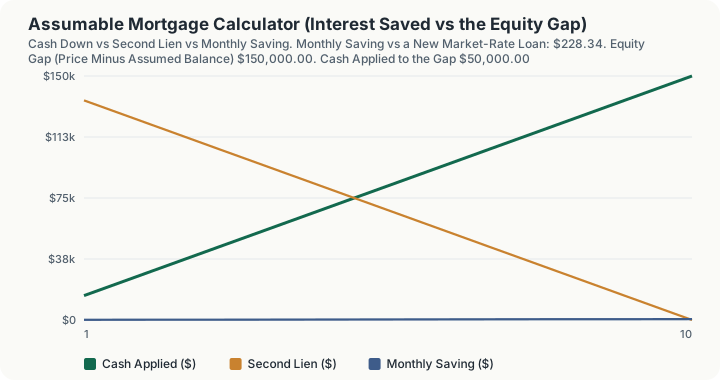
Quick Answer: Assuming a $350,000 balance at 3.25% with 300 months left, and closing the $150,000 equity gap with $50,000 of cash and a $100,000 second lien at 8.5% over 15 years, beats a new 6.75% 30-year first mortgage by $228.34 a month, or $68,502 across the 300 months the assumed loan has left to run. The equity gap can grow to about $123,188 of second-lien debt before that advantage disappears entirely.
What does this calculator do?
When a seller holds a 3% mortgage and the market is at 7%, the loan itself is an asset. FHA, VA and USDA loans can generally be assumed with lender approval; conventional notes cannot, because the standard note carries a due-on-sale clause. So the question is not whether cheap money is good. It obviously is. The question is whether the cheap money survives the problem it creates.
That problem is the equity gap. An assumption transfers the seller's remaining balance, not the price. Everything between the two (the seller's equity, which grows every month they pay down the loan and every month the house appreciates) has to be funded by the buyer in cash or by a second lien. Second liens price above firsts, often well above. A large gap financed at second-lien rates can wipe out the entire benefit of the cheap first.
This calculator prices that trade directly. It builds the actual two-lien structure, builds the one-loan alternative on the same cash down, and reports the difference. It also solves for the largest second lien that still leaves you ahead, which is the number to carry into a negotiation.
How is this calculated?
The engine compares two structures on the same cash outlay at closing.
gap = price − assumed balance
saving = PMT_market − (PMT_assumed + PMT_second)
Every payment uses the standard annuity payment, PMT = P⋅i/(1 − (1 + i)⁻ⁿ), with $i$ the monthly rate and $n$ the months remaining on that particular lien.
Step 1: Find the equity gap. $500,000 - $350,000 = $150,000
Step 2: Apply your cash to the gap. $150,000 - $50,000 = $100,000 of second lien needed
Step 3: Payment on the assumed first, over its REMAINING term. $350,000 at 3.25% / 12 for 300 months = $1,705.61
Step 4: Payment on the second lien, over its own term. $100,000 at 8.5% / 12 for 180 months = $984.74
Step 5: Add them. $1,705.61 + $984.74 = $2,690.35 combined monthly payment
Step 6: Build the alternative on the same cash down. $500,000 - $50,000 = $450,000 of new first mortgage
Step 7: Payment on that new loan. $450,000 at 6.75% / 12 for 360 months = $2,918.69
Step 8: The monthly saving. $2,918.69 - $2,690.35 = $228.34
Step 9: Total it over the like-for-like horizon. The comparison runs over the shorter of the two horizons, which is the assumed loan's 300 remaining months: $228.34 x 300 = $68,502
Step 10: The blended rate across both liens. Balance-weighted, not an average of the two rates: ($350,000 x 3.25% + $100,000 x 8.5%) / $450,000 = 4.4166666667%
Step 11: The break-even second lien. The engine then solves by bisection for the largest second-lien principal whose payment exactly consumes the headroom between the market payment and the assumed payment: $2,918.69 - $1,705.61 = $1,213.08 of headroom, which at 8.5% over 180 months supports $123,188.41 of second lien.
Worked Example
The default deal is comfortably worth doing. The instructive case is watching it fail.
Step 1: Suppose the seller has paid down further, to a $150,000 balance. $500,000 - $150,000 = $350,000 equity gap
Step 2: The same $50,000 of cash leaves a much larger second. $350,000 - $50,000 = $300,000 of second lien
Step 3: The assumed payment falls, because the balance is smaller. A $150,000 balance at 3.25% over 300 months is roughly $731 a month
Step 4: But the second lien payment explodes. $300,000 at 8.5% over 180 months is roughly $2,954 a month
Step 5: The combined payment now exceeds the alternative. About $3,685 combined against the same $2,918.69 market payment, so the monthly saving turns firmly negative.
The lesson generalises: the value of an assumption is not the rate on it, and it is not even the spread against market. It is the balance. A 3% loan with $350,000 left is a gift. The identical 3% loan with $150,000 left, on the same house, is worse than a new mortgage, because the gap it leaves behind has to be financed at 8.5%.
The break-even figure in step 11 is what makes this actionable. At $123,188.41, you know before you negotiate exactly how much second-lien debt this structure will carry. If the seller's equity exceeds your cash plus that number, the assumption is not worth taking as structured, and the fix is more cash or a cheaper second, not a better first.
What does this calculator not account for?
- Whether the loan is actually assumable, or whether you will be approved. FHA, VA and USDA loans are generally assumable subject to the servicer qualifying the buyer. Conventional loans generally are not. The engine assumes approval is granted.
- Assumption fees, VA funding fee, and the servicer's processing time. Assumptions routinely take far longer to close than a new loan, and none of that cost or delay is modelled.
- VA entitlement. When a VA loan is assumed by a non-veteran, the seller's entitlement generally remains tied up until the loan is paid off. That is a real cost to the seller and is not in this calculation.
- Mortgage insurance. FHA annual mortgage insurance premiums continue on an assumed FHA loan and are not modelled on either side of the comparison.
- Taxes, insurance and HOA. Both structures are compared on principal and interest only. Those costs are identical across the two and would not change the difference.
- The second lien's own structure. The engine prices a fully amortising second. A HELOC with a draw period, a variable rate, or a balloon behaves differently.
- What happens after the second lien is retired. At the defaults the second matures in 180 months while the first runs 300, so the last 120 months are cheaper still than this comparison credits.
What mistakes do people make with this?
- Comparing the assumed rate against the market rate and stopping. The rate on the first tells you nothing until you have priced the second lien that bridges the gap.
- Assuming a fresh 30-year term. You inherit the seller's remaining term. At the defaults that is 300 months, not 360, which is why the saving is measured over 300 months rather than a full new term.
- Averaging the two rates. The blended rate is balance-weighted. At the defaults it is 4.42%, not the 5.88% a simple average of 3.25% and 8.5% would suggest, because the cheap first is the much larger balance.
- Ignoring that the seller's equity grows while you negotiate. Every month of payments and every dollar of appreciation widens the gap you have to fund.
- Forgetting that a second lien is permanent. Unlike mortgage insurance, nothing terminates it automatically. It runs its whole term.
Frequently Asked Questions
Which mortgages can actually be assumed?
Why does the calculator use 300 months instead of 30 years?
What is the equity gap and why does it decide everything?
How large a second lien can I take before this stops being worth it?
Is the blended rate the number I should quote?
Should I just bring more cash instead of taking a second lien?
Sources
- Consumer Financial Protection Bureau, Buying a house. consumerfinance.gov/owning-a-home
Also consulted: This calculation is loan arithmetic. The engine module cites no statutory table or published rate: every rate, term and balance on the page is a user input, and the primitive derives payments from the standard annuity formula, the blended rate from a balance-weighted average, and the combined loan-to-value from the two lien balances against the price; Assumability itself rests on the terms of the note. The due-on-sale clause in the standard conventional note is what makes conventional loans non-assumable; FHA, VA and USDA programme rules permit assumption subject to servicer approval. The engine does not model eligibility and assumes approval.