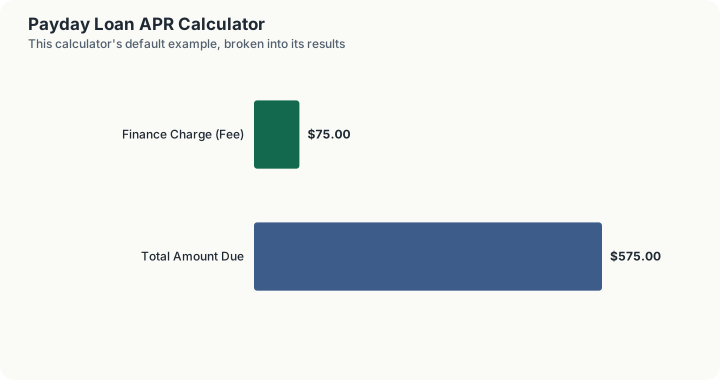
Quick Answer: A typical $500 payday loan with a $15-per-$100 fee due in 14 days carries a $75.00 finance charge and an effective APR of 391.07%.
Overview
Payday lenders almost never advertise an interest rate. Instead, they quote a flat dollar fee per $100 borrowed, something like "$15 per $100," due back in full on your next payday, usually 7 to 14 days later. That framing makes the loan sound cheap: $15 doesn't sound like much. But a flat fee charged over a term measured in days, not years, translates into an annualized interest rate that is enormous once you convert it to the same terms used for every other kind of credit, a credit card, a car loan, a mortgage.
This calculator exists specifically to do that conversion. It takes the fee structure payday lenders actually quote and expresses it the way federal law requires other lenders to disclose their cost of credit: as an Annual Percentage Rate. The gap between the "$15 fee" framing and the "391% APR" framing is the entire point of this tool, and it is not a rounding artifact or a technicality. It is the same cost, expressed honestly.
How This Is Calculated
The finance charge is the flat fee applied to the amount borrowed:
`
Finance Charge = Loan Amount × (Fee per $100 / 100)
`
That fee, charged over the loan's actual term, is first expressed as a periodic rate:
`
Finance Charge Rate = Finance Charge / Loan Amount
`
This is the true cost of the loan for however many days the term lasts, before any annualizing. To make it comparable to every other form of credit, it is annualized using the standard method regulators use for single-payment, short-term loans: multiply the periodic rate by the number of times that period would repeat in a 365-day year, then convert to a percentage.
`
APR = (Finance Charge / Loan Amount) × (365 / Loan Term Days) × 100
`
This calculator also shows a second, more aggressive number: the effective annual rate if the same loan were renewed, or "rolled over," back-to-back for a full year, which compounds the fee the way credit card interest or any recurring debt actually compounds when it isn't paid off.
`
Effective Annual Rate = (1 + Finance Charge Rate)^(365 / Loan Term Days) − 1
`
The first formula (simple annualization) is the standard APR disclosure required under the Truth in Lending Act for this loan type. The second (compounded) formula is not a required disclosure, but it is the more realistic picture of what repeat borrowing actually costs, since a large share of payday loans are, in practice, renewed rather than paid off in one cycle.
Worked Example
Take the most common payday loan structure: $500 borrowed, a $15 fee per $100, due in 14 days.
- Finance charge: $500 × (15 / 100) = $75.00
- Total amount due at term end: $500 + $75.00 = $575.00
- Finance charge rate for the 14-day period: $75.00 / $500 = 0.15, or 15%
- Number of 14-day periods in a year: 365 / 14 ≈ 26.071
- APR: 0.15 × 26.071 × 100 = 391.07%
For comparison, the same $75 fee on a $100 loan, the textbook regulatory example, produces the identical 391.07% APR, because the fee-to-principal ratio and the term are what drive the rate, not the absolute dollar amounts.
Now consider what happens if that loan isn't paid off and instead gets renewed every 14 days for a full year: $(1.15)^{26.071} - 1 \approx 3{,}723.66\%$. That number looks almost implausible, but it is simply compound interest applied honestly to a fee structure that repeats every two weeks. It illustrates why repeat borrowing, not a single loan, is where payday lending becomes most financially damaging.
What This Does Not Account For
- Rollover and renewal fees. Many states allow or effectively permit lenders to charge a new fee each time a loan is renewed rather than paid off. The "effective annual rate if rolled over" figure assumes the same fee rate applies every cycle; actual rollover fee structures vary and are sometimes higher for renewals.
- State-specific rate caps and bans. A number of states cap payday loan APRs far below what an uncapped fee structure would produce, and some states ban payday lending outright. This calculator computes the APR implied by whatever fee and term you enter; it does not check that fee against your state's legal limit.
- Additional fees beyond the stated finance charge. Some lenders charge separate application fees, NSF fees, or late fees that are not captured in a simple "fee per $100" structure. Those would raise the true cost above what this calculator shows.
- Installment payday loans. Some products marketed as payday loans are actually multi-payment installment loans with their own amortization schedule rather than a single lump-sum repayment. This calculator models the single-payment structure; it is not appropriate for a multi-installment product.
- Ability-to-repay and underwriting considerations. This tool computes cost, not affordability. It does not assess whether a given loan amount is sustainable relative to your income or expenses.
Common Pitfalls
- Anchoring on the dollar fee instead of the APR. "$15 per $100" and "391% APR" describe the exact same cost. Comparing a payday loan's dollar fee to a credit card's percentage rate, without converting both to the same units, makes the payday loan look far cheaper than it is.
- Underestimating how much the term length matters. The same dollar fee produces a dramatically higher APR on a 7-day loan than on a 14-day loan, since the identical charge is being annualized over half the time. Shorter-term payday products are, dollar for dollar, more expensive on an annualized basis.
- Treating a single loan's cost as the full picture. The Consumer Financial Protection Bureau has found that a majority of payday loan volume comes from borrowers who take out multiple loans in a row, effectively rolling the debt over. The single-loan APR badly understates the cost for anyone who ends up in that cycle.
- Assuming a lower stated fee always means a cheaper loan. A $10-per-$100 fee on a 7-day term can carry a higher APR than a $15-per-$100 fee on a 21-day term. Always compare the annualized figure, not the raw fee, when shopping between offers.
- Confusing APR with the total dollar cost. APR is a rate, not a dollar amount. A small loan with a triple-digit APR can still cost far less in actual dollars than a large loan with a lower APR. Look at both numbers, the fee in dollars and the APR, before deciding.
Frequently Asked Questions
Why is the APR on a payday loan so much higher than a credit card's?
Is a 391% APR actually legal?
How is payday loan APR different from a mortgage or auto loan APR?
What happens if I can't repay a payday loan on time?
Is there a cheaper alternative to a payday loan?
Sources
- Truth in Lending Act (TILA) / Regulation Z, 12 CFR § 1026: Federal APR disclosure requirements for consumer credit, including single-payment short-term loans. ecfr.gov/current/title-12/chapter-X/part-1026
- Consumer Financial Protection Bureau (CFPB): "Payday Loans and Deposit Advance Products" report, documenting repeat-borrowing and rollover patterns. consumerfinance.gov
- Federal Trade Commission (FTC): Consumer guidance on payday lending costs and state regulation. consumer.ftc.gov