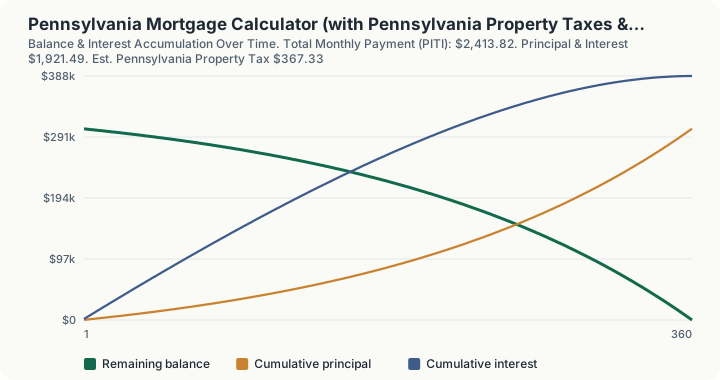
Quick Answer: A $380,000 Pennsylvania home bought with 20% down at a 6.5% rate runs about $2,413.82 a month, with roughly $367.33 of that going to Pennsylvania's comparatively high average property tax bill.
Overview
Pennsylvania's property tax system is built almost entirely around local school district funding, which is why it produces some of the widest tax-rate variation of any state in the country. There is no statewide property tax rate; instead, each of the state's roughly 500 school districts, along with overlapping county and municipal governments, sets its own millage rate against locally assessed value. The result is that two homes of identical market value ten miles apart, one in a high-spending suburban Philadelphia school district and one in a rural county, can carry meaningfully different tax bills. This calculator uses a 1.16% statewide average effective rate, above the roughly 0.89% national average, as a planning baseline.
Pennsylvania also has a real estate transfer tax, generally 1% state plus a matching local share for a combined 2% in most municipalities (higher in Philadelphia and Pittsburgh), paid at closing and typically split between buyer and seller by local custom. That transfer tax is a one-time closing cost rather than a recurring monthly expense, so it does not appear in the PITI figure here, but it is a real cash requirement buyers should budget for separately. This tool focuses on the recurring monthly obligation: principal, interest, property tax escrow, and a flat insurance estimate, run through a full 360-month amortization engine.
How This Is Calculated
- Loan principal. The down payment percentage reduces the home price to determine the financed balance. At the defaults, 20% down on $380,000 leaves a $304,000 loan.
- Principal and interest. The $304,000 balance amortizes over 360 monthly periods at the entered annual rate, using the periodic rate
i = APR / 12and the fixed payment formulaM = P × i × (1 + i)^n / ((1 + i)^n − 1), calculated period by period rather than estimated. - Escrow stack. Monthly property tax equals home price times 1.16% divided by 12, and a flat $125 monthly insurance estimate is added to that.
- Total PITI. The three components, principal and interest, tax, and insurance, sum into the single monthly figure a Pennsylvania homeowner actually pays.
Worked Example
Using the platform defaults ($380,000 home price, 20% down, 6.5% APR), the engine produces:
- Loan principal: $304,000.00
- Monthly principal & interest: $1,921.49
- Monthly Pennsylvania property tax (1.16% of price, over 12 months): $367.33
- Monthly insurance estimate: $125.00
- Total monthly PITI: $2,413.82
- Total interest paid over 30 years: $387,735.24
The property tax line comes from $380,000 × 0.0116 = $4,408.00 per year, divided by 12 to reach $367.33 a month, roughly 55% higher than what the identical purchase would generate in a low-tax state like Oklahoma. Add the $1,921.49 principal and interest payment and the $125.00 insurance estimate, and the monthly total reaches $2,413.82. Over the full 30-year term, the loan itself accumulates $387,735.24 of interest on top of the $304,000 principal, separate from the roughly $132,240 in cumulative property tax escrow the homeowner will pay over that same period at a static 1.16% rate.
What This Does Not Account For
- School district millage variation. Pennsylvania's roughly 500 school districts each set independent rates, so a specific address can carry an effective rate well above or below the 1.16% statewide average used here.
- The one-time real estate transfer tax. Pennsylvania's combined state and local transfer tax, typically 2% of the sale price in most municipalities and higher in Philadelphia and Pittsburgh, is a closing cost split by local custom between buyer and seller, not a recurring monthly PITI item, so it is intentionally excluded from this calculation.
- The Homestead/Farmstead property tax relief (Act 50/Act 1) exclusion. Many Pennsylvania school districts offer a reduced assessed value for owner-occupied homes funded by gaming revenue, which can lower the real tax bill below the flat estimate shown here.
- PMI for low down payment loans. Below roughly 20% equity, most conventional loans require private mortgage insurance, which is not reflected in the flat $125 insurance line.
- County reassessment cycles. Some Pennsylvania counties have gone decades without a full property reassessment, which can leave assessed values, and therefore actual tax bills, disconnected from current market value in either direction.
Common Pitfalls
- Assuming a single statewide millage rate exists. Pennsylvania has no such thing; tax bills are the sum of school district, county, and municipal millage, each set independently, which is why two nearby ZIP codes can differ substantially.
- Forgetting the transfer tax at closing. Buyers focused only on the recurring PITI payment shown here can be caught off guard by a 2% one-time transfer tax due in cash (or financed into closing costs) at settlement.
- Not applying for the Homestead exclusion. Owner-occupants who skip the paperwork leave a real, recurring reduction in taxable assessed value unclaimed.
- Comparing raw millage numbers across counties. Because assessed value ratios differ by county (some assess near market value, others use a much older base year), comparing millage rates directly across county lines without adjusting for the assessment ratio is misleading.
- Skipping PMI in a low-down-payment scenario. Buyers modeling 5% or 10% down should add an estimated PMI line on top of the numbers shown here until reaching 20% equity.
Frequently Asked Questions
Why is Pennsylvania's property tax estimate higher than neighboring states in this calculator series?
Does the calculator include Pennsylvania's real estate transfer tax?
How much does the Homestead exclusion actually save?
Why do two homes of the same price have different tax bills in Pennsylvania?
Can I compare a smaller down payment or a higher purchase price?
Sources
- Pennsylvania Department of Revenue: Realty Transfer Tax statute and regulations (Act 77). revenue.pa.gov
- Consumer Financial Protection Bureau: Regulation Z disclosure requirements for fixed-rate mortgage APR and finance charges. ecfr.gov/current/title-12/chapter-X/part-1026
Also consulted: Pennsylvania Department of Community and Economic Development: local tax and millage rate resources; Pennsylvania Department of Education: Homestead/Farmstead Exclusion program (Act 1 of 2006) guidance.