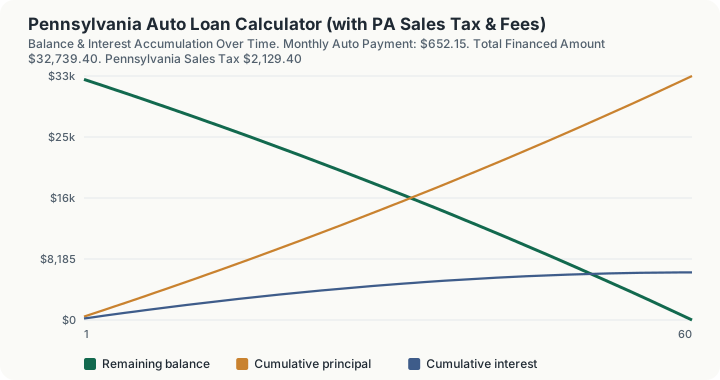
Quick Answer: A $35,000 vehicle in Pennsylvania with $5,000 cash down, a $490 dealer documentary fee, a 60-month term, and a 7.25% APR carries a $652.15 monthly payment at the statewide 6% rate. That includes $2,129.40 of sales tax and $120 in title and registration, financing $32,739.40. Register the same car in Philadelphia and the payment is $666.29; in Allegheny County, $659.22.
Overview
Pennsylvania is one of the simplest states in the country for vehicle tax, with one rule that trips up buyers in the two metros where most of the state lives.
The rate is 6% under 72 P.S. § 7202, the same as the general sales tax. There is no separate automotive rate. Exactly two jurisdictions add anything on top: Allegheny County charges 1% and Philadelphia charges 2%. Every other county in the state is a flat 6%. Pennsylvania is one of the rare states where the local automotive rate equals the local general sales tax rate, so for once the substitution most calculators make happens to be correct.
The rule that catches people is sourcing. The tax follows where the vehicle will be registered, meaning your home address, not where the dealership sits. A Philadelphia resident who drives to a Bucks County dealer to escape the 2% add-on still owes 8% when PennDOT processes the title. Dealers collect it as agent for the Department of Revenue, so the surcharge appears on the buyer's order regardless.
Trade-ins work in the buyer's favor here. 61 Pa. Code § 31.44 permits a deduction from the purchase price equal to the trade-in allowance, provided the trade happens at the same time as the sale, and it reduces the base for the local add-on as well as the state 6%.
Auto Loan APR by Credit Score
The APR columns below are national averages, not Pennsylvania figures. No primary source publishes average auto loan APR by state: Experian's report has no geographic cut, the CFPB publishes state origination volume but no rates, and the New York Fed publishes state delinquency only. The payment column is the part that is specific to Pennsylvania, because it runs this calculator's own Pennsylvania tax and fee rules at each tier's rate.
| Credit Tier | VantageScore 4.0 | Avg New APR | Avg Used APR | Est. Payment in Pennsylvania |
|---|---|---|---|---|
| Super prime | 781-850 | 4.55% | 6.30% | $611.11 |
| Prime | 661-780 | 6.23% | 8.77% | $636.45 |
| Nonprime | 601-660 | 9.67% | 14.03% | $690.31 |
| Subprime | 501-600 | 13.44% | 19.42% | $752.32 |
| Deep subprime | 300-500 | 16.01% | 21.77% | $796.33 |
Payment assumptions: $35,000 vehicle price, $0 trade-in, $5,000 cash down, $490 dealer documentation fee, 60-month term, new-vehicle APR applied to the Pennsylvania delivered price including tax and statutory fees. At the 6.39% overall new-car average the same purchase costs $638.90 a month.
The score bands are VantageScore 4.0, not FICO. The same borrower can land in a different tier under each model, so a FICO score pulled from a card issuer will not always match the band here. Source: Experian, State of the Automotive Finance Market, Q1 2026, slide 45.
What Moves Your Payment
Each row changes one input and leaves the rest at the baseline below. The dollar effects are this calculator's own output for Pennsylvania, not a rule of thumb.
| Factor | What Changes | Effect on Monthly Payment | Effect on Total Interest |
|---|---|---|---|
| Vehicle Price | Each extra $1,000 of price raises both the amount financed and the sales tax base, so the tax rises with it. | +$21.11 | +$206.87 |
| Trade-In Allowance | A $1,000 allowance cuts the amount financed by $1,000 and reduces the sales tax base by the same amount, so it saves tax as well as principal. | -$21.12 | -$206.88 |
| Cash Down Payment | A $1,000 larger down payment cuts the amount financed by $1,000. It never reduces the sales tax, which is assessed on the price, not on what you borrow. | -$19.92 | -$195.17 |
| Dealer Doc Fee | A $100 higher documentation fee adds $100 to the amount financed and is inside the sales tax base, so it is taxed on top of itself. Pennsylvania caps the fee at $490. | +$2.11 | +$20.68 |
| Longer Term | Stretching the same balance from 60 months to 72 months spreads the principal over twelve more payments at the same rate. | -$90.04 | +$1,343.24 |
Baseline: $35,000 vehicle price, $0 trade-in, $5,000 cash down, $490 documentation fee, 60 months at 7.25% APR, giving a $652.15 payment and $6,389.47 of total interest.
How This Is Calculated
Pennsylvania collects through PennDOT at titling, applying the state rate and any local rate to the same uncapped base. Five steps.
1. Net taxable base. 61 Pa. Code § 31.44 subtracts the trade-in allowance from the purchase price. The doc fee is treated as part of the purchase price here.
The allowance is capped at the price of the vehicle being purchased, so an oversized trade cannot push the base below zero and generate a refund of tax never paid.
2. Sales tax. State and local are applied to the same base, since Pennsylvania caps neither.
3. Title and registration. A fixed $120, being the $72 certificate of title and the $48 annual passenger registration from PennDOT Form MV-70S. Both are separately stated and outside the tax base.
4. Amount financed. The trade-in works twice: it lowered the tax base in step one and it reduces the balance borrowed.
5. Amortization. The financed amount amortizes as a fixed-rate installment loan:
where $P$ is the financed amount, $i$ is the monthly rate (APR ÷ 12), and $n$ is the term in months.
Pennsylvania Vehicle Tax Rates by Metro
| Metro | County | Local Add-On | State | Combined |
|---|---|---|---|---|
| Philadelphia | Philadelphia | 2.0% | 6% | 8.0% |
| Pittsburgh | Allegheny | 1.0% | 6% | 7.0% |
| Harrisburg | Dauphin | 0.0% | 6% | 6.0% |
| Allentown | Lehigh | 0.0% | 6% | 6.0% |
| Erie | Erie | 0.0% | 6% | 6.0% |
The Allegheny 1% applies anywhere in the county, not just inside Pittsburgh city limits. The Philadelphia 2% is county and city at once, since they are coterminous. There are no other local sales tax jurisdictions in Pennsylvania, so the third row of this table describes 65 of the state's 67 counties.
Worked Example
Only two Pennsylvania jurisdictions add to the 6% state rate, and both of them apply the trade-in credit against the higher combined figure. The statewide run comes first, then the two county cases.
- Vehicle price: $35,000
- Trade-in allowance: $0
- Cash down: $5,000
- Dealer doc fee: $490
- Local rate: 0% (statewide)
- Term: 60 months at 7.25% APR
Step 1 -- The taxable base. Purchase price including the capped doc fee, less a simultaneous trade-in: $35,000 + $490 - $0 = $35,490.00
Step 2 -- Pennsylvania sales tax at 6%. $35,490.00 x 6% = $2,129.40
Step 3 -- Title and registration, outside the base. $72.00 title + $48.00 registration = $120.00
Step 4 -- Total delivered price. $35,000 + $490.00 + $2,129.40 + $120.00 = $37,739.40
Step 5 -- Amount financed. $37,739.40 - $0 trade-in - $5,000 cash down = $32,739.40
Step 6 -- The monthly payment. $32,739.40 at 7.25% over 60 months = $652.15
Step 7 -- Month 1. $32,739.40 x (7.25% / 12) = $197.80 interest, $454.35 principal, balance $32,285.05
Step 8 -- Month 2. $32,285.05 x (7.25% / 12) = $195.06 interest, $457.09 principal, balance $31,827.96. Cumulative interest: $392.86
Step 9 -- The running total. Interest through month 12 is $2,188.74, balance $27,102.34. Over the full term, $6,389.47
Change nothing but the registration county. In Allegheny the tax rises to $2,484.30 and the payment to $659.22. In Philadelphia the tax is $2,839.20 and the payment $666.29. The Philadelphia add-on costs $709.80 on this purchase, which is roughly $14 a month over five years.
Now add a $10,000 trade-in at the statewide rate. The base falls to $25,490, tax falls to $1,529.40, and the payment drops to $441.00. The trade-in saved $600.00 in tax on its own. The same trade-in in Philadelphia is worth $800.00, because the credit is applied against the full 8%. That gap is the practical case for trading in rather than selling privately: a private buyer has to beat the dealer's allowance by more than the tax credit for the private sale to come out ahead.
What This Does Not Account For
- Doc fee taxability. Pennsylvania generally taxes charges that form part of the purchase price, and this calculator treats the documentary fee as taxable on that basis. A primary-source confirmation specific to the documentary fee was not located, so the tax figure could be overstated by $29.40 at 6% if the Department of Revenue treats it otherwise. The doc fee cap itself comes from an industry association rather than PennDOT and should be treated as reported rather than confirmed.
- Lien recording. PennDOT charges $36 per lien. Every financed purchase has at least one, and it is not in the $120 fixed-fee figure.
- The Fee for Local Use. Participating counties add $5 a year to registration.
- EV and PHEV road user charges. For 2026 these are $250 a year for a battery electric vehicle and $63 for a plug-in hybrid, on top of the $48 registration.
- Two-year registration. Pennsylvania offers a $96 two-year option. The calculator uses the annual $48.
- The Motor Vehicle Understated Value Program. The Department of Revenue can reassess the taxable base on a private-party sale reported below book value, so a bargain price on paper does not always produce a bargain tax bill.
- Private-party purchases generally. Tax is paid at PennDOT on transfer rather than collected by a dealer, and there is no dealer trade-in to deduct.
- GAP insurance, extended warranties, and aftermarket add-ons, unless you fold them into the vehicle price.
Common Pitfalls
- Shopping across the county line to dodge the local rate. It does not work. Tax follows your registration address. A Philadelphia resident owes 8% no matter which Pennsylvania dealer sells the car.
- Assuming Allegheny's 1% applies only in Pittsburgh. It is countywide, so Bethel Park, Monroeville, and McKeesport all pay 7%.
- Treating a separate sale as a trade-in. 61 Pa. Code § 31.44 requires the trade to occur at the same time as the purchase, and the traded vehicle must be registered in the purchaser's name. Selling your old car to a third party and handing the dealer the cash earns no deduction.
- Paying more than the capped doc fee. The reported 2026 caps are $490 for electronic filing and $409 for paper. A quoted fee above the electronic cap should be questioned.
- Forgetting the lien fee and local use fee when reconciling the buyer's order against an online estimate. Together they can add $41 that no percentage calculation predicts.
- Judging the loan by payment alone. Stretching this $32,739.40 balance from 60 to 72 months cuts the payment to $562.11 and raises total finance charges from $6,389.47 to $7,732.82.
Frequently Asked Questions
What is Pennsylvania's sales tax rate on cars?
Does where I buy the car change the tax rate?
Does a trade-in reduce sales tax in Pennsylvania?
How much are Pennsylvania title and registration fees?
Is there a cap on dealer doc fees in Pennsylvania?
Does Pennsylvania charge an annual car property tax?
Sources
- Pennsylvania Department of Revenue, motor vehicle sales tax guidance (tax collected by PennDOT as agent; Allegheny 1% and Philadelphia 2% local rates; sourcing to registration address) revenue.pa.gov
- Consumer Financial Protection Bureau, Truth in Lending Act (Regulation Z, 12 CFR § 1026.22) disclosure requirements for installment credit. ecfr.gov/current/title-12/chapter-X/part-1026
Also consulted: 72 P.S. § 7202 (Pennsylvania sales and use tax imposition, 6% rate); 61 Pa. Code § 31.44 (computation of tax on motor vehicles; trade-in deduction from purchase price); PennDOT Form MV-70S, Schedule of Fees, revision 4-26 ($72 certificate of title, $48 annual passenger registration, $36 lien recording, $5 Fee for Local Use, 2026 EV and PHEV road user charges); Pennsylvania Association of Notaries, 2026 documentary fee cap notice ($490 electronic, $409 paper). Reported figure, not a state publication; Pennsylvania Department of Revenue, Motor Vehicle Understated Value Program; Experian, State of the Automotive Finance Market, Q1 2026, slide 45 (average new and used auto loan APR by VantageScore 4.0 credit tier; national, no state level cut published).