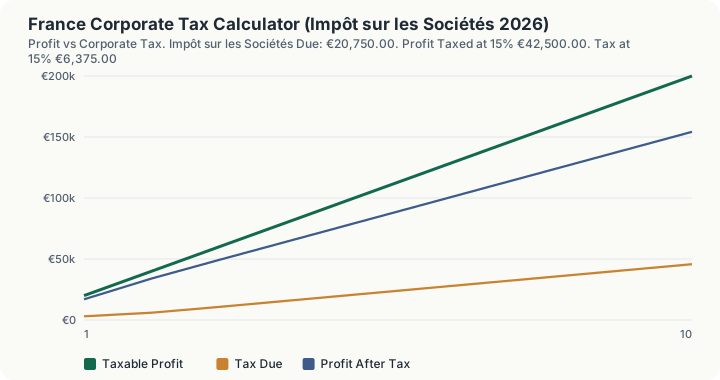
Quick Answer: A company with €100,000 of taxable profit that qualifies for the reduced rate pays €20,750.00: 15% on the first €42,500 and 25% on the remaining €57,500, an effective rate of 20.75%. Without the reduced rate the bill is €25,000. The reduced band is worth exactly €4,250, no matter how large the profit.
What does this calculator do?
France charges impôt sur les sociétés at 25%, with a reduced rate of 15% on the first €42,500 of profit for companies that meet three conditions at once:
- turnover below €10 million
- capital fully paid up
- at least 75% held by natural persons
All three must hold. Two of them cannot be inferred from a profit figure, which is why this calculator asks you to confirm eligibility rather than guessing from the numbers.
The relief is a fixed-size benefit. Because it applies to a capped band at a ten-point discount, it is worth €42,500 × 10% = €4,250 and no more. That is substantial for a company earning €100,000 and immaterial for one earning €5 million.
How is this calculated?
IS = 0.15 × min(P, 42,500) + 0.25 × max(0, P − 42,500)
where the 15% band applies only if all three eligibility conditions are met. Where they are not, the whole profit is charged at 25%.
The effective rate therefore starts at 15% for a profit entirely within the band and rises asymptotically toward 25% as profit grows, without ever reaching it for an eligible company.
Worked Example
The impot sur les societes is a two-band calculation for an eligible company and a flat one otherwise, so it is worth seeing both bands fill up and then seeing what happens once the reduced band is exhausted.
Step 1: The reduced band ceiling. €42,500 of taxable profit, available only where turnover is under €10m, capital is fully paid up, and at least 75% is held by natural persons
Step 2: A company with taxable profit of exactly €42,500, all three conditions met. Profit at 15%: €42,500.00, tax €6,375.00 Profit at 25%: €0.00, tax €0.00 Total: €6,375.00, an effective rate of 15.00%
Step 3: The same profit without eligibility. €42,500.00 x 25% = €10,625.00, an effective rate of 25.00% The reduced band is therefore worth €4,250.00, being €42,500 x the ten point rate difference
Step 4: One euro more of profit, €42,501, still eligible. Profit at 15%: €42,500.00, tax €6,375.00 Profit at 25%: €1.00, tax €0.25 Total: €6,375.25
Step 4 confirms the band is a threshold on the profit, not a cliff on the company. The euro above the ceiling is taxed at 25%; the €42,500 beneath it stays at 15%.
Step 5: Profit of €100,000, eligible. Profit at 15%: €42,500.00, tax €6,375.00 Profit at 25%: €100,000 - €42,500 = €57,500.00, tax €14,375.00 Total: €6,375.00 + €14,375.00 = €20,750.00 Effective rate: 20.75%
Step 6: Profit after tax at €100,000. €100,000.00 - €20,750.00 = €79,250.00
Step 7: The same €100,000 without eligibility. €100,000.00 x 25% = €25,000.00, leaving €75,000.00 Saving from the reduced rate: €4,250.00, exactly as in step 3
Step 8: Profit of €500,000, eligible. Profit at 15%: €42,500.00, tax €6,375.00 Profit at 25%: €457,500.00, tax €114,375.00 Total: €120,750.00, effective rate 24.15% Saving: still €4,250.00
The saving in steps 3, 7 and 8 is identical because the reduced band is capped in euros rather than expressed as a share of profit. It is worth a full ten points at €42,500 of profit, four and a quarter points at €100,000, and less than a point at €500,000. The effective rate accordingly climbs from 15.00% toward 25% and never reaches it. Two of the three eligibility conditions cannot be inferred from the profit figure, which is why the calculator asks you to confirm them rather than guessing.
What does this calculator not account for?
- Verifying eligibility. Turnover, paid-up capital and the 75% natural-person shareholding test are taken as confirmed by you. Only the first is even loosely related to profit.
- The group turnover test. For companies belonging to a group, the €10 million threshold is assessed on a basis that the reduced rate guidance has revised, so a small subsidiary of a large group may not qualify.
- Determining taxable profit. Amortisation, provisions, non-deductible charges and interest deductibility limits all sit upstream of the figure entered here.
- The contribution sociale sur les bénéfices, an additional charge on larger companies.
- CVAE and other production taxes, which are separate from IS.
- Crédit d'impôt recherche (CIR) and other credits, which reduce the final liability substantially for companies that qualify.
- Intégration fiscale, under which a group is taxed on a consolidated result.
- Report en avant and report en arrière of losses, including the carry-back mechanism.
- Acomptes, the quarterly instalments paid during the year.
- Pillar Two top-up tax for very large groups.
What mistakes do people make with this?
- Assuming eligibility follows from small profits. It follows from turnover, capital and shareholding. A company with a tiny profit but €20 million of turnover pays 25% on everything.
- Overstating what the reduced rate is worth. It is capped at €4,250. Business plans that model 15% across a whole profit substantially understate the tax.
- Missing the 75% natural-person test. A company owned through another company can fail this even if it is small by every other measure, and the shareholding is the condition most often overlooked.
- Forgetting the group turnover rule. Belonging to a group changes how the €10 million threshold is measured.
- Treating IS as the whole corporate burden. The contribution sociale sur les bénéfices and production taxes sit outside it.
- Ignoring the CIR. For research-intensive companies the research credit can dwarf the reduced-rate band.
Frequently Asked Questions
What is the French corporate tax rate?
How much is the reduced rate actually worth?
Do I qualify automatically if my profits are small?
What is the 75% shareholding condition?
Does belonging to a group matter?
Is 25% the whole corporate tax burden in France?
Sources
- impots.gouv.fr: "Taux réduit d'impôt sur les sociétés (IS) : le critère du chiffre d'affaires revu pour les entreprises appartenant à des groupes" (14 April 2026). impots.gouv.fr/actualite/taux-reduit-dimpot-sur-les-societes-le-critere-du-chiffre-daffaires-revu-pour-les
All figures verified on 30 August 2026
Also consulted: economie.gouv.fr: "L'impôt sur les sociétés, comment ça marche?", standard rate 25%, reduced rate 15% on the first €42,500, and the three eligibility conditions.