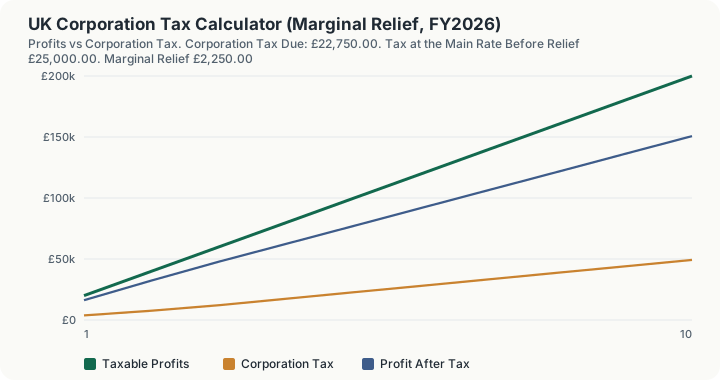
Quick Answer: A company with £100,000 of taxable profits and no associated companies pays £22,750.00 in Corporation Tax. That is the 25% main rate of £25,000, reduced by £2,250 of Marginal Relief, giving an effective rate of 22.75%. Between £50,000 and £250,000 the marginal rate on each additional pound of profit is 26.5%, which is higher than the main rate itself.
What does this calculator do?
UK Corporation Tax has had two rates since 1 April 2023. Profits at or below £50,000 are charged at the small profits rate of 19%. Profits at or above £250,000 are charged at the main rate of 25%. Between those limits, the main rate applies but is reduced by Marginal Relief, which tapers the effective rate smoothly from 19% up to 25%.
The consequence catches people out: because the effective rate is climbing across that band, the marginal rate on profits inside it is 26.5%, higher than the headline main rate. A company just below £250,000 pays more tax on its next £1,000 of profit than a company well above it.
Both limits are reduced if a company has associated companies, and pro-rated for accounting periods shorter than 12 months.
How is this calculated?
Step 1: Adjust the limits. The £50,000 lower limit and £250,000 upper limit are each divided by the number of associated companies plus one, then multiplied by the accounting period length over 365 days. A company with three other associates has limits of £12,500 and £62,500.
Step 2: Determine the basis of charge. If augmented profits are at or below the adjusted lower limit, the small profits rate of 19% applies to taxable total profits. If they are at or above the adjusted upper limit, the main rate of 25% applies with no relief. Otherwise, Marginal Relief applies.
Step 3: Marginal Relief. HMRC's statutory formula is:
MR = F × (U − A) × N/A
where F is the standard fraction of 3/200, U is the adjusted upper limit, A is augmented profits, and N is taxable total profits. The Corporation Tax due is then the main rate charge less this relief.
The fraction of 3/200 is not arbitrary. It is derived from the rates and limits as (25% − 19%) × £50,000 ÷ £200,000 = 0.015, which is exactly what makes the relief reconcile to 19% at the lower limit and 25% at the upper limit.
Worked Example
£100,000 profits, no associates, 12-month period:
- Limits are unadjusted: £50,000 and £250,000
- Profits sit between them, so Marginal Relief applies
- Relief: 3/200 × (£250,000 − £100,000) × (£100,000 ÷ £100,000) = 0.015 × £150,000 = £2,250
- Tax: £100,000 × 25% − £2,250 = £25,000 − £2,250 = £22,750
- Effective rate: 22.75%
Checking the boundaries:
- At £50,000: the small profits rate gives £9,500, which is exactly 19%
- At £250,000: no relief remains, so £62,500, exactly 25%
- At £200,000: relief is 0.015 × £50,000 = £750, so £50,000 − £750 = £49,250
From £100,000 to £200,000 the tax rises by £26,500 on £100,000 more profit, which is the 26.5% marginal rate.
£100,000 profits with three associated companies:
- Limits become £12,500 and £62,500
- £100,000 now exceeds the adjusted upper limit, so the full main rate applies
- Tax: £25,000, an extra £2,250 purely because of the associations
What does this calculator not account for?
- Computing taxable total profits. This starts from a profit figure you supply. Capital allowances, full expensing, disallowable expenditure, R&D relief and loss relief all sit upstream of it.
- Augmented profits differing from taxable total profits. Augmented profits include exempt distributions from non-group companies. Where the two differ, the N/A term in the formula matters; the calculator assumes they are equal, which is correct for most standalone companies.
- Accounting periods straddling two financial years, where rates or limits differ between them and profits must be apportioned.
- Ring fence profits from oil and gas extraction, which have their own rates and limits.
- Close investment-holding companies, which are denied the small profits rate entirely.
- Whether companies are actually associated. This depends on control and substantial commercial interdependence, and is a judgement rather than a calculation.
- Quarterly instalment payments, which large and very large companies must make rather than paying nine months and one day after the period end.
What mistakes do people make with this?
- Assuming the marginal rate is 25%. Inside the relief band it is 26.5%. A company at £240,000 of profit pays 26.5p of tax on its next pound, while one at £300,000 pays 25p.
- Forgetting associated companies. This is the most common way a company ends up paying the main rate unexpectedly. Three associates cut the upper limit to £62,500, so quite modest profits reach the main rate.
- Pro-rating profits instead of the limits for a short period. The limits are pro-rated; the profits are whatever they actually were.
- Looking for the standard fraction on the main gov.uk guidance page. It is not there: that page points to an online calculator. The fraction of 3/200 is in HMRC's Company Taxation Manual at CTM03925.
- Treating dividends paid as deductible. They are not. Corporation Tax is charged on profits before distributions, and the shareholder is then taxed separately on the dividend.
- Assuming a group of companies shares one set of limits proportionally by size. The limits are divided equally by the number of associated companies, regardless of their relative size.
Frequently Asked Questions
Why is my marginal rate 26.5% when the main rate is 25%?
What is the 3/200 standard fraction?
How do associated companies affect the calculation?
What are augmented profits?
Does the small profits rate apply automatically?
Sources
- HM Revenue and Customs (HMRC), the official authority for the national tax authority this calculator relates to. gov.uk/government/organisations/hm-revenue-customs
All figures verified on 30 August 2026 and mirrored in engine/tables/2026/uk-2026-27.json
Also consulted: GOV.UK: "Corporation Tax rates and reliefs", main rate 25% above £250,000, small profits rate 19% at or below £50,000, effective from 1 April 2023; HMRC Company Taxation Manual CTM03925, the Marginal Relief formula (F x (U - A)) x (N / A) and the standard fraction of 3/200; HMRC Company Taxation Manual CTM03930, pro-rating the limits for accounting periods shorter than 12 months; Corporation Tax Act 2010 Part 3A: associated companies and the division of the limits.