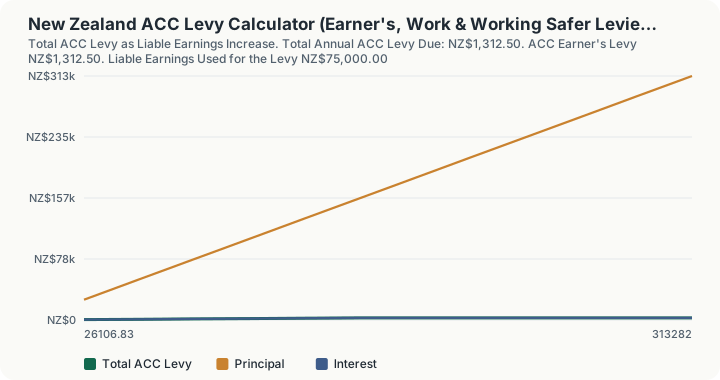
Quick Answer: A New Zealand PAYE employee earning NZ$75,000 a year pays NZ$1,312.50 in ACC Earner's Levy for the 2026-27 levy year (1.75% of liable earnings). A self-employed electrician earning NZ$90,000 of liable income pays substantially more -- NZ$3,537.00 total -- because self-employed people are separately invoiced for a classification-based Work Levy (NZ$1,890.00 at the electrician trade's published NZ$2.10-per-$100 rate) on top of the same Earner's Levy (NZ$1,575.00) and the flat Working Safer Levy (NZ$72.00).
Overview
This calculator is built specifically for New Zealand's ACC (Accident Compensation Corporation) levy system and reports every figure in New Zealand dollars (NZ$). ACC funds New Zealand's no-fault accident compensation scheme -- in exchange for near-universal cover for injury, regardless of fault, everyone working in New Zealand pays into it through one or more levies, and the levy structure is genuinely different depending on whether you're a PAYE employee or self-employed.
Employees only ever see one ACC line on their payslip: the Earner's Levy. Self-employed people and business owners, by contrast, are invoiced separately by ACC each year for up to three distinct levies -- the Earner's Levy, a Work Levy specific to their industry classification, and the Working Safer Levy collected on behalf of WorkSafe New Zealand. This calculator models both structures side by side, since conflating them is one of the most common ACC misunderstandings among people who move between employment and self-employment.
How This Is Calculated
Step 1 -- determine your employment type. Employees pay only the Earner's Levy, deducted automatically through PAYE. Self-employed people (sole traders, most partners, and many shareholder-employees not on standard PAYE) are invoiced directly by ACC for all three levy components.
Step 2 -- the Earner's Levy (both employees and self-employed). For the 2026-27 levy year (1 April 2026-31 March 2027), the rate is 1.75% of liable earnings, capped at NZ$156,641 of annual income -- so the maximum anyone pays through this levy alone is NZ$2,741.22, regardless of how much higher their income goes.
Step 3 -- the Work Levy (self-employed only). ACC assigns every self-employed person and business a Classification Unit (CU) based on their BIC/IRD industry code, grouping similar businesses by their typical risk of workplace injury. Each CU carries its own Work Levy rate -- ACC's own published range runs roughly from NZ$0.10 to NZ$8 or more per NZ$100 of liable earnings, with low-risk clerical and office-based work at the bottom and higher-risk trades near the top. There are several hundred distinct CUs in total, so this calculator offers illustrative rate bands plus a verified example (a self-employed electrician's CU, at NZ$2.10 per NZ$100 -- ACC's own published worked example) rather than attempting to enumerate every CU precisely.
Step 4 -- the Working Safer Levy (self-employed only). A flat NZ$0.08 per NZ$100 of liable earnings, collected by ACC on behalf of WorkSafe New Zealand to fund its work.
Step 5 -- total levy. For an employee, the total is simply the Earner's Levy. For a self-employed person, the total is the Work Levy plus the Earner's Levy plus the Working Safer Levy, all calculated on the same capped liable earnings figure.
Worked Example
Employee example: Wiremu is a PAYE employee earning NZ$75,000 a year. His only ACC levy is the Earner's Levy: NZ$75,000 × 1.75% = NZ$1,312.50 for the year, deducted automatically through his payslip.
Self-employed example: Hana is a self-employed electrician with NZ$90,000 of liable earnings for the year. Her ACC invoice has three components: a Work Levy of NZ$90,000 × 2.10% = NZ$1,890.00 (her electrician CU's published rate), an Earner's Levy of NZ$90,000 × 1.75% = NZ$1,575.00, and a Working Safer Levy of NZ$90,000 × 0.08% = NZ$72.00. Her total ACC levy for the year is NZ$1,890.00 + NZ$1,575.00 + NZ$72.00 = NZ$3,537.00 -- nearly three times what an employee earning the same amount pays, because of the added Work Levy.
High earner, capped out: Consider a self-employed office administrator with NZ$250,000 of liable earnings. Because liable earnings for ACC purposes are capped at NZ$156,641, her levy is calculated on that capped figure, not the full NZ$250,000: a Work Levy of NZ$156,641 × 0.30% = NZ$469.92, an Earner's Levy of NZ$156,641 × 1.75% = NZ$2,741.22 (the maximum anyone pays), and a Working Safer Levy of NZ$156,641 × 0.08% = NZ$125.31 -- a total of NZ$3,336.45, even though her actual income is well above that.
What This Does Not Account For
- Your exact Classification Unit rate. ACC uses several hundred distinct CUs, each with its own Work Levy rate set by that industry's actual claims history and injury risk. This calculator offers illustrative bands (confirmed at one verified data point -- the electrician CU) rather than a full CU lookup table; always confirm your exact rate on your ACC invoice or via your myACC for Business account before relying on a figure for real financial decisions.
- CoverPlus Extra. Self-employed people can opt into CoverPlus Extra, which lets them agree an amount of cover (rather than being assessed on actual liable earnings) for a different premium structure; this calculator models the standard CoverPlus liable-earnings basis only.
- Experience rating and No Claims Discount programmes. Some ACC levy products adjust a business's rate up or down based on its own claims history; this calculator uses the standard published CU rate without any such adjustment.
- Motor vehicle and other specific levies. ACC also collects separate levies tied to vehicle licensing and other specific activities; this calculator covers only the Earner's, Work, and Working Safer levies tied to income.
- Minimum liable earnings thresholds for full-time self-employed workers. Some secondary guidance describes a minimum liable-earnings floor that can apply to full-time self-employed people below a certain income; this figure was not independently confirmed against an ACC primary source in this calculator's build and is not applied here -- self-employed users with unusually low liable earnings should confirm directly with ACC whether a minimum applies to them.
- GST. All levy rates in this calculator, consistent with ACC's own published guidebook, are shown exclusive of GST.
Common Pitfalls
- Assuming self-employed people only pay the Earner's Levy. This is the single most common ACC misunderstanding among people moving from PAYE employment into self-employment -- the Work Levy and Working Safer Levy are real, separate, and often larger than the Earner's Levy itself for higher-risk trades.
- Not updating your Classification Unit when your business activity changes. If ACC doesn't have accurate information about what you actually do, it can default you to a higher-risk (and higher-cost) CU, such as a general manufacturing classification -- one of the most common and expensive ACC billing mistakes for the self-employed.
- Assuming the levy applies to your full income with no cap. All three levy components are capped at the same NZ$156,641 maximum liable earnings for 2026-27 -- a high earner's ACC bill stops growing once liable earnings cross that threshold.
- Confusing the Work Levy rate with the Earner's Levy rate. They're calculated the same way (a percentage of liable earnings) but are entirely separate line items with entirely different rates -- a low Work Levy CU (like office administration) does not mean a low total levy if you're also comparing it to an employee who pays no Work Levy at all.
- Forgetting the Working Safer Levy exists. It's small (NZ$0.08 per NZ$100) but is a real, separate, flat component of every self-employed ACC invoice, easy to overlook when estimating total ACC costs.
Frequently Asked Questions
What is the ACC Earner's Levy rate for 2026-27?
Do employees pay a Work Levy?
How do I find my exact ACC Classification Unit rate?
What is the Working Safer Levy?
Is there a maximum amount of ACC levy I can be charged?
Can I choose a different way to be assessed if I'm self-employed?
Sources
- Inland Revenue (IRD), "ACC earners' levy rates" (ird.govt.nz/income-tax/income-tax-for-individuals/acc-clients-and-carers/acc-earners-levy-rates) -- 2026-27 Earner's Levy rate (1.75%) and maximum liable earnings (NZ$156,641). ird.govt.nz
Also consulted: ACC, "Understanding levies if you work or own a business" (acc.co.nz/for-business/understanding-levies-if-you-work-or-own-a-business) -- Earner's Levy, Work Levy, and Working Safer Levy structure; ACC, Levy Guidebook 2026/27 (acc.co.nz/assets/business/Levy-Guidebook-2026-2027.pdf) -- Working Safer Levy rate (NZ$0.08 per $100) for the 2026/27 levy year; ACC / Hnry, "A guide to ACC levies for sole traders" -- verified worked example of a self-employed electrician's Classification Unit Work Levy rate (NZ$2.10 per $100); illustrative CU rate bands corroborated by multiple concordant secondary sources, with a caveat that exact CU rates require ACC's own classification lookup.