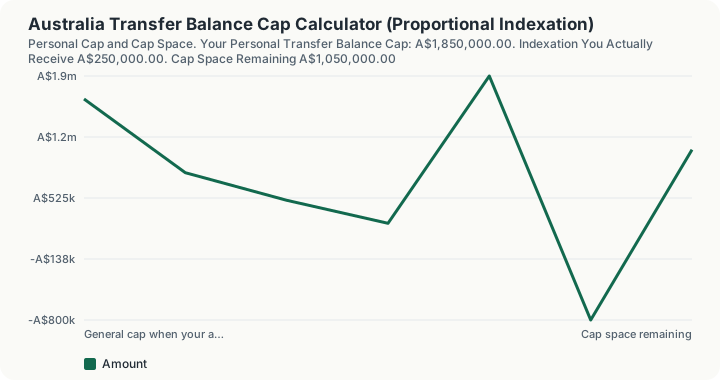
Quick Answer: An account that started when the general cap was A$1,600,000, with a highest-ever balance of A$800,000, carries a personal cap of A$1,850,000 now that the general cap is A$2,100,000 (from 1 July 2026). Half the original cap went unused, so half the A$500,000 of indexation is credited, and A$1,050,000 of cap space remains.
What does this calculator do?
Two people the same age, both retiring with the same balance, can have permanently different transfer balance caps. That is not an anomaly. It is the design.
Start with a disclosure that matters more than any number on this page. A$1,600,000, the cap for 2017-18, is the only transfer balance cap figure stated anywhere in the Income Tax Assessment Act 1997. Section 294-35(3) reads: the general transfer balance cap is, for the 2017-2018 financial year, A$1,600,000; or for a later financial year, "the amount worked out by indexing annually" that amount. The indexing runs through Subdivision 960-M and consumes ABS Consumer Price Index numbers, which are statistical publications that appear in no Act and no legislative instrument. The current general cap is therefore published by the ATO, not stated in any Act. The ATO announced that it rose from A$2,000,000 to A$2,100,000 on 1 July 2026, and that is the default here. It stays a user input so that a later year's figure can be entered once the ATO publishes it.
With that said, the mechanic the calculator exists to explain is s 294-40, proportional indexation.
A member's personal cap is not the current general cap. Under s 294-35(1) and (2), the cap in the year the transfer balance account first exists equals the general cap for that year, and in later years it equals the previous year's cap, subject to s 294-40. Section 294-40 then grants an increase equal to the unused cap percentage multiplied by the indexation increase. So indexation is rationed by how much of the cap you never used.
The consequences are severe and permanent:
- A member who once used 100% of their cap receives no indexation ever, however far the general cap rises afterwards. Their cap is frozen at the figure that applied when they started.
- A member who used 40% receives 60% of every future increase.
- The unused percentage is fixed by the highest balance the account ever reached, not the current balance. Drawing an account back down frees room under the cap but restores no indexation. The percentage never recovers.
How is this calculated?
- Step 1: Work out the unused proportion of the cap, using the highest balance the account ever reached. (A$1,600,000 - A$800,000) / A$1,600,000 = 50%
- Step 2: Work out the increase in the general cap since the account started. A$2,100,000 - A$1,600,000 = A$500,000
- Step 3: Apply s 294-40: the increase you receive is your unused percentage of that. 50% x A$500,000 = A$250,000
- Step 4: Add the increase to the cap that applied when the account started. A$1,600,000 + A$250,000 = A$1,850,000
- Step 5: Measure the current balance against the personal cap to find remaining space. A$1,850,000 - A$800,000 = A$1,050,000
- Step 6: Test for an excess transfer balance. max(0, A$800,000 - A$1,850,000) = A$0
- Step 7: Optional cross-check on the general cap you entered, using the s 960-280(1) indexation factor from the two CPI index numbers. 145.0 / 110.0 = 1.318182
- Step 8: Section 960-285(2): index the A$1,600,000 base amount by that factor. A$1,600,000 x 1.318182 = A$2,109,090.91
- Step 9: Section 960-285(7) table item 3: round DOWN to the nearest A$100,000 rounding amount. floor(A$2,109,090.91 / A$100,000) x A$100,000 = A$2,100,000
Worked Example
The rounding rule in step 9 explains a feature of the cap that puzzles people every year: it moves in A$100,000 steps and sometimes does not move at all despite positive inflation.
Take a comparison quarter CPI of 130.0 instead of 145.0.
- Indexation factor. 130.0 / 110.0 = 1.181818...
- Indexed base amount. A$1,600,000 x 1.181818... = A$1,890,909.09
- Round down to the nearest A$100,000. A$1,890,909.09 becomes A$1,800,000. Ninety thousand dollars of accumulated indexation is simply discarded until the next A$100,000 boundary is crossed. Section 960-285(4) adds that there is no indexation at all if the factor is 1 or less.
Now the mechanic that costs real money. Compare two members whose accounts both started when the general cap was A$1,600,000.
- Member A started a A$1,600,000 pension. Unused percentage: (A$1,600,000 - A$1,600,000) / A$1,600,000 = 0%. Indexation received: 0% x A$500,000 = A$0. Personal cap: A$1,600,000, forever.
- Member B started an A$800,000 pension. Unused percentage: 50%. Indexation received: A$250,000. Personal cap: A$1,850,000.
Member A then commutes back to A$500,000. The personal cap stays at A$1,600,000, because the unused percentage was fixed by the highest balance ever reached. Available space rises to A$1,100,000, but the frozen cap does not thaw.
If a balance exceeds the personal cap, say a personal cap of A$1,600,000 against an account of A$1,750,000, the excess is A$150,000, and the ATO issues a determination requiring the excess to be commuted, with excess transfer balance tax on top.
What does this calculator not account for?
- Future general caps. The A$2,100,000 default is the ATO's figure from 1 July 2026. It is not in the Act or any legislative instrument, and later years depend on ABS CPI numbers, so enter the ATO's figure for any later year.
- The CPI index numbers themselves. The 110.0 and 145.0 defaults are illustrative inputs for the s 960-285 working, not published ABS figures.
- Transfer balance account credits and debits in detail. The account is modelled by two numbers: the highest balance ever reached and the current balance. Division 294 sets out a full table of credits and debits: commutations, structured settlement contributions, limited recourse borrowing arrangement payments, family law splits, the loss of retirement-phase status on a failed defined benefit pension, and none of those events are individually modelled.
- Excess transfer balance tax and excess transfer balance earnings. The calculator identifies an excess and its size; it does not compute the tax on it or the notional earnings that accrue while the excess persists.
- Timing. The result is a position at a point in time, not a projection across future indexation years.
What mistakes do people make with this?
- Assuming your cap is the current general cap. It is only that if you have never had a transfer balance account. Everyone else is on a personal cap set by s 294-40.
- Using your current balance to work out the unused percentage. It is the highest balance the account ever reached. This is the error that makes people believe a commutation restored their indexation.
- Believing a rollback undoes a full-cap start. It does not. Cap space returns; the unused percentage does not.
- Expecting the cap to track CPI smoothly. The A$100,000 rounding in s 960-285(7) table item 3 means it lurches, and can stall for a year with positive inflation.
- Relying on a remembered current cap figure. Because it is not in legislation, remembered figures go stale silently, with no amending Act to notice.
Frequently Asked Questions
Why is the current general cap an input rather than built in?
If I fully used my cap, will I ever get indexation?
I drew my pension back down. Does that restore indexation?
Why does the cap move in A$100,000 steps?
Sources
- Income Tax Assessment Act 1997, Division 294 (ss 294-35 and 294-40) and Subdivision 960-M (ss 960-265, 960-280 and 960-285): legislation.gov.au/C2004A05138/latest/text
Read from authorised text on the Federal Register of Legislation, Compilation No. 266, compilation date 1 July 2026.
- Australian Taxation Office, "General transfer balance cap indexation on 1 July 2026": the general cap rises from A$2,000,000 to A$2,100,000. ato.gov.au/individuals-and-families/super-for-individuals-and-families/self-managed-super-funds-smsf/smsf-newsroom/general-transfer-balance-cap-indexation-on-1-july-2026