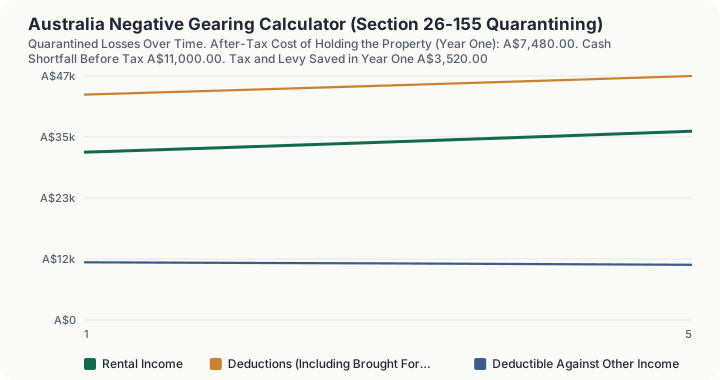
Quick Answer: A rental returning A$32,000 against A$34,000 of interest and A$9,000 of other costs runs an A$11,000 loss. For an owner on A$130,000 of other income in 2026-27 that loss is fully deductible, saves A$3,520.00 of tax and levy, and leaves an after-tax holding cost of A$7,480.00 in year one. From 2027-28 the same property costs the full A$11,000.00, because nothing is deductible against salary.
What does this calculator do?
Negative gearing on Australian residential property is being quarantined, not abolished, and the distinction is the whole story.
Treasury Laws Amendment (Tax Reform No. 1) Act 2026 (No. 49, 2026), Schedule 2, inserts s 26-155 into the ITAA 1997. Where the deductions relating to using or holding residential dwellings as residential accommodation exceed the assessable income from doing so, s 26-155(1) does three things to the excess:
- (a) it "is not deductible for that income year", so it cannot reduce salary, business income or anything else;
- (b) it becomes a quarantined amount that could be applied under the s 102-5 method statement, meaning it can be absorbed against a net capital gain in the same year;
- (c) to the extent any part remains, it "is treated as an amount relating to using or holding residential dwellings as residential accommodation for the next income year".
Paragraph (c) is the part most commentary misses. The loss is deferred, not lost, and because it lands in next year's rental deduction pool alongside next year's own costs, it compounds. A property that runs an A$11,000 excess this year starts next year already A$11,000 in deficit before a dollar of interest is charged, and unless rent overtakes costs the pool builds year on year.
Schedule 2 item 2 applies the whole thing to the 2027-28 income year and later. For 2026-27 negative gearing is unrestricted, which is why the default result above is the ordinary pre-reform outcome.
How is this calculated?
- Step 1: Total the deductible costs. A$34,000 interest + A$9,000 other costs = A$43,000
- Step 2: Work out the excess of deductions over rental income. A$43,000 - A$32,000 = A$11,000
- Step 3: Test whether s 26-155 applies. The selected year is 2026-27, which is before the 2027-28 start date in Schedule 2 item 2, so the quarantine does not engage and the excess is deductible against other income. Not quarantined: A$11,000 deductible
- Step 4: Income tax on other income without the deduction, at the 2026-27 resident rates. A$4,020 + (A$85,000 x 30%) = A$29,520
- Step 5: Income tax on other income reduced by the deduction. A$130,000 - A$11,000 = A$119,000; A$4,020 + (A$74,000 x 30%) = A$26,220
- Step 6: Income tax saved. A$29,520 - A$26,220 = A$3,300
- Step 7: Medicare levy saved, at the 2% s 6(1) rate on the same A$11,000 of income removed. (A$130,000 x 2%) - (A$119,000 x 2%) = A$2,600 - A$2,380 = A$220
- Step 8: Total tax and levy saved. The combined effect is a 30% marginal rate plus the 2% levy, so 32% of the loss. A$3,300 + A$220 = A$3,520
- Step 9: After-tax cost of holding the property in year one. A$11,000 - A$3,520 = A$7,480.00
Worked Example
Change one input, the income year, to 2027-28, and watch the same property behave completely differently.
- The excess is unchanged. A$43,000 - A$32,000 = A$11,000.
- Section 26-155(6) reduces the excess first, by any net income from non-quarantined dwellings and any gain from a realisation event on a revenue-asset dwelling. Both are nil by default. A$11,000 - A$0 = A$11,000
- Section 26-155(1)(b) applies the remainder against a net capital gain. No gain is available. min(A$11,000, A$0) = A$0 absorbed
- Section 26-155(1)(a) denies the deduction against other income. A$0 deductible
- Tax and levy saved. A$0
- After-tax cost in year one becomes the whole cash shortfall. A$11,000 - A$0 = A$11,000
- Section 26-155(1)(c) carries the excess forward. In year two, with rent growing 3% and costs 2%, the deduction pool is next year's A$43,860 of costs plus the A$11,000 brought forward, against A$32,960 of rent. The carried amount grows again, and the projection table shows it climbing across the horizon.
What does this calculator not account for?
- Section 26-155(4) excepted entities. The calculator assumes an individual holding the dwelling directly. There is no entity selector, so the exception for a widely held unit trust or a complying superannuation entity is described below as law but is never applied to the figures.
- Section 26-155(7) trust attribution. Rental amounts derived through a trust are attributed to beneficiaries by that subsection. The engine models an individual holding directly and does not perform the attribution.
- Sections 26-155(8) and (9) bankruptcy extinguishment. Unused quarantined amounts are extinguished on bankruptcy. That is not modelled.
- Section 26-155(2)(c) ministerial determinations. The Minister may determine activities or purposes that escape the quarantine, constrained by s 26-155(3A) to social and affordable housing and to housing outcomes for Aboriginal or Torres Strait Islander persons, persons with a disability, aged persons, or another class of persons suffering disadvantage. No such determination is modelled, because the content of any determination is unknown.
- Whether the costs entered are actually deductible. Interest, rates, insurance, strata, agent fees, repairs and depreciation are taken at the figures entered. The engine does not apply the capital-versus-revenue distinction, Division 40 effective lives, or the restrictions on travel and second-hand asset depreciation.
- Capital gains on eventual sale. The calculator projects the holding position only. The CGT outcome, including the withdrawal of the 50% discount from 1 July 2027, belongs to the capital gains calculator.
- The Medicare levy surcharge and any offsets.
What mistakes do people make with this?
- Believing the loss is destroyed. It is not. Paragraph (1)(c) rolls it into the next year's pool, so it survives and accumulates. What the taxpayer loses is the timing benefit, and with it the cash flow.
- Testing the grandfathering by settlement date. Section 26-155(2)(a) grandfathers a dwelling last acquired before 7.30pm, by legal time in the Australian Capital Territory, on 12 May 2026, and s 26-155(3) says that where the dwelling is acquired under a contract the ownership interest exists from the time the contract is entered into. Contract date, not settlement.
- Assuming grandfathering is attached to the property. It attaches to when you last acquired your interest. A grandfathered dwelling sold to a new buyer in 2028 is quarantined in the buyer's hands.
- Reading "new builds" as any recent purchase. Section 26-155(2)(b) exempts a dwelling that is a new residential dwelling in relation to you, which is a defined status, not a description of the building's age.
- Ignoring the s 26-155(6) netting. An investor with one profitable grandfathered property and one loss-making quarantined property is quarantined on the net figure, not the gross.
- Overstating the tax benefit even before the reform. At A$130,000 of income the saving is 32 cents in the dollar including the levy, so the investor still funds 68 cents of every dollar of loss.
Frequently Asked Questions
Is negative gearing abolished from 2027-28?
Does the quarantine apply to a property I already own?
What counts as a new residential dwelling?
Can a company or trust avoid the rule?
Why does the projected loss keep growing?
Sources
- Treasury Laws Amendment (Tax Reform No. 1) Act 2026 (No. 49, 2026), Schedule 2: legislation.gov.au/C2026A00049/latest/text
- Income Tax Assessment Act 1997, s 26-155 and s 102-5: legislation.gov.au/C2004A05138/latest/text
- Income Tax Assessment Act 1936, Schedule 2F s 272-105: legislation.gov.au/C1936A00027/latest/text
- Income Tax Rates Act 1986, Schedule 7 Part I: legislation.gov.au/C2004A03348/latest/text
- Medicare Levy Act 1986, s 6: legislation.gov.au/C2004A03351/latest/text
All figures were read from authorised text on the Federal Register of Legislation.