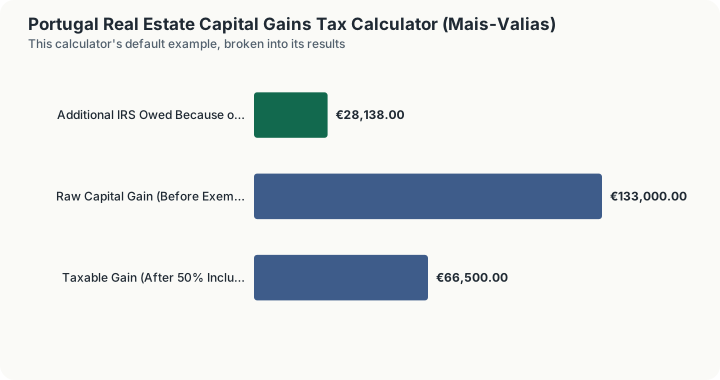
Quick Answer: Selling a Portuguese property for €350,000 that was bought for €180,000, with €37,000 of documented acquisition and sale costs, produces a €133,000 raw gain. With no reinvestment, half of that gain (€66,500) stacks on €25,000 of other income, adding €28,138.00 in additional IRS at a 48% marginal rate. Fully reinvesting the net proceeds into another primary residence instead exempts the entire gain, adding €0 in tax.
Overview
Portugal taxes real estate capital gains (mais-valias imobiliárias) under a distinctive "50% inclusion" rule set out in Article 43(2) of the CIRS: the balance of gains and losses on the disposals listed in Article 10(1)(a), (c) and (d) "é apenas considerado em 50% do seu valor". Only half of the net gain is added to your other taxable income for the year and taxed at your ordinary progressive IRS rates, rather than the full gain being taxed at a flat capital-gains rate as in many other countries. This makes the tax genuinely dependent on your other income for the year, since the taxable half of the gain stacks on top and can push you into a higher marginal bracket.
There's also a significant exemption available under Article 10(5) of the CIRS: if the property you sold was your own permanent home, and you reinvest the proceeds into another primary residence within 24 months before or 36 months after the sale, the gain (or a proportional share of it, based on how much of the net proceeds you actually reinvest) is exempt from tax entirely. This calculator computes both the raw gain and, if applicable, how much of it the reinvestment exemption shields from the 50% inclusion rule.
How This Is Calculated
- Corrected acquisition value. Portugal allows an official annual inflation-adjustment coefficient (coeficiente de desvalorização da moeda), published by acquisition year, to increase your deductible acquisition value before computing the gain.
- Raw gain. Sale value minus corrected acquisition value minus all deductible costs (acquisition costs, sale costs, documented improvements from the last 12 years).
- Reinvestment exemption (if applicable). If the property was your own permanent home and you're reinvesting in another one, the exempt share of the gain is proportional to how much of the net sale proceeds (sale value minus any mortgage settled) you actually reinvest.
- 50% inclusion rule. Only half of whatever gain remains after any reinvestment exemption is added to your other taxable income for the year.
- Marginal tax stacking. The taxable half of the gain is combined with your other annual taxable income, taxed under the ordinary progressive brackets (and the quociente conjugal split, if married), and the additional tax caused specifically by the sale is the difference between tax-with-the-gain and tax-without-it -- including any change in the solidarity surcharge.
Worked Example
Using the calculator's default inputs (€350,000 sale, €180,000 acquisition, €37,000 total costs, no reinvestment, €25,000 other income, single):
- Raw gain: 350,000 − 180,000 − (12,000 + 15,000 + 10,000) = €133,000.
- No reinvestment, so the full gain enters the 50% inclusion rule: taxable gain = €66,500.
- Combined taxable income: 25,000 + 66,500 = 91,500, reaching the top 48% bracket.
- Additional tax from the sale (including the solidarity surcharge on the portion above €80,000): €28,138.00.
Full Reinvestment Into a New Primary Residence
Reinvesting the full €300,000 net sale value (350,000 sale minus 50,000 mortgage settled) into a new primary home reaches a 100% reinvestment fraction -- the entire €133,000 gain is exempt, and additional tax from the sale is €0.
Partial Reinvestment (50%)
Reinvesting only €150,000 of the €300,000 net sale value -- a 50% fraction -- exempts half the gain, leaving the other half subject to the 50% inclusion rule: taxable gain of €33,250, adding €12,855.55 in tax at this income level.
Monetary Correction Coefficient Above 1
A coefficient of 1.2 on a €100,000 acquisition raises the corrected acquisition value to €120,000, directly shrinking the raw gain compared to using the unadjusted original purchase price.
What This Does Not Account For
- The non-resident position. This calculator models a Portuguese tax resident. The 50% inclusion in Article 43(2) of the CIRS was historically written to apply to disposals by residents, and that restriction has been struck down repeatedly by the CJEU and by CAAD arbitral tribunals as an unlawful restriction on the free movement of capital under Article 63 TFEU. Non-resident treatment is therefore both different and actively contested, and this calculator does not attempt to model it.
- The official annual monetary correction coefficient table by acquisition year could not be retrieved this session. Rather than fabricating a lookup table, this calculator exposes the coefficient as a manual input (default 1.0, meaning no adjustment) -- look up your specific year's official coefficient on the Portal das Finanças and enter it directly.
- The reinvestment exemption's exact procedural requirements (declaring intent to reinvest, the specific 24-months-before/36-months-after window mechanics) are modeled at the calculation level, not the filing/declaration level.
- Gains from non-real-estate assets (shares, funds, crypto) follow different rules entirely and are out of scope for this calculator.
- Inherited or gifted property's acquisition value basis (which follows special rules distinct from a straightforward purchase) is not modeled -- this calculator assumes you personally purchased the property.
Common Pitfalls
- Forgetting the 50% inclusion rule and expecting the full gain to be taxed at a flat rate. Portugal's system is meaningfully different from a flat capital-gains-tax country -- only half the gain enters your taxable income, but it's taxed at your marginal IRS rate, not a separate flat percentage.
- Assuming the reinvestment exemption is automatic. It requires the sold property to have been your own permanent home and genuine reinvestment in a new one within the specific time windows -- an investment property sale never qualifies, regardless of what you do with the proceeds.
- Not applying the monetary correction coefficient. Skipping this can overstate your gain (and your tax) for properties held many years, since the coefficient exists specifically to adjust for inflation since acquisition.
- Missing documented improvement expenses. Only improvements with a supporting invoice count, and only from the 12 years before the sale -- undocumented or older improvements can't reduce the taxable gain.
- Not realizing the taxable gain stacks on your OTHER income for bracket purposes. A seemingly modest taxable half-gain can push your marginal rate meaningfully higher if your other income already sits near a bracket boundary.
Frequently Asked Questions
Do I pay tax on the full gain or only half?
What if I only reinvest part of the sale proceeds?
Where do I find my property's official monetary correction coefficient?
Does the reinvestment window only count time after the sale?
Is a rental or investment property eligible for the reinvestment exemption?
Sources
- Código do IRS (CIRS), Article 43(2): the balance of gains and losses on the disposals in Article 10(1)(a), (c) and (d) is taken into account at 50% of its value. Verified 2026-08-28 against the published statutory text and against CAAD arbitral decisions quoting the provision directly. irs.gov
- Portuguese Tax and Customs Authority, the official authority for the national tax authority this calculator relates to. portaldasfinancas.gov.pt
Also consulted: CAAD arbitral case law and CJEU authority on Article 63 TFEU, for the point that confining the 50% inclusion to residents has been held to be an unlawful restriction on the free movement of capital; taxsummaries.pwc.com/portugal, for the Article 10(5) primary-residence reinvestment exemption mechanics (24 months before / 36 months after the sale, proportional exemption net of any outstanding mortgage settled); Portugal's IRS 2026 progressive bracket table and solidarity surcharge thresholds, as used elsewhere in this platform's Portugal calculators, applied here to the taxable half of the gain.