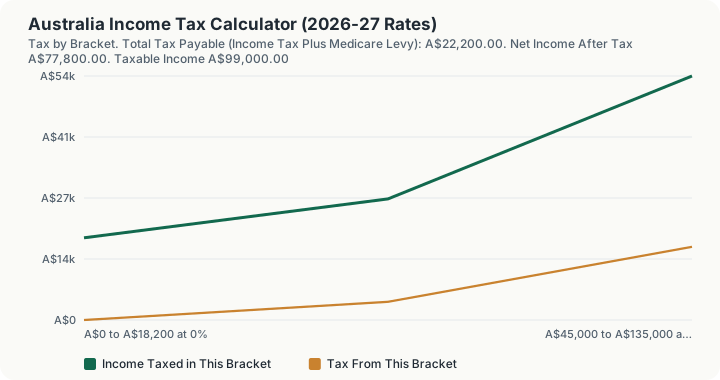
Quick Answer: On a gross income of A$100,000 for 2026-27, with no work-related deductions claimed, this calculator returns total tax payable of A$22,200.00: A$20,220.00 of income tax plus A$1,980.00 of Medicare levy.
What does this calculator do?
The 2026 reform did two separate things, and most discussion of it mentions only the first. The Income Tax Rates Amendment (Tax Reform No. 1) Act 2026 cut the first marginal rate from 16% to 15% for 2026-27, falling again to 14% from 2027-28. The quieter change is in the companion Act, the Treasury Laws Amendment (Tax Reform No. 1) Act 2026, whose Schedule 4 inserted s 25-130 into the Income Tax Assessment Act 1997: a standard deduction lifting a taxpayer's work-related claims up to A$1,000.
At A$100,000 the second change is worth more than the first. The rate cut applies to one point on the A$26,800 slice between the tax-free threshold and A$45,000, so it saves A$268. The standard deduction removes A$1,000 from a 30% bracket and from the 2% levy base, so it saves A$320. Compared with the same A$100,000 in 2025-26, the two together cut the bill by A$588.
A third element of the reform, the Working Australians tax offset in the new Subdivision 61-E of the ITAA 1997, is law but not yet claimable: Schedule 3 Part 2 item 4 of Act No. 49 of 2026 applies it only to 2027-28 and later assessments, so it returns nil here.
Every rate, threshold and offset figure used here was read from the authorised compilations on the Federal Register of Legislation.
How is this calculated?
Using the defaults: gross income A$100,000, income year 2026-27, Australian resident, no work-related deductions, no other deductions, no spouse or dependants.
- Step 1: Compute the standard deduction top-up (ITAA 1997 s 25-130(2)). It is the lesser of A$1,000 and assessable labour income, reduced by actual work-related deductions. min(A$1,000, A$100,000) - A$0 = A$1,000.00
- Step 2: Total the deductions. Actual work-related deductions plus the top-up plus other deductions. A$0 + A$1,000.00 + A$0 = A$1,000.00
- Step 3: Compute taxable income. A$100,000 - A$1,000.00 = A$99,000.00
- Step 4: Tax the first bracket (Income Tax Rates Act 1986 Sch 7 Pt I, 2026-27 table). Nil up to A$18,200, then 15% to A$45,000. (A$45,000 - A$18,200) x 15% = A$26,800 x 15% = A$4,020.00
- Step 5: Tax the second bracket at 30%. The slice from A$45,000 up to taxable income. (A$99,000 - A$45,000) x 30% = A$54,000 x 30% = A$16,200.00
- Step 6: Sum the brackets to get income tax before offsets. A$4,020.00 + A$16,200.00 = A$20,220.00
- Step 7: Apply the offsets (ITAA 1997 s 61-115, ITAA 1936 s 160AAAA, Subdiv 61-E). LITO cuts out above A$66,667, SAPTO is not selected, and the Working Australians tax offset is nil before 2027-28. A$0 + A$0 + A$0 = A$0.00
- Step 8: Deduct the offsets from income tax, floored at nil. A$20,220.00 - A$0.00 = A$20,220.00
- Step 9: Compute the Medicare levy (Medicare Levy Act 1986 s 6(1)). Taxable income of A$99,000 is above the A$35,013 phase-in limit, so the full 2% applies. A$99,000.00 x 2% = A$1,980.00
- Step 10: Add the levy to the income tax. The levy is imposed by a separate Act and is not reduced by the offsets, so it is added after them. A$20,220.00 + A$1,980.00 = A$22,200.00
- Step 11: Compute net income. A$100,000 - A$22,200.00 = A$77,800.00
Worked Example
Take the same A$100,000 in the previous income year, 2025-26, and the size of the reform becomes visible.
- The standard deduction did not exist: s 25-130 applies only from 2026-27, so the top-up is A$0.00 and taxable income is A$100,000.00.
- The first bracket was 16%: A$26,800 x 16% = A$4,288.00.
- The second bracket: (A$100,000 - A$45,000) x 30% = A$55,000 x 30% = A$16,500.00.
- Income tax: A$4,288.00 + A$16,500.00 = A$20,788.00.
- Medicare levy: A$100,000 x 2% = A$2,000.00.
- Total: A$20,788.00 + A$2,000.00 = A$22,788.00.
Against the 2026-27 result of A$22,200.00, the saving is A$588.00. Splitting it: applying the 2026-27 rates to an unreduced A$100,000 gives A$20,520.00 of income tax plus A$2,000.00 of levy, or A$22,520.00, so the rate cut alone is worth A$268.00 and the standard deduction accounts for the remaining A$320.00 (A$1,000 at a 30% marginal rate, plus A$20 of levy on the same A$1,000).
What does this calculator not account for?
- Superannuation. Compulsory employer contributions, concessional contributions tax and Division 293 tax are outside the model entirely. Gross income here means assessable income, not a total remuneration package.
- Study and training loan repayments. HELP and VET Student Loan compulsory repayments are not included in the total tax figure.
- The Medicare levy surcharge. Only the s 6 levy is applied. The surcharge turns on private hospital cover and on income tier thresholds; the Medicare levy surcharge calculator applies the 2026-27 tiers.
- Tax offsets other than LITO, SAPTO and WATO. Franking credits, the foreign income tax offset, the private health insurance rebate and the zone offsets are not modelled. Nor are the ITAA 1997 s 61-115(2) to (4) LITO caps for minors, or the SAPTO spouse transfer in reg 12 of the Income Tax Assessment (1936 Act) Regulations 2025.
- Family income for the levy. Where a spouse is indicated, the calculator uses your own taxable income as the family income figure rather than a separate spouse income input. If your spouse has income, the family Medicare levy threshold test here will be more generous than the Act allows.
- Part-year residency, capital gains, and business or trust structures. The rate schedule chosen is applied to the whole year on a single residency status.
What mistakes do people make with this?
- Treating the standard deduction as an extra A$1,000 on top of real claims. Section 25-130(2) reduces the A$1,000 by your actual work-related deductions. A taxpayer already claiming A$1,200 gets nothing from it; a taxpayer claiming A$400 gets A$600.
- Expecting offsets to cut the Medicare levy. LITO, SAPTO and WATO reduce income tax only. The levy is imposed by the Medicare Levy Act 1986, a separate Act, and survives an income tax bill reduced to nil.
- Expecting an offset refund. All three are non-refundable under ITAA 1997 s 63-10(1); entitlement beyond your income tax bill is lost, which this calculator reports separately.
- Claiming the Low and Middle Income Tax Offset. LMITO ended after the 2021-22 income year and was never extended. Subdivision 61-D of the ITAA 1997 contains only LITO.
- Assuming the Working Australians tax offset applies now. It is law, but it applies to 2027-28 assessments and later.
- Applying the tax-free threshold as a foreign resident. Schedule 7 Part II gives none: 30% applies from the first dollar, and no top-up, LITO or SAPTO is given either, though no Medicare levy is charged.
Frequently Asked Questions
Is the 15% first bracket actually in force?
Did any thresholds change?
Why is my average rate so much lower than my marginal rate?
How does the Medicare levy interact with a low income?
Are any figures in this calculator unverified?
Sources
- Income Tax Rates Act 1986, series C2004A03348, Compilation No. 66, compilation date 1 July 2026, Schedule 7 Parts I, II and III: legislation.gov.au/C2004A03348/latest/text
- Income Tax Rates Amendment (Tax Reform No. 1) Act 2026, No. 50, 2026: legislation.gov.au/C2026A00050/latest/text
- Treasury Laws Amendment (Tax Reform No. 1) Act 2026, No. 49, 2026, Schedules 3 and 4: legislation.gov.au/C2026A00049/latest/text
- Income Tax Assessment Act 1997, series C2004A05138, Compilation No. 266, Subdivisions 61-D and 61-E, ss 25-130 and 63-10: legislation.gov.au/C2004A05138/latest/text
- Income Tax Assessment Act 1936, series C1936A00027, Compilation No. 192, s 160AAAA: legislation.gov.au/C1936A00027/latest/text
Also consulted: Income Tax Assessment (1936 Act) Regulations 2025, F2025L01060, ss 4, 9, 10 and 11:; Medicare Levy Act 1986, series C2004A03351, Compilation No. 53, compilation date 1 July 2026, ss 3, 6, 7 and 8:; Treasury Laws Amendment (Delivering an Efficient and Trusted Tax System) Act 2026, No. 58, 2026, Schedule 5:.