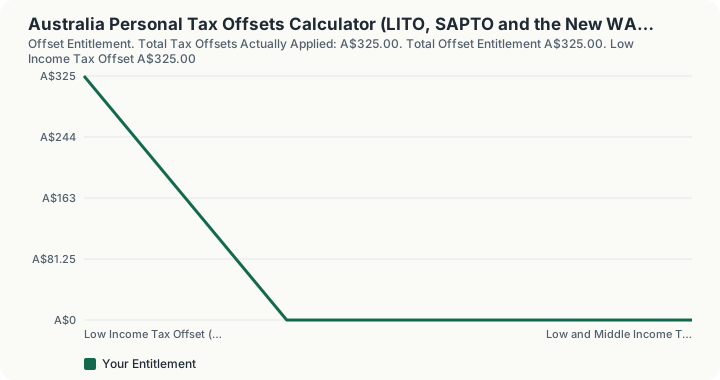
Quick Answer: The LMITO no longer exists: it ended after the 2021-22 income year and no current provision grants it. On the default inputs, a resident with A$45,000 of taxable income in 2026-27 receives A$325.00 of tax offsets actually applied, all of it Low Income Tax Offset, reducing income tax from A$4,020.00 to A$3,695.00.
What does this calculator do?
The Low and Middle Income Tax Offset is gone. It was a temporary measure, it ended after the 2021-22 income year, it was never extended, and there is no provision in the current Income Tax Assessment Act 1997 that grants it. Subdivision 61-D of the ITAA 1997, read in Compilation No. 266 with a compilation date of 1 July 2026, contains the Low Income Tax Offset and nothing else. The new Subdivision 61-E inserted by Act No. 49 of 2026 is the Working Australians tax offset, which is a different thing.
What actually exists for an individual is three offsets:
- LITO, the Low Income Tax Offset, ITAA 1997 ss 61-110 and 61-115. Up to A$700, cutting out at A$66,667.
- SAPTO, the Seniors and Pensioners Tax Offset, ITAA 1936 s 160AAAA, with the amounts in the Income Tax Assessment (1936 Act) Regulations 2025.
- WATO, the Working Australians tax offset, ITAA 1997 Subdivision 61-E, capped at A$250 and available only from the 2027-28 income year.
All three are non-refundable, which matters more than the headline amounts do. They reduce income tax to nil and stop. They do not reduce the Medicare levy, which is imposed by a separate Act.
There is one subtlety worth stating up front, because it is invisible in every published table. The SAPTO shade-out threshold is not a printed figure. It is a formula, in ss 9(5) and 9(6) of the Regulations 2025, and one of its inputs is the lowest marginal tax rate. The 2026 reform steps that rate down from 16% to 15% to 14%, so the SAPTO threshold moves every year purely as a side effect of the rate cut, and in 2027-28 it switches formula branches.
How is this calculated?
- Step 1: Locate the LITO table item. Taxable income of A$45,000 exceeds A$37,500 but is not more than A$45,000, so s 61-115(1) table item 2 applies. Item 2
- Step 2: Work out the item 2 excess. A$45,000 - A$37,500 = A$7,500
- Step 3: Taper the A$700 maximum by 5% of that excess. A$700 - (A$7,500 x 5%) = A$700 - A$375 = A$325
- Step 4: SAPTO. The default taxpayer is not flagged as eligible under ITAA 1936 s 160AAAA, so the offset is nil. A$0
- Step 5: WATO. Schedule 3 Part 2 item 4 of Act No. 49 of 2026 applies Subdivision 61-E only to the 2027-28 income year and later. The selected year is 2026-27. A$0
- Step 6: Total offset entitlement. A$325 + A$0 + A$0 = A$325
- Step 7: Basic income tax liability at the 2026-27 resident rates, where the first marginal rate is 15% above the A$18,200 tax-free threshold. (A$45,000 - A$18,200) x 15% = A$26,800 x 15% = A$4,020
- Step 8: Apply the offsets, capped at the tax payable because they are non-refundable. min(A$325, A$4,020) = A$325.00
- Step 9: Income tax after offsets. A$4,020 - A$325 = A$3,695
- Step 10: Entitlement wasted. A$325 - A$325 = A$0
Worked Example
The SAPTO threshold is where the interesting arithmetic lives. Take a single senior on A$40,000 of rebate income.
- Base rebate amount, from Regulations 2025 s 9(2) for a person who is not the spouse of another individual: A$2,230.
- The s 9(5) formula, which is the tax-free threshold plus the rebate maximum amount and the base rebate amount divided by the lowest marginal tax rate. For 2026-27 the lowest marginal rate is 15%. A$18,200 + (A$445 + A$2,230) / 0.15 = A$18,200 + A$17,833.33 = A$36,033.33
- Section 9(8) rounds up to the nearest whole dollar. The s 9(5) result does not exceed the A$37,000 rebate reduction threshold, so this branch stands. A$36,034
- Section 11(2)(b) tapers the base rebate by 12.5 cents in the dollar of the excess. A$2,230 - 0.125 x (A$40,000 - A$36,034) = A$2,230 - A$495.75 = A$1,734.25
- The s 10(1) cut-out is the base rebate divided by 0.125, plus the threshold: A$17,840 + A$36,034 = A$53,874.
Now change nothing but the year. In 2027-28 the lowest marginal rate is 14%, so the s 9(5) result becomes A$18,200 + A$2,675 / 0.14 = A$37,307.14, which exceeds the A$37,000 rebate reduction threshold. Section 9(4) therefore switches to the s 9(6) branch, which divides by the sum of the rebate reduction rate and the second lowest marginal rate and adds the s 9(7) amount, and the threshold comes out at A$37,137. A rate cut aimed at ordinary taxpayers moved a seniors threshold by A$1,103 and changed which formula applies, without anyone amending the Regulations.
What does this calculator not account for?
- The LMITO, because it does not exist. It is listed at nil with an ABOLISHED status and cannot be computed.
- The s 61-115(2) to (4) minor caps on LITO for prescribed persons under ITAA 1936 Part III Division 6AA, and for trustees assessed on a minor beneficiary's share.
- SAPTO transfer between spouses under s 12 of the Regulations 2025. An unused base rebate amount can be transferred to a spouse; the calculator works out one person's entitlement only.
- Rebate income adjustments. SAPTO is worked out on rebate income, which adds reportable superannuation contributions, adjusted fringe benefits and net investment losses to taxable income. The calculator uses the taxable income figure entered for both.
- The Medicare levy and surcharge. Offsets do not reduce the levy, and the levy is not computed on this page.
- Eligibility for SAPTO itself. The age and Australian Government pension conditions in ITAA 1936 s 160AAAA are taken as a yes-or-no input, not tested.
What mistakes do people make with this?
- Expecting an LMITO. Any calculator or table still showing one is describing 2021-22 or earlier.
- Applying offsets against the Medicare levy. They reduce income tax only. A taxpayer with A$570 of income tax and A$2,930 of entitlement still pays their levy in full.
- Assuming entitlement equals benefit. On A$22,000 a single senior is entitled to A$700 of LITO plus A$2,230 of SAPTO, but the tax bill is only A$570, so A$2,360 of entitlement simply evaporates. Non-refundable means non-refundable.
- Treating the SAPTO threshold as a fixed published number. It is derived from the marginal rates, so it changes in any year the rates change.
- Expecting WATO in 2026-27. It is nil until 2027-28, and then capped at the lesser of A$250 and the tax on net labour income alone.
Frequently Asked Questions
Can I still claim the LMITO?
What is the Working Australians tax offset?
Why does the SAPTO threshold change when the tax rates change?
At what income does LITO run out?
Sources
- Income Tax Assessment Act 1997, Subdivisions 61-D and 61-E and s 63-10: legislation.gov.au/C2004A05138/latest/text
- Income Tax Assessment Act 1936, s 160AAAA: legislation.gov.au/C1936A00027/latest/text
- Income Tax Assessment (1936 Act) Regulations 2025, ss 4, 9, 10, 11 and 12: legislation.gov.au/F2025L01060/latest/text
- Treasury Laws Amendment (Tax Reform No. 1) Act 2026 (No. 49, 2026), Schedule 3: legislation.gov.au/C2026A00049/latest/text
- Income Tax Rates Act 1986, Schedule 7 Part I: legislation.gov.au/C2004A03348/latest/text
All figures were read from authorised text on the Federal Register of Legislation.