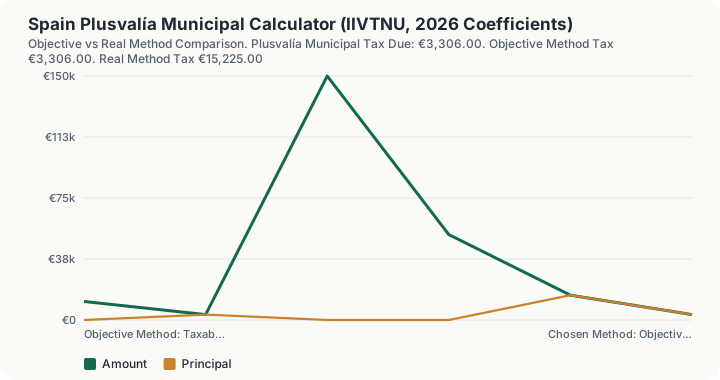
Quick Answer: Selling a Madrid property held for 8 years, with a €60,000 land-only cadastral value and a €150,000 real gain (35% attributable to land), owes €3,306 of plusvalía municipal under the objective method. That method wins because the real gain method would produce €15,225, a saving of €11,919. Spanish law lets you pick whichever costs less, and a sale at a loss owes €0 either way.
Overview
Plusvalía municipal (formally, the Impuesto sobre el Incremento de Valor de los Terrenos de Naturaleza Urbana, IIVTNU) is a municipal tax -- paid to the local ayuntamiento, not the national or regional government -- charged when urban land changes hands, based on how much the LAND (not the building) is deemed to have increased in value while you owned it.
This tax has a turbulent recent history. In 2021, Spain's Constitutional Court (STC 182/2021) struck down the old calculation system because it could tax a "gain" even when a property had genuinely LOST value -- a real problem during and after the 2008-2013 property crash. Real Decreto-ley 26/2021 rebuilt the tax from the ground up: it introduced two calculation methods, let the taxpayer choose whichever produces LESS tax, and -- critically -- created a genuine exemption when there is no real economic gain at all.
How This Is Calculated
Step 1: Check for a real gain. If your transfer value is less than or equal to your acquisition value, you owe nothing -- the transfer falls entirely outside the tax's scope. You must declare this and provide both sets of deeds to claim it.
Step 2: If there is a real gain, compute BOTH methods and take whichever is lower.
- Objective method: Taxable base = cadastral value of the LAND ONLY (not the building) at the time of transfer, × a coefficient that depends on how many complete years you held the property. The coefficient curve is unusual -- it is HIGHEST for very short holds (0.15 for under 1 year) and very long holds (0.40 for 20+ years), and LOWEST for a 12-15 year hold (0.09), because the underlying formula reflects assumed annual value growth compounding differently at different horizons.
- Real method: Taxable base = (transfer value − acquisition value) × the proportion that the land's cadastral value represents of the TOTAL (land + building) cadastral value. This isolates the portion of your actual, documented gain that is attributable to the land specifically, since only land value increases are taxed by this specific tax.
Step 3: Apply the municipal rate. Both methods' taxable base is multiplied by the SAME rate, set by your city's own ordinance up to a 30% legal maximum. This calculator uses representative rates for Madrid (29%), Barcelona (30%, the maximum), and Valencia (29.7%).
Step 4: Pay the lower of the two resulting tax amounts.
Worked Example
Madrid property, 8 years held, land cadastral value €60,000, sold for €350,000 (bought for €200,000), land = 35% of total cadastral value:
- Real gain check: €350,000 > €200,000, so the transfer IS subject to tax.
- Objective method: 8-year coefficient = 0.19. Taxable base = €60,000 × 0.19 = €11,400. Tax = €11,400 × 29% = €3,306.
- Real method: Gain = €350,000 − €200,000 = €150,000. Taxable base = €150,000 × 35% = €52,500. Tax = €52,500 × 29% = €15,225.
- Choose the cheaper method: €3,306 under the objective method against €15,225 under the real method, so the objective method applies and the saving from making the right election is €11,919. Note how much the choice is worth here: the objective method looks at a €60,000 land cadastral value while the real method looks at €52,500 of actual land gain, and the two bases are simply not close to each other.
- Objective method wins -- you pay €3,306, saving well over €10,000 versus the real method.
Contrast: a 22-year hold in Barcelona with only a modest real gain (bought for €250,000, sold for €260,000, land 35% of value): the objective method's 20+-year coefficient (0.40) produces a comparatively large taxable base regardless of your modest actual profit, while the real method captures only the true €10,000 gain -- so here the real method wins, at a small fraction of the objective method's tax.
What This Does Not Account For
- Every Spanish municipality's own exact rate. Only Madrid, Barcelona, and Valencia are included as representative examples (secondary-source corroborated, not pulled from each city's own ordinance document); every one of Spain's roughly 8,000 municipalities sets its own rate up to the 30% cap.
- Local bonifications for inherited primary residences. Many municipalities offer their OWN discretionary bonification (commonly up to 95%) when a primary residence passes to a direct descendant on death -- a completely separate, city-specific benefit not modeled here.
- The 2026 coefficient volatility. The government attempted to RAISE these coefficients twice recently (via Real Decreto-ley 9/2024 and, briefly, Real Decreto-ley 16/2025 for a few weeks in January 2026) -- both attempts were rejected by Congress and formally repealed, so the 2023 coefficient table (verified directly against BOE's current consolidated law text) is what applies today. This could change again with a future budget law.
- Documentation/verification disputes. Municipalities retain the right to challenge your declared acquisition/transfer values; this calculator assumes the figures you enter would be accepted as-is.
- Non-urban (rústica) land, which this tax does not apply to at all -- IIVTNU only taxes urban land value increases.
Common Pitfalls
- Not checking for the no-gain exemption first. If you sold at or below your purchase price, you owe nothing regardless of how the coefficient table or rate would otherwise compute -- but you must actively declare this with your deeds, it is not automatic.
- Assuming the objective method is mandatory. Since the 2021 reform, you have a genuine right to use whichever method is lower, provided you can document your actual transfer and acquisition values.
- Misunderstanding the coefficient curve's shape. It is easy to assume "longer hold = higher coefficient" throughout, but the actual curve dips to its LOWEST point around 12-15 years before rising again for very long holds -- a genuinely counterintuitive design that surprises many sellers.
- Using the building's cadastral value instead of the land's. The objective method uses ONLY the land portion of the cadastral value -- using the combined land+building figure will substantially overstate your tax.
- Assuming this tax was abolished. It was reformed, not eliminated -- the 2021 changes added the no-gain exemption and the dual-method choice, but the tax itself remains very much in force.
Frequently Asked Questions
Can I really choose whichever method gives me less tax?
What happens if I sell at a loss?
Why does the coefficient go UP again for very long holds (20+ years)?
Does the 30% rate apply everywhere?
Is this the same as capital gains tax?
Sources
- Spanish Tax Agency (Agencia Tributaria), the official authority for the national tax authority this calculator relates to. sede.agenciatributaria.gob.es
Also consulted: Real Decreto Legislativo 2/2004 (Ley Reguladora de las Haciendas Locales), Arts. 104-110, live consolidated text -- confirmed by direct read of boe.es, 2026-08-22: formula, dual-method system, no-real-gain non-subjection rule, and the 30% municipal rate cap (Art. 108.1, direct quote: "sin que dicho tipo pueda exceder del 30 por ciento"); Real Decreto-ley 26/2021, de 8 de noviembre (BOE núm. 268), following Constitutional Court ruling STC 182/2021: origin of the current dual-method system; Ley 31/2022 (Presupuestos Generales del Estado 2023): source of the coefficient table currently in force, confirmed directly against BOE's live consolidated text as still applicable today, after two later attempts to raise it (Real Decreto-ley 9/2024 and Real Decreto-ley 16/2025) were both rejected by Congress and formally repealed (the latter via a BOE resolution published 28 January 2026); City rates: Madrid (29%), Barcelona (30%), and Valencia (29.7%) corroborated via guiafiscal.es, 2026 -- secondary-source confidence; not independently pulled from each city's own ordenanza fiscal document.