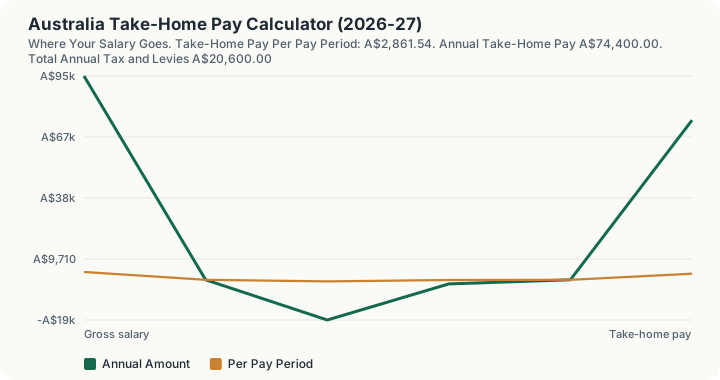
Quick Answer: On a gross salary of A$95,000 for 2026-27, paid fortnightly, with private hospital cover held, take-home pay is A$2,861.54 per fortnight: A$74,400.00 a year after A$18,720.00 of income tax and A$1,880.00 of Medicare levy.
What does this calculator do?
The most expensive misunderstanding in Australian salary packaging is that salary sacrifice reduces every income test the same way. It does not. Sacrificing into superannuation genuinely removes the sacrificed amount from assessable income, so income tax and the 2% Medicare levy both fall. But the Medicare levy surcharge is tested on income for surcharge purposes, and reportable employer superannuation contributions are added back into that figure. This calculator models that add-back explicitly: it computes income for surcharge purposes as taxable income plus the amount sacrificed, so a package designed to duck under a surcharge threshold does not, in fact, duck under it.
From 2026-27 a salary earner who claims nothing gets something anyway: s 25-130 of the ITAA 1997, inserted by Schedule 4 of the Treasury Laws Amendment (Tax Reform No. 1) Act 2026, tops work-related deductions up to A$1,000. On the A$95,000 default it takes taxable income to A$94,000 without a receipt being kept.
The surcharge tier thresholds are defined by reference to the Private Health Insurance Act 2007, which indexes them every year under s 22-45. The indexed amounts are published at privatehealth.gov.au; for 2026-27 the singles thresholds are A$105,000, A$123,000 and A$164,000, and those are the defaults here (editable for other years). On the defaults, hospital cover is held and no surcharge arises at all; even without cover, the A$94,000 default income is below the A$105,000 tier 1 threshold.
How is this calculated?
Using the defaults: gross salary A$95,000, fortnightly pay, 2026-27, Australian resident, no work-related deductions, no salary sacrifice, private hospital cover held, no spouse or dependants.
- Step 1: Reduce salary by any amount sacrificed to superannuation. A$95,000 - A$0 = A$95,000.00
- Step 2: Compute the standard deduction top-up (ITAA 1997 s 25-130(2)). The lesser of A$1,000 and assessable labour income, reduced by actual work-related deductions. min(A$1,000, A$95,000.00) - A$0 = A$1,000.00
- Step 3: Compute taxable income. A$95,000.00 - A$1,000.00 = A$94,000.00
- Step 4: Tax the 15% bracket (Income Tax Rates Act 1986 Sch 7 Pt I, 2026-27 table). (A$45,000 - A$18,200) x 15% = A$26,800 x 15% = A$4,020.00
- Step 5: Tax the 30% bracket. (A$94,000.00 - A$45,000) x 30% = A$49,000 x 30% = A$14,700.00
- Step 6: Sum the brackets for income tax before offsets. A$4,020.00 + A$14,700.00 = A$18,720.00
- Step 7: Apply the offsets. LITO cuts out above A$66,667 of taxable income, SAPTO is not engaged by this calculator, and the Working Australians tax offset is nil before 2027-28. A$18,720.00 - A$0.00 = A$18,720.00
- Step 8: Compute the Medicare levy (Medicare Levy Act 1986 s 6(1)). A$94,000 is above the A$35,013 phase-in limit, so the full 2% applies. A$94,000.00 x 2% = A$1,880.00
- Step 9: Compute income for surcharge purposes. Taxable income plus the amount salary sacrificed, which is added back as a reportable employer superannuation contribution. A$94,000.00 + A$0 = A$94,000.00
- Step 10: Compute the Medicare levy surcharge (Medicare Levy Act 1986 s 8B(1)(c)). Complying private patient hospital cover is held for the whole year, so no surcharge is imposed regardless of income. A$0.00
- Step 11: Total the tax and levies. A$18,720.00 + A$1,880.00 + A$0.00 = A$20,600.00
- Step 12: Compute annual take-home pay. Assessable salary, not gross salary, less total tax. A$95,000.00 - A$20,600.00 = A$74,400.00
- Step 13: Divide by the number of pay periods. Fortnightly is 26 pays. A$74,400.00 / 26 = A$2,861.54
Worked Example
Take a A$112,000 salary with no hospital cover and sacrifice A$10,000 into superannuation, hoping to get under the A$105,000 surcharge threshold, and the trap becomes arithmetic.
- Assessable salary: A$112,000 - A$10,000 = A$102,000.00.
- Standard deduction top-up: A$1,000.00. Taxable income: A$101,000.00, which is below A$105,000 on its own.
- Income tax: A$4,020.00 + (A$101,000 - A$45,000) x 30% = A$4,020.00 + A$16,800.00 = A$20,820.00.
- Medicare levy: A$101,000 x 2% = A$2,020.00.
- Income for surcharge purposes: A$101,000.00 + A$10,000 = A$111,000.00. The sacrifice is added straight back.
- That is above the A$105,000 tier 1 threshold but not above A$123,000, so tier 1 applies at 1%. The surcharge is charged on taxable income, not on income for surcharge purposes: A$101,000.00 x 1% = A$1,010.00.
Sacrificing A$10,000 cut income tax by A$3,000.00 and the levy by A$200.00, but the surcharge stayed: A$1,010.00 instead of the A$1,110.00 it would be on A$111,000 of taxable income without the sacrifice, a difference of only A$100.00. If sacrifice reduced surcharge income, the whole A$1,010.00 would have fallen away.
What does this calculator not account for?
- Surcharge thresholds for years other than 2026-27. The tier thresholds default to the 2026-27 figures whichever income year is selected; enter the published figures for another year (2025-26: A$101,000, A$118,000, A$158,000).
- A spouse's income in the surcharge test. Where a spouse or dependants are indicated, the doubled family thresholds are used, but they are tested against your own income for surcharge purposes rather than the couple's combined income.
- Tax inside the superannuation fund. Sacrificed contributions are taxed at 15% in the fund and can attract Division 293 tax. Neither is modelled, so the true cost of a sacrifice arrangement is higher than the income tax saving shown.
- PAYG withholding. This computes the annual assessment position divided by pay periods, not the amount your employer withholds each pay, which follows the ATO withholding schedules and usually differs.
- Study and training loan repayments. HELP and similar compulsory repayments are not deducted.
- SAPTO and spouse income. The seniors and pensioners offset is called with eligibility set to false, so it is always nil here; and where a spouse is indicated, your own taxable income is used as the family income figure for the levy.
- Other income and deductions. Only salary, work-related deductions and salary sacrifice are modelled. Investment income, rental losses and capital gains are not.
What mistakes do people make with this?
- Believing salary sacrifice avoids the surcharge. It does not. Reportable employer superannuation contributions are added back into income for surcharge purposes, which is why step 9 adds the sacrificed amount straight back on.
- Confusing the levy with the surcharge. The 2% Medicare levy is charged under s 6 on nearly everyone. The surcharge is an extra 1%, 1.25% or 1.5% charged only on people above a tier threshold who do not hold complying hospital cover.
- Buying extras-only cover. Only complying private patient hospital cover removes the surcharge. An extras policy does not.
- Comparing take-home pay against a package figure. The gross salary input excludes compulsory employer superannuation, so a A$95,000 salary is not a A$95,000 package.
- Expecting the fortnightly figure to match your payslip. Employer withholding follows the ATO schedules and is reconciled at assessment; this is the assessment result spread evenly.
Frequently Asked Questions
Why is the surcharge charged on taxable income rather than on the income tested?
Is there a surcharge on the default salary without cover?
Does the standard deduction help someone who already claims expenses?
What changes in 2027-28?
Sources
- Income Tax Rates Act 1986, series C2004A03348, Compilation No. 66, compilation date 1 July 2026, Schedule 7: legislation.gov.au/C2004A03348/latest/text
- Medicare Levy Act 1986, series C2004A03351, Compilation No. 53, compilation date 1 July 2026, ss 6, 7, 8 and 8B to 8D: legislation.gov.au/C2004A03351/latest/text
- Treasury Laws Amendment (Tax Reform No. 1) Act 2026, No. 49, 2026, Schedules 3 and 4: legislation.gov.au/C2026A00049/latest/text
- Income Tax Rates Amendment (Tax Reform No. 1) Act 2026, No. 50, 2026: legislation.gov.au/C2026A00050/latest/text
- Income Tax Assessment Act 1997, series C2004A05138, Compilation No. 266, ss 25-130, 61-115 and Subdiv 61-E: legislation.gov.au/C2004A05138/latest/text
- Private Health Insurance Ombudsman, Medicare Levy Surcharge income thresholds and rates (2026-27): privatehealth.gov.au/health_insurance/surcharges_incentives/medicare_levy.htm
Also consulted: Private Health Insurance Act 2007, series C2007A00031, ss 22-35, 22-40 and 22-45 (tier thresholds and their indexation):; Income Tax Assessment (1936 Act) Regulations 2025, F2025L01060:.