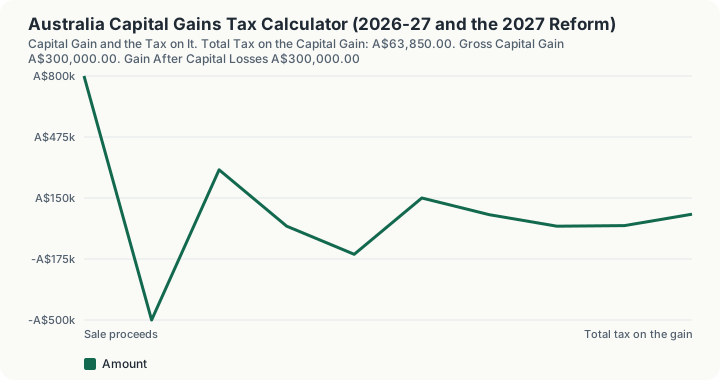
Quick Answer: An A$800,000 sale of an asset with an A$500,000 cost base, held over 12 months by a resident with A$120,000 of other income, attracts A$63,850.00 of tax in 2026-27: A$60,850.00 of ordinary income tax on the discounted A$150,000 net gain, plus A$3,000.00 of Medicare levy, with no Division 119 minimum tax.
What does this calculator do?
The 50% CGT discount has an expiry date, and it is 1 July 2027.
Treasury Laws Amendment (Tax Reform No. 1) Act 2026 (No. 49, 2026), assented 26 June 2026, does two separate things to capital gains from that date, and they are frequently conflated.
First, it withdraws the discount. Schedule 1 Part 1 item 28 rewrites ITAA 1997 s 115-100. New paragraph (aa) confines the individual 50% discount to "a CGT event happening before 1 July 2027". Item 29 then adds new paragraph (f): "0% if none of the above paragraphs applies to the gain." There is no taper and no transitional percentage. An ordinary asset sold on 30 June 2027 gets 50%; the same asset sold on 1 July 2027 gets nothing. Only two categories survive indefinitely: new residential dwellings under s 115-102 and affordable housing under s 115-125.
Second, it inserts Division 119, a 30% minimum rate. This is a floor, not a surcharge. Section 119-1 states the purpose as ensuring, before applying offsets, a rate of tax of 30% on the gains remaining after s 119-5. The s 119-10(2) method statement charges only the shortfall between 30% of the gain and the ordinary tax the gain already bears at the taxpayer's own marginal rates. A taxpayer already on the 37% or 45% rate has no shortfall and pays nothing extra. The Division bites only where a low marginal rate had brought the effective rate on the gain below 30%.
How is this calculated?
The order of operations is the ITAA 1997 s 102-5(1) method statement: capital losses come off before the discount. Inverting those two steps is the single most common error in this area, and it always understates the gain.
- Step 1: Work out the gross capital gain. A$800,000 - A$500,000 = A$300,000
- Step 2: Apply capital losses (s 102-5 steps 1 to 3), current year then carried forward. A$300,000 - A$0 - A$0 = A$300,000
- Step 3: Apply the s 115-100 discount percentage to the gain after losses. The event is in 2026-27, before 1 July 2027, the asset was held at least 12 months (s 115-25) and the taxpayer is a resident (ss 115-105, 115-110), so the percentage is 50%. A$300,000 x 50% = A$150,000 discount
- Step 4: Net capital gain added to taxable income. A$300,000 - A$150,000 = A$150,000
- Step 5: Total taxable income including the gain. A$120,000 + A$150,000 = A$270,000
- Step 6: Basic income tax liability on that total, at the 2026-27 resident rates, less the low income tax offset. LITO (ITAA 1997 s 61-115) is A$700 up to A$37,500 of taxable income and tapers to nil at A$66,667; it is non-refundable and reduces income tax only. At A$270,000 it is nil. (A$26,800 x 15%) + (A$90,000 x 30%) + (A$55,000 x 37%) + (A$80,000 x 45%) - A$0 = A$87,370
- Step 7: The same liability without the gain. At A$120,000 LITO is also nil. A$4,020 + (A$75,000 x 30%) - A$0 = A$26,520
- Step 8: Ordinary income tax attributable to the gain. A$87,370 - A$26,520 = A$60,850
For a lower earner the LITO matters. With A$30,000 of other income and a A$20,000 net capital gain, tax without the gain is A$1,770 - A$700 LITO = A$1,070, and with it A$5,520 - A$250 LITO = A$5,270, so the gain bears A$4,200: the A$3,750 of extra bracket tax plus A$450 of LITO it takes away. The calculator reports that lost offset separately. LITO is applied only on the Australian resident option. A temporary resident who is an Australian resident for tax purposes is entitled to it, so on the "foreign or temporary resident" option the tax for such a person is slightly overstated.
- Step 9: Division 119 minimum tax gap amount. The Division applies only from 2027-28, so for this year it is nil. A$0
- Step 10: Medicare levy attributable to the gain, at the 2% s 6(1) rate on the extra taxable income. A$150,000 x 2% = A$3,000
- Step 11: Total tax on the gain. A$60,850 + A$0 + A$3,000 = A$63,850.00
Worked Example
Take the same A$300,000 gross gain into 2027-28 with no other income, and shrink it to A$100,000 so the Division 119 floor actually bites.
- The discount is gone. New s 115-100(f) gives 0%, so the whole A$100,000 is the net capital gain.
- Step 1 of s 119-10(2): 30% of the minimum tax capital gain. A$100,000 x 30% = A$30,000
- Step 2: basic income tax liability on the full taxable income, at the 2027-28 rates where the first marginal rate is 14%. (A$26,800 x 14%) + (A$55,000 x 30%) = A$3,752 + A$16,500 = A$20,252
- Step 3: the same liability with taxable income reduced by the gain, but not below nil. Tax on A$0 = A$0
- Step 4: the ordinary tax the gain already bears. A$20,252 - A$0 = A$20,252
- Step 5: the shortfall against the 30% floor. A$30,000 - A$20,252 = A$9,748
- Steps 6 and 7: round down to whole dollars; if positive, that is the minimum tax gap amount. A$9,748
- Total tax on the gain. A$20,252 + A$9,748 = A$30,000, which is exactly 30% of the gain, and exactly what the Division exists to guarantee.
What does this calculator not account for?
- The s 102-6 residential apportionment. Act No. 49 of 2026 also splits a gain into a "residential capital gain" and a "non-residential capital gain" by counting residential-accommodation days over the post-July-2027 ownership period. That is real law. This engine does not take a per-asset day history and does not perform the apportionment, so a gain on a dwelling that changed use after 1 July 2027 is not modelled.
- The main residence exemption, small business CGT concessions, rollovers, and the CGT treatment of collectables and personal use assets.
- Cost base composition. The cost base is taken as entered. The engine does not build it up from the ITAA 1997 s 110-25 elements or test whether holding costs qualify.
- The Medicare levy surcharge for people without private hospital cover (2026-27 singles tiers from A$105,000; see the Medicare levy surcharge calculator). Only the 2% levy itself is applied here.
What mistakes do people make with this?
- Applying the discount before capital losses. With a A$300,000 gain and a A$100,000 loss the correct order gives A$200,000 then 50%, so A$100,000. Discounting first gives A$150,000 less A$100,000, so A$50,000, understating the gain by half.
- Reading Division 119 as a 30% surcharge. It adds nothing to a taxpayer whose gain is already taxed above 30%. On the default figures it contributes A$0.
- Assuming the discount survives for anything held long enough. The test in new s 115-100(aa) is the date of the CGT event, not the holding period. Twenty years of ownership does not preserve it past 1 July 2027.
- Forgetting the Medicare levy. The gain lifts taxable income, and the levy follows it. A$3,000 of the A$63,850 default result is levy, not income tax.
Frequently Asked Questions
Does the 50% discount still apply in 2026-27?
Is Division 119 an extra tax on top of my marginal rates?
Which assets keep the discount after 1 July 2027?
Do capital losses reduce the amount Division 119 looks at?
Can Division 119 be switched off entirely?
Sources
- Treasury Laws Amendment (Tax Reform No. 1) Act 2026 (No. 49, 2026), Schedule 1: legislation.gov.au/C2026A00049/latest/text
- Income Tax Assessment Act 1997, Divisions 102, 115 and 119: legislation.gov.au/C2004A05138/latest/text
- Income Tax Rates Act 1986, Schedule 7 Part I and s 12AA: legislation.gov.au/C2004A03348/latest/text
- Income Tax Rates Amendment (Tax Reform No. 1) Act 2026 (No. 50, 2026): legislation.gov.au/C2026A00050/latest/text
- Medicare Levy Act 1986, s 6: legislation.gov.au/C2004A03351/latest/text
All figures were read from authorised text on the Federal Register of Legislation.