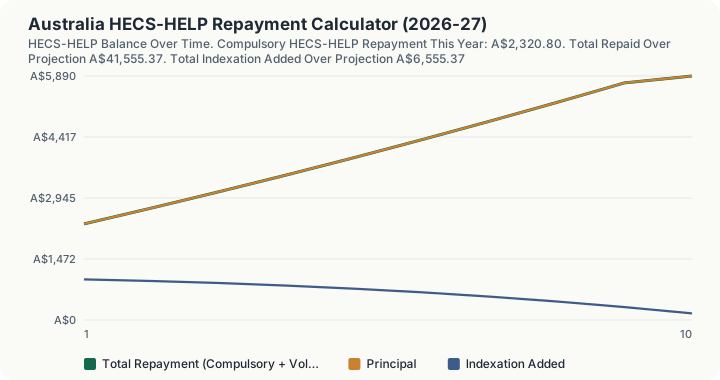
Quick Answer: With a A$35,000 HECS-HELP balance and A$85,000 of repayment income for 2026-27, compulsory repayment for the year is A$2,320.80 (15% on the A$15,472 above the A$69,528 threshold). Projected forward 10 years with 3% annual income growth and no extra voluntary repayments, this debt is fully repaid within the 10-year horizon.
Overview
HECS-HELP is Australia's income-contingent student loan system for university tuition. Unlike a conventional loan, there's no interest charged in the traditional sense -- instead, the outstanding balance is indexed once a year (1 June) to reflect changes in the cost of living, and repayment is entirely determined by your income, deducted automatically through the tax system once your "repayment income" (broadly, taxable income plus certain add-backs like reportable fringe benefits and net investment losses) crosses a threshold.
The system changed significantly from 1 July 2025. Previously, HECS-HELP used roughly 19 flat-rate tiers applied to your WHOLE repayment income at once -- crossing a threshold by even one dollar could push your entire income into a higher flat rate, producing sharp "cliff" effects where a small pay rise could actually reduce your take-home pay. The new marginal system applies rates only to the portion of income within each band, exactly like income tax brackets, eliminating those cliffs. This calculator models the current marginal system and projects your balance forward year by year, accounting for annual indexation and any voluntary extra repayments you choose to make.
How This Is Calculated
- Repayment income. Broadly your taxable income, plus reportable fringe benefits, net investment losses, exempt foreign income, and reportable super contributions.
- Compulsory repayment (marginal system, effective 1 July 2025). For 2026-27: 0% below A$69,528; 15% on the portion between A$69,528 and A$129,717; 17% (plus a fixed base amount) on the portion between A$129,717 and A$186,051; and a flat 10% of your TOTAL repayment income above A$186,051 (a deliberate cap, not a continuation of the marginal stack -- at the boundary, the marginal formula and the flat 10% figure coincide almost exactly).
- Annual indexation. Each 1 June, your outstanding balance is indexed by the LOWER of CPI (to the March quarter) or the Wage Price Index (to the December quarter) -- a rule change backdated to 1 June 2023 specifically to prevent indexation from outpacing wage growth.
- Balance projection. Each year in the projection: indexation is applied first to the opening balance, then the compulsory repayment (based on that year's repayment income) plus any voluntary extra repayment reduces the balance, with income growing at your assumed annual rate for the following year.
Worked Example
Using the calculator's default inputs (A$35,000 opening balance, A$85,000 repayment income, 3% income growth, 10-year projection, no voluntary repayments):
- Repayment income above the A$69,528 threshold: 85,000 − 69,528 = A$15,472.
- Compulsory repayment this year: 15,472 × 15% = A$2,320.80.
- Projecting forward with 2.8% annual indexation (the 2026 rate) and 3% income growth, the debt is fully paid off within the 10-year projection horizon.
- In year 1 specifically, indexation adds A$980.00 to the opening balance before the A$2,320.80 repayment is applied, leaving a year-end balance of approximately A$33,659.20.
Below the Threshold
Someone with A$60,000 of repayment income owes A$0.00 in compulsory repayment for 2026-27, since this falls entirely under the A$69,528 threshold.
A Higher Earner, Old System vs. New System
At A$150,000 of repayment income, this year's compulsory repayment under the current marginal system is A$12,476.46 -- lower than the A$12,950.00 that the same income would have owed under the OLD flat-rate-on-whole-income system, illustrating the marginal system's design goal of reducing repayments for people just above key thresholds.
Indexation and Repayments Racing Each Other
A HECS-HELP balance moves twice a year in opposite directions, and the first year alone does not show which side is winning.
Step 1 -- Year 1. Indexation adds A$980.00, the compulsory repayment removes A$2,320.80, closing at A$33,659.20
Step 2 -- Year 2. Indexation adds A$942.46 on the smaller balance, the repayment rises with income to A$2,703.30, closing at A$31,898.36
Step 3 -- Repaid after two years. A$2,320.80 + A$2,703.30 = A$5,024.10
Step 4 -- Indexation added over the same two years. A$980.00 + A$942.46 = A$1,922.46
Step 5 -- The full ten-year projection. Repayments total A$41,555.37, indexation adds A$6,555.37, and the balance reaches A$0.00
Two years of repayments moved the balance down by only A$3,101.64, because indexation clawed back A$1,922.46 of the A$5,024.10 paid. That ratio improves every year as income growth lifts the repayment and the shrinking balance attracts less indexation, but over the whole ten years A$6,555.37 of the A$41,555.37 repaid never touched the original A$35,000 debt. Indexation is applied before the compulsory repayment is credited, which is why the first years look so unrewarding.
What This Does Not Account For
- The exact FBT/gross-up figures used elsewhere in this platform's Australia calculators are unrelated to HECS-HELP -- this calculator's own figures (repayment thresholds, indexation rate, the one-off 20% balance reduction) come from a distinct source set, cross-corroborated across 5 independent sources including a direct fetch of H&R Block's published guide.
- The one-off 20% reduction applied to HELP balances as they stood immediately before the 1 June 2025 indexation is a real, widely-reported 2025 federal measure, but relies on a single corroborating secondary source in this build's research -- flagged as lower confidence than the repayment-threshold figures themselves. This calculator does not automatically apply that one-off historical reduction to your CURRENT balance input; enter your balance as it stands today.
- Multiple concurrent HELP-family loans (HECS-HELP alongside FEE-HELP, VET Student Loans, etc., which share the same repayment threshold system but are separate debts) are not modeled -- this calculator treats your input as a single combined balance.
- Repayment income's exact add-back components (reportable fringe benefits, net investment losses, exempt foreign income) are not separately itemized -- enter your already-calculated repayment income directly.
- Overseas repayment obligations for HECS-HELP debtors living abroad, which follow a parallel but separate reporting and repayment regime, are out of scope.
- Voluntary repayments do not receive any bonus or discount under current rules (a historical voluntary-repayment bonus was abolished some years ago) -- this calculator correctly applies voluntary repayments dollar-for-dollar with no bonus.
Common Pitfalls
- Assuming HECS-HELP charges "interest" like a normal loan. It doesn't -- the balance is indexed once a year to broadly track cost-of-living changes, not charged interest at a market rate.
- Forgetting the marginal system replaced the old flat-rate tiers in 2025. If you're recalling how HECS-HELP repayments worked before 1 July 2025, the old system could produce a genuine pay cut from crossing a threshold -- the current system eliminates that specific problem.
- Confusing the repayment threshold with a tax-free threshold. Below the HECS-HELP repayment threshold, you owe nothing on your student debt specifically, but you may still owe ordinary income tax on the same income.
- Not accounting for indexation when estimating how fast your debt will shrink. Indexation adds to your balance every year before your repayment reduces it -- in a low-income year, indexation can actually outpace your repayment, temporarily growing the balance.
- Assuming voluntary repayments earn a discount. They don't under current rules -- a voluntary extra repayment reduces your balance dollar-for-dollar, with no bonus multiplier.
Frequently Asked Questions
Is HECS-HELP the same as FEE-HELP or other HELP loans?
Why did the repayment system change in 2025?
How is HELP debt indexation calculated?
Do I have to make repayments if I'm not currently working?
Can I pay off my HECS-HELP debt faster with voluntary repayments?
Sources
- atotaxcalculator.com.au "HECS Debt Indexation 2026," fetched directly, for the lower-of-CPI-or-WPI indexation rule (backdated to 1 June 2023) and the current 2026 indexation rate. bls.gov/cpi
- Internal Revenue Service, the official authority for the tax rules this calculator relates to. irs.gov
Also consulted: H&R Block Australia's "Tax Academy: Understanding HECS-HELP" guide, fetched directly, cross-corroborated against 4 independent secondary sources (income-tax-calculator.com.au, austax.tools, taxbne.com.au, accountantplus.com.au), for the 2025-26 and 2026-27 marginal repayment thresholds and rates; atotaxcalculator.com.au, for the one-off 20% HELP balance reduction applied before the 1 June 2025 indexation (a single-source, lower-confidence figure -- see the caveat above).