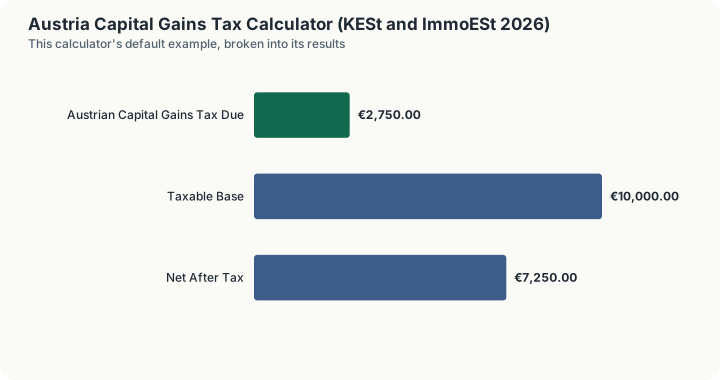
Quick Answer: A €10,000 gain on shares bought in 2011 or later owes €2,750 of Kapitalertragsteuer, a flat 27.5% withheld at source with no tax-free allowance at all. The same gain on shares bought on or before 31 December 2010 owes €0, because that Altbestand remains fully exempt. Real estate is a separate regime, taxed at a flat 30% on a base that depends on acquisition date.
Overview
Austria does not have a single capital gains tax. It has two flat-rate regimes that share almost nothing beyond the name, and the one that applies to you depends entirely on what you sold.
Securities -- shares, fund units, and the dividends they throw off -- fall under Kapitalertragsteuer (KESt) at a flat 27.5%. It is a final withholding tax (Endbesteuerung): your Austrian bank deducts it at source and the income never appears on a tax return. And there is no annual exempt amount. Unlike Germany's €1,000 Sparer-Pauschbetrag or the UK's annual exempt amount, Austria taxes the first euro of gain exactly like the ten-thousandth.
This calculator models shares and fund units only. Bonds and other Forderungswertpapiere (debt securities) use the same 27.5% rate but a different Altbestand/Neubestand cutoff date (31 March 2012, not 31 December 2010) -- see "What This Does Not Account For."
Real estate falls under Immobilienertragsteuer (ImmoESt) at a flat 30%. Here the tax turns on a single date -- 31 March 2002 -- which splits property into two regimes with completely different arithmetic. For property acquired after that date (Neuvermögen), you pay 30% of the actual gain. For property acquired on or before it (Altvermögen), what you actually paid is irrelevant: the law substitutes a deemed acquisition cost of 86% of the sale price, leaving a taxable base of 14% and an effective tax of just 4.2% of gross proceeds.
Each regime also has its own escape hatch. Securities bought on or before 31 December 2010 ("Altbestand") predate the 2011 KESt reform and their disposal gains are still completely tax-free in 2026. Real estate that served as your main home can qualify for the Hauptwohnsitzbefreiung, which exempts the entire gain regardless of size or regime.
This calculator handles both regimes with an asset-type selector, because the practical question -- "what will Austria take from this sale?" -- is the same question, even though the machinery behind the answer is not.
How This Is Calculated
Securities (KESt, §27 Abs 3 / §27a EStG):
The gain is your net figure for the calendar year: sale proceeds minus acquisition cost, after offsetting losses realized on other securities in the same year.
Real estate (ImmoESt, §30 / §30a EStG):
| Regime | Acquisition Date | Acquisition Cost Used | Taxable Base | Effective Tax |
|---|---|---|---|---|
| Neuvermögen | After 31 Mar 2002 | Actual cost paid | Sale price − actual cost | 30% of the gain |
| Altvermögen | On/before 31 Mar 2002 | Deemed: 86% of sale price | 14% of sale price | 4.2% of sale price |
| Altvermögen, rezoned after 1987 | On/before 31 Mar 2002 | Deemed: 40% of sale price | 60% of sale price | 18% of sale price |
The rezoning variant catches windfall gains: land reclassified as building land (Umwidmung) after 31 December 1987 typically multiplied in value, so the law shrinks the deemed cost from 86% to 40% to capture more of that uplift.
The Hauptwohnsitzbefreiung overrides both real estate regimes and exempts the entire gain if either test is met:
- The 2-year rule: the property was your continuous main residence from acquisition until sale, for at least 2 years. This test does not apply to property you received by gift or inheritance.
- The 5-out-of-10-years rule: the property was your main residence for at least 5 years within the last 10 years before the sale. This test does apply to gifted and inherited property.
Both require that you actually give up the main residence promptly after the sale -- the exemption is for people moving house, not for landlords with a paper claim to residence.
Worked Example
Securities, Neubestand, €10,000 gain: 1. Realized gain: €10,000 2. No allowance is deducted -- the full amount is taxable 3. €10,000 × 27.5% = €2,750 KESt, withheld at source by the bank 4. Net gain retained: €7,250
Securities, Altbestand (bought 2009), €10,000 gain: The shares were acquired before 1 January 2011, so the disposal gain falls outside the §27 Abs 3 regime entirely. Tax: €0. Net gain retained: the full €10,000.
Real estate, Altvermögen, sold for €500,000, never rezoned: 1. Deemed acquisition cost: 86% × €500,000 = €430,000 2. Taxable base: €500,000 − €430,000 = €70,000 3. ImmoESt: €70,000 × 30% = €21,000 4. Effective rate: €21,000 ÷ €500,000 = 4.2% of the sale price 5. Net proceeds: €479,000
Note what did not enter this calculation: what the seller actually paid in, say, 1994. For Altvermögen it makes no difference whatsoever -- the tax is a fixed 4.2% skim off the top of the sale price.
Real estate, Neuvermögen, bought €300,000, sold €420,000: 1. Actual gain: €420,000 − €300,000 = €120,000 2. ImmoESt: €120,000 × 30% = €36,000 3. Net proceeds: €384,000
That is 8.6% of the gross sale price -- more than double the Altvermögen burden on a larger sale, which is exactly why the 31 March 2002 cutoff matters so much to Austrian property sellers.
What This Does Not Account For
- Bonds and other debt securities (Forderungswertpapiere). This calculator's Altbestand/Neubestand toggle uses the shares/fund-units cutoff (31 December 2010 / 1 January 2011). Bonds and certificates use a different cutoff -- 31 March 2012 -- with securities acquired between 1 October 2011 and 31 March 2012 treated as old-style Spekulationsgeschäfte regardless of when they're sold. If you're selling a bond bought in that window, do not rely on this calculator's Altbestand/Neubestand selector; the 27.5% rate itself is the same, but the exemption cutoff is not.
- The Regelbesteuerungsoption, an election to have securities income taxed at your ordinary progressive rate instead of the flat 27.5%. It only helps taxpayers whose marginal rate is below 27.5%, and it applies to all your capital income at once, not selectively.
- The Budgetbegleitgesetz 2027-2028 ImmoESt change, now enacted as BGBl. I Nr. 62/2026: it cuts the Altvermögen flat-rate deemed acquisition cost from 86% to 80% (effective rate 4.2% to 6% of the sale price) and the rezoned-land figure from 40% to 30% (18% to 21%). It first applies to disposals after 31 December 2026, so it does not touch a 2026 sale and is deliberately excluded here.
- The 1% shareholding test on the Altbestand exemption. Shares acquired on or before 31 December 2010 are exempt only where the holding was under 1% of the issuing company. A pre-2011 Beteiligung of 1% or more was already taxable under the old §31 EStG and remains inside the 27.5% regime, so the calculator's Altbestand option would understate the tax for such a holding.
- The 31 March 1997 variant of the Altvermögen cutoff. The general rule is that Altvermögen is property that was no longer taxable on 31 March 2012, which for most private holdings means acquisition on or before 31 March 2002 under the ten-year Spekulationsfrist. Where a fifteen-year Frist applied, because Herstellungsaufwendungen had been written off in Zehntel- or Fünfzehntelabsetzungen, the corresponding date is 31 March 1997. The calculator uses the ten-year case.
- Herstellerbefreiung and other §30 Abs 2 exemptions -- the exemption for self-built buildings, for expropriation proceedings, and for certain land-consolidation transfers.
- Inflation adjustment (Inflationsabschlag), abolished for disposals from 1 January 2016 and not available in 2026 for any holding period.
- Deductible costs on a Neuvermögen sale beyond the acquisition cost you enter -- notary fees, the Grunderwerbsteuer paid on purchase, capitalized improvement expenditure, and the ImmoESt-Selbstberechnung fee can all adjust the base. Enter your fully-loaded cost basis rather than the bare purchase price.
- Depreciation recapture for property that was previously rented out -- prior AfA deductions increase the taxable gain on sale.
- Foreign-broker holdings, where no Austrian KESt is withheld at source and the gains must be declared on your own tax return at the same 27.5% rate (Sondersteuersatz) instead.
- Corporate sellers, whose real estate and securities gains fall under Körperschaftsteuer rather than these private-investor regimes.
- Double taxation treaty relief on foreign securities or foreign real estate.
Common Pitfalls
- Expecting a tax-free allowance on securities. There isn't one. Austrian investors coming from Germany's Sparer-Pauschbetrag or the UK's annual exempt amount consistently over-estimate their net return -- Austria taxes from the first euro.
- Assuming Altbestand exemption survives a switch of holdings. The 2010 cutoff attaches to the specific securities, not to the account. Selling pre-2011 shares and reinvesting the proceeds creates Neubestand, and that exemption is gone for good. It is a one-way door.
- Applying the actual purchase price to an Altvermögen property. The whole point of the Altvermögen regime is that the statutory 86% deemed cost replaces your real figures. Entering a genuine 1990s purchase price and computing 30% of the real gain will vastly over-state the tax.
- Treating the Hauptwohnsitz 2-year rule as available for inherited property. It is not. An inherited home only qualifies through the 5-out-of-10-years route, which requires the heir themselves to have lived there.
- Forgetting to actually vacate. Both Hauptwohnsitz variants require giving up the main residence promptly after the sale. Selling to an investor and staying on as a tenant defeats the exemption.
- Expecting to carry securities losses forward. Austrian private investors cannot. Losses offset only same-category securities gains realized in the same calendar year -- an unused loss simply expires on 31 December.
- Trying to offset a property loss against share gains. The two regimes are strictly ring-fenced. A real estate loss can only reach rental and lease income, and then only 60% of it, spread over 15 years (or claimed fully in the year of sale by election).
- Overlooking the rezoning trap. Inherited farmland or plot land rezoned as building land after 1987 is taxed at 18% of the sale price, not 4.2% -- a factor-of-four difference that surprises sellers who only know the headline Altvermögen number.
Frequently Asked Questions
Is there really no tax-free allowance on Austrian securities gains?
My shares were bought in 2009. Are they genuinely still tax-free in 2026?
Why is a €500,000 Altvermögen sale taxed less than a €420,000 Neuvermögen sale?
Does the Hauptwohnsitzbefreiung apply to Altvermögen as well as Neuvermögen?
Can I offset a loss on shares against a gain on my property, or vice versa?
What is the rezoning (Umwidmung) rule and how do I know if it applies to me?
Do I need to file anything, or is the tax handled automatically?
Does the 2027 reform change my 2026 sale?
Sources
- bmf.gv.at, Besteuerung von Kapitalvermögen -- Substanzgewinne (Austrian Federal Ministry of Finance) -- the flat 27.5% KESt rate on securities gains and dividends, its status as a final withholding tax (Endbesteuerung), the absence of any general allowance, and the Altbestand/Neubestand split at 31 December 2010. bmf.gv.at
Also consulted: EStG §27 Abs 3 and §27a (Einkommensteuergesetz 1988) -- the statutory basis for the securities regime introduced by the Budgetbegleitgesetz 2011, and the Sondersteuersatz applying to undeclared foreign-broker holdings; EStG §30 and §30a -- the flat 30% Immobilienertragsteuer, the 31 March 2002 Altvermögen/Neuvermögen cutoff, the 86% statutory deemed acquisition cost, and the reduced 40% deemed cost for land rezoned to building land after 31 December 1987; EStG §30 Abs 2 Z 1 -- the Hauptwohnsitzbefreiung, both the "at least 2 years continuously from acquisition" variant (unavailable for gifted or inherited property) and the "5 years within the last 10" variant (available regardless of how the property was acquired), each conditional on giving up the main residence promptly after the sale; EStG §27 Abs 8 and §30 Abs 7 -- the Verlustausgleich restrictions: same-year, same-category offsetting only for securities with no private-investor carryforward, and the 60%-over-15-years ring-fenced treatment of real estate losses against rental and lease income; Verification note (28 August 2026): the 27.5% KESt rate, the 31 December 2010 Altbestand cutoff with its 1% shareholding limit, the 30% ImmoESt rate, and the 86% and 40% deemed acquisition costs were re-checked against BMF and WKO guidance and are unchanged for 2026. The Budgetbegleitgesetz 2027-2028 (BGBl. I Nr. 62/2026) has since cut those deemed costs to 80% and 30% for disposals after 31 December 2026; that is confirmed but out of scope for a 2026 sale and is not modeled.