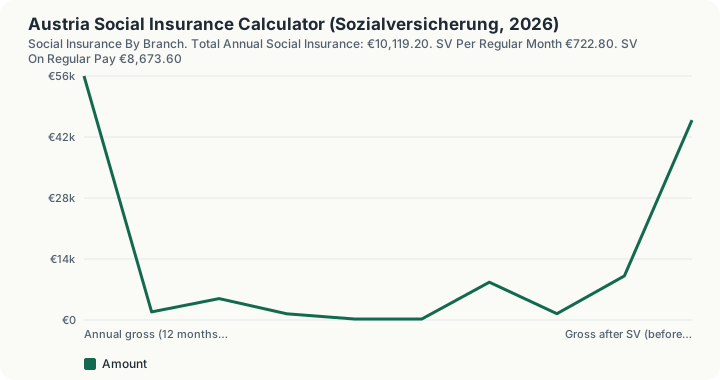
Quick Answer: A €4,000 regular monthly gross with the usual two special payments carries €10,119.20 of employee social insurance (Dienstnehmeranteil) across 2026: €722.80 out of each of the twelve ordinary payslips, or €8,673.60, plus €1,445.60 charged on the 13th and 14th salaries. That is 18.07% of the €56,000 annual gross, leaving €45,880.80 to go forward into the Lohnsteuer calculation.
What does this calculator do?
Austrian payslips deduct social insurance (Sozialversicherung, SV) before income tax, and the employee share is split across five named branches: Krankenversicherung (health), Pensionsversicherung (pension), Arbeitslosenversicherung (unemployment), the Arbeiterkammerumlage (Chamber of Labour levy) and the Wohnbauförderungsbeitrag (housing subsidy levy). Accident insurance (Unfallversicherung) exists but is charged entirely to the employer, so it does not appear in an employee deduction at all.
Two features make Austria awkward to estimate with a single "gross times rate" multiplication, and both are modelled here.
The first is the 14-payment year. Almost every Austrian collective agreement provides a 13th salary (Urlaubsgeld, holiday pay) and a 14th (Weihnachtsgeld, Christmas pay). These are not simply extra months bolted onto the regular base. They carry their own separate annual contribution ceiling of €13,860 for 2026, entirely independent of the €6,930 monthly ceiling that applies to regular pay. A calculator that adds the 13th and 14th to annual gross and applies one ceiling will get the wrong answer for anyone near either limit.
The second is the tapered unemployment-insurance rate. Arbeitslosenversicherung is not a flat 2.95% for everyone. It runs on a four-step scale by monthly gross: 0% up to €2,225, 1% up to €2,427, 2% up to €2,630, and the full 2.95% above that. A low earner therefore faces a materially lower total contribution rate than the headline 18.07%.
How is this calculated?
The employee contribution rate is the sum of five branch rates, with only the unemployment component varying by income:
r_DN = 3.87% + 10.25% + r_AV(Gₘ) + 0.50% + 0.50%
and the annual charge applies that rate to two separately capped bases:
SV_annual = 12 × r_DN × min(Gₘ, 6,930) + r_DN × min(S, 13,860)
where Gₘ is regular monthly gross and $S$ is the total of the special payments.
Step 1: Establish the special payments from the monthly gross. The calculator does not ask for a separate amount. It multiplies the regular monthly gross by the number of special payments you select (0, 1 or 2), on the standard assumption that each is worth one month's salary.
Step 2: Pick the unemployment-insurance rate from the four-step scale. The step is chosen on the uncapped regular monthly gross, before any ceiling is applied. Up to €2,225 the rate is 0%; up to €2,427 it is 1%; up to €2,630 it is 2%; above €2,630 it is 2.95%.
Step 3: Add the five branch rates into the total employee rate. 3.87% + 10.25% + the rate from Step 2 + 0.50% + 0.50%.
Step 4: Cap the regular monthly base. Take the lower of the regular monthly gross and the €6,930 monthly Höchstbeitragsgrundlage. Every euro of monthly pay above that ceiling carries no social insurance at all.
Step 5: Charge the regular months. Capped monthly base times the total rate gives one month's deduction; multiply by twelve for the year.
Step 6: Cap the special payments separately. Take the lower of the total special payments and the €13,860 annual Sonderzahlungen ceiling. This ceiling is applied to the special payments on their own; it is never combined with the monthly one.
Step 7: Charge the special payments at the same rate. The capped special-payment base times the same total rate from Step 3.
Step 8: Add the two charges. Regular annual SV plus special-payment SV is the headline figure.
Step 9: Split the regular charge into named branches. For the by-branch table, each branch rate is applied to the capped monthly base and multiplied by twelve. Note that these five branch rows describe the regular twelve months only; the special-payment charge is shown as its own separate row rather than being redistributed across the branches.
Step 10: Report the effective rate and the residual gross. Total SV divided by annual gross gives the effective rate, which falls below the nominal rate as soon as either ceiling binds. Annual gross minus total SV is the figure that goes forward to income tax.
Worked Example
A salaried employee (Angestellte) earns €4,000 per month with the customary Urlaubsgeld and Weihnachtsgeld.
Step 1: Special payments. €4,000 x 2 = €8,000 per year
Step 2: Annual gross. (€4,000 x 12) + €8,000 = €56,000
Step 3: Unemployment-insurance rate. €4,000 is above the €2,630 top step, so the rate is 2.95%
Step 4: Total employee contribution rate. 3.87% + 10.25% + 2.95% + 0.50% + 0.50% = 18.07%
Step 5: Capped regular monthly base. min(€4,000, €6,930) = €4,000
Step 6: One month's deduction. €4,000 x 18.07% = €722.80
Step 7: Twelve regular months. €722.80 x 12 = €8,673.60
Step 8: Capped special-payment base. min(€8,000, €13,860) = €8,000
Step 9: Contribution on the 13th and 14th salaries. €8,000 x 18.07% = €1,445.60
Step 10: Total annual social insurance. €8,673.60 + €1,445.60 = €10,119.20
Step 11: Gross after SV. €56,000 - €10,119.20 = €45,880.80
Step 12: Effective rate. €10,119.20 / €56,000 = 18.07%, identical to the nominal rate here because neither ceiling binds at this salary.
The branch split of the €8,673.60 regular charge is Krankenversicherung €1,857.60, Pensionsversicherung €4,920.00, Arbeitslosenversicherung €1,416.00, Arbeiterkammerumlage €240.00 and Wohnbauförderungsbeitrag €240.00. Pension is by far the largest single branch, at more than half the total.
What does this calculator not account for?
- Income tax (Lohnsteuer) is not calculated here at all. This page stops at the social insurance line. The "Gross After SV" figure is what feeds the income-tax calculation, not a net salary.
- The employer's contributions are excluded. Austrian employers pay a substantial separate set of charges, including accident insurance (Unfallversicherung), which is employer-only and therefore appears nowhere in these figures.
- Vienna's higher Wohnbauförderungsbeitrag is not modelled. The primitive uses the national-standard 0.50% rate that appears in the Dachverband tariff table. Vienna raised its levy to 0.75% per side from 1 January 2026 (Landesgesetzblatt für Wien 2025/73; wien.gv.at/wohnen/wohnbaufoerderungsbeitrag), and this calculator does not apply that higher Vienna rate, so a Vienna employee's deduction is 0.25% of the contribution base too low.
- The special payments are assumed to equal one month's gross each. There is no field to enter a different amount, so a contract with a partial or performance-linked 13th salary will be overstated or understated.
- Special payments are assumed to be paid at the same rate as the regular months. The tiered AV rate is selected once, from the regular monthly gross, and then applied to both bases.
- The Jahressechstel taxation of the 13th and 14th salaries is not applied here. Special payments enjoy a preferential income-tax treatment under §67 EStG, but that is an income-tax rule, not a social insurance one, and it does not change the SV charge on this page.
- Contribution-free and reduced-contribution statuses are ignored. Geringfügige Beschäftigung (marginal employment), apprentices, pensioners, civil servants under separate schemes and self-employed people under GSVG or SVS all follow different rules from the ASVG employee rates used here.
- The pension-branch rate is applied to everyone. Employees above statutory retirement age who continue working, and others with branch-specific exemptions, are not distinguished.
What mistakes do people make with this?
- Adding the 13th and 14th salaries to the monthly base. They have their own €13,860 annual ceiling. Combining the bases and applying a single ceiling is the most common way to get an Austrian SV estimate wrong, and it goes wrong in both directions depending on which side of the ceilings you sit.
- Assuming 18.07% applies to everyone. Below €2,630 a month the unemployment component is reduced or absent, so the total rate falls to as little as 15.12%. The taper is set on the uncapped monthly gross, so it never applies to someone whose pay only falls below the threshold after a cap.
- Expecting the ceiling to cut the tax bill too. Pay above €6,930 per month is free of social insurance, but it is fully liable to income tax at up to 55%. The effective SV rate falls with every extra euro; the effective total burden does not.
- Treating the Arbeiterkammerumlage as optional. The 0.5% Chamber of Labour levy is compulsory for employees and appears on the payslip whether or not you use the Chamber's services.
- Confusing the employee rate with the total cost of employment. The 18.07% here is the employee's share only. Total Austrian labour cost is far higher once employer contributions, Dienstgeberbeitrag and communal tax are added.
- Reading "Gross After SV" as take-home pay. It is the taxable base before Lohnsteuer, so the real net figure is considerably lower.
Frequently Asked Questions
Why do the 13th and 14th salaries have a separate ceiling?
At what salary do I stop paying more social insurance?
Why is my unemployment insurance zero?
Does this figure include income tax?
Which branch takes the most?
What happens if my contract has no 13th or 14th salary?
Sources
- Austrian Federal Ministry of Finance, the official authority for the national tax authority this calculator relates to. bmf.gv.at
The rates come from the Dachverband's 2026 tariff table and the ÖGK's 2026 contribution values.
Also consulted: Dachverband der österreichischen Sozialversicherungen, "Tarifsystem für Dienstgeberinnen und Lohnverrechnerinnen", Stand 19 September 2025, gültig ab 1 Jänner 2026, the primary source for the employee (DN) branch rates: KV 3.87%, PV 10.25%, AV 2.95% base, UV 0.00% (employer-only), AK 0.50%, WF 0.50%, total 18.07%; Österreichische Gesundheitskasse (ÖGK), "Veränderliche Werte 2026", oegk.at, the primary source for the 2026 Höchstbeitragsgrundlage of €6,930 per month (€231 daily) and €13,860 per year for Sonderzahlungen, and for the graduated employee AV thresholds of €2,225 / €2,427 / €2,630; Wirtschaftskammer Österreich (WKO), wko.at, 2026 Einkommen- und Körperschaftsteuer guidance, used as the cross-check on the surrounding payroll parameters.