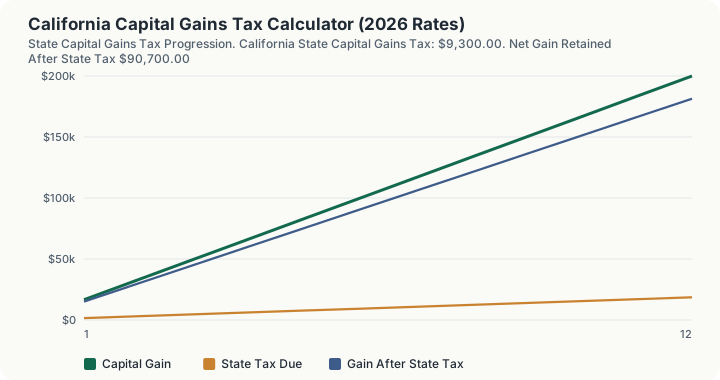
Quick Answer: On a $100,000 capital gain layered on $75,000 of other income, California's graduated state tax adds $9,300.00 to your bill, an effective rate of 9.30%.
Overview
California taxes capital gains as ordinary income under a graduated progressive bracket schedule, with marginal statutory rates ranging from 1.00% up to a top marginal rate of 13.30%.
There's no separate capital gains rate here. Gains simply get added to your other taxable earnings and pushed through the same progressive brackets everything else uses, so a large gain realized on top of salary or business income can land at the taxpayer's top marginal bracket, up to 13.30%.
That matters a lot if you're a high-net-worth individual, a portfolio manager, a corporate executive, or a real estate investor selling something big. State income tax eats directly into your net return on a sale, and it shapes how you should think about 1031 exchanges, installment sale structuring, and the timing of equity compensation exercises like ISOs, NSOs, and RSUs.
For anyone managing significant wealth or underwriting a private deal, getting the state-level exposure right, alongside the statutory rate itself, means paying attention to residency rules across jurisdictions. Whether you're disposing of publicly traded securities, a privately held business, real property, or digital assets, state tax exposure deserves the same scrutiny as the federal side when you're modeling a sale before it closes.
Timing and holding structure both drive your actual after-tax proceeds, so track taxable events across both federal and state reporting cycles, and understand how your federal adjusted gross income interacts with California's own modifications before you close a substantial transaction.
How This Is Calculated
California taxes a capital gain as ordinary income across nine brackets running from 1% to 12.3%, with no long-term preference of any kind. That combination gives it the steepest state treatment of investment gain in the country: a large gain stacked on a professional salary can meet the top brackets in a way it would in no other state. Above $1,000,000 of taxable income the Mental Health Services Tax adds a further 1% under Cal. Rev. & Tax. Code section 17043, enacted by Proposition 63, which is what takes the top marginal rate to 13.3%. This calculator applies that surcharge as a tenth bracket, so a gain that crosses $1,000,000 is taxed at 13.3% on the excess rather than 12.3%. The $1,000,000 threshold is not adjusted for inflation and does not double for joint filers.
The gain is stacked on top of your other income and walked through the bands from there.
Step by step, with your numbers:
- Start with the net gain. Capital losses and loss carryforwards are netted against the gain before anything else happens.
- Stack the gain on your other income. Ordinary income fills the lower brackets first and the gain sits on top of it, so the gain is taxed at whatever rates are still open above your salary. The same gain costs a high earner more than it costs a low earner. Enter other income as a taxable-income figure: the calculator does not subtract a standard deduction or personal exemption for you.
- Walk the brackets. The slice of the gain that falls in each band is multiplied by that band's rate, and the pieces are added together.
- Effective rate. Total California tax divided by the whole realized gain. On a graduated schedule this sits below the top marginal rate, because the lower slices were taxed at lower rates.
- Net proceeds. Subtract the state tax from the gain to get what you keep before federal tax.
Worked Example
Consider an investor in California who realizes $100,000 in capital gains on top of $75,000 in baseline ordinary income for the year.
- Stack the income. California taxes capital gains as ordinary income. Since income fills the lower brackets first, the $75,000 of baseline income already occupies the lower tiers, so the $100,000 gain stacks on top and pushes into higher brackets.
- Apply the marginal brackets. Working through California's bracket schedule, each slice of the gain is taxed at its own bracket's rate, with the highest slice reaching the 9.30% top marginal bracket.
- Total state tax due. Summing the tax owed across every bracket the gain touches produces a total California state tax liability of $9,300.00.
- Effective rate. Because the $75,000 of other income already fills the brackets below California's top rate, the entire gain lands in the 9.30% bracket, so the effective rate on the gain equals the marginal rate: 9.30%.
- Net proceeds. After paying $9,300.00 in state tax, the investor keeps $90,700.00 of the $100,000 gain, before any federal tax applies.
Strategic Tax Planning
California investors and their advisors lean on a handful of structures to manage this exposure: - Charitable Remainder Unitrusts (CRUTs). Donating appreciated assets to a CRUT eliminates immediate capital gains tax on disposition, and generates both an income tax charitable deduction and an ongoing income stream. - Installment Sales (IRC § 453). Spreading gain recognition across multiple tax years keeps a large single-year gain from pushing you into higher federal and state brackets all at once. - Opportunity Zone Funds. Reinvesting eligible gains into Qualified Opportunity Funds offers temporary tax deferral, and tax-free appreciation if you hold for at least 10 years. - Tax-loss harvesting. Realizing losses before year-end offsets gains dollar-for-dollar, and up to $3,000 of excess losses can offset ordinary income too.
Regulatory Framework
- California tax code and Franchise Tax Board regulations govern taxable gain recognition, apportionment, and non-resident withholding.
- Federal conformity. California's rolling or static conformity with federal adjusted gross income definitions under IRC § 61 and § 1001 shapes how state taxable income is computed.
- Quarterly estimated payments are due April 15, June 15, September 15, and January 15; missing them triggers underpayment penalties and interest.
- Residency and domicile. Taxpayers who establish residency in a low-tax or zero-tax state need solid documentation, the 183-day rule, primary dwelling, center of vital interests, to withstand a residency audit.
What This Does Not Account For
This calculator models state statutory tax penny-exactly, but a few federal and transactional complexities need separate review: - Federal Capital Gains Taxes: Federal long-term brackets (0%, 15%, 20%) and short-term ordinary rates up to 37% under IRC § 1. - Net Investment Income Tax (NIIT): The 3.8% surtax on net investment income under IRC § 1411 for single filers over $200,000 (married joint over $250,000). - Alternative Minimum Tax (AMT): Federal AMT calculations under IRC § 55 impacting incentive stock option (ISO) exercise spread. - Section 1031 Like-Kind Exchanges: Tax deferral mechanisms for real property held for productive use in trade, business, or investment. - Qualified Small Business Stock (QSBS): Federal Section 1202 gain exclusions where state conformity varies significantly.
Common Pitfalls
- Assuming Federal Rate Parity: Most states do not offer preferential long-term capital gains rates; gains are taxed at standard ordinary income rates.
- Failing to Track Holding Periods: Short-term gains (assets held ≤1 year) generate higher federal tax liabilities even if state rates treat both holding periods identically.
- Underestimating Multi-State Apportionment: Selling real estate or business assets located in other jurisdictions triggers multi-state non-resident return filing obligations.
- Neglecting Underpayment Penalties: Substantial one-time liquidity events require prompt estimated tax payments within the quarter of sale to avoid statutory penalties.
- Mismatched Cost Basis Records: Failure to document reinvested dividends, stock splits, or structural return-of-capital distributions leads to inflated taxable gain calculations.
Frequently Asked Questions
Does California have a state capital gains tax?
How are short-term and long-term capital gains taxed in California?
Are retirement account distributions subject to capital gains tax in California?
Can capital losses offset capital gains in California?
When are estimated state tax payments required on capital gains?
Sources
- California Franchise Tax Board: 2026 Statutory Individual Income Tax Rate Schedules. ftb.ca.gov
- Internal Revenue Service (IRS): Publication 544 (Sales and Other Dispositions of Assets) and Publication 550 (Investment Income and Expenses). irs.gov/publications/p544