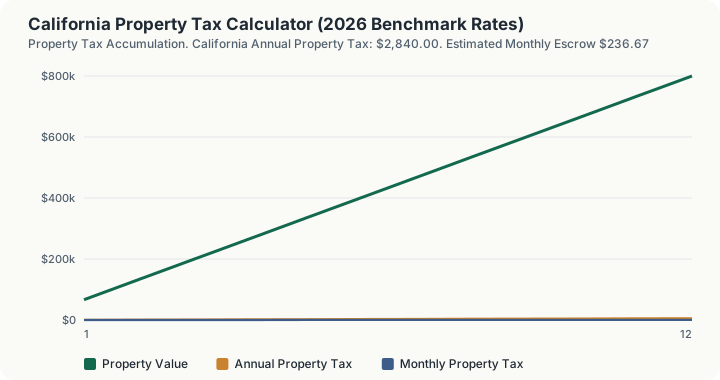
Quick Answer: A $400,000 home in California carries an estimated $2,840.00 in annual property tax at the state's 0.71% effective rate, or about $236.67 a month.
Why California's Effective Rate Is Below Its Statutory One
Proposition 13 sets the ad valorem rate at 1% of assessed value and limits growth in that assessed value to 2% a year while ownership is unchanged. Yet this calculator uses 0.71%, and the gap is the whole story of California property tax.
The 0.71% is an empirical figure, not a statutory one: median real estate taxes paid divided by median home value, from the U.S. Census Bureau's 2024 1-Year American Community Survey, published in SmartAsset's property tax dataset and cross-checked against WalletHub's 2025 ranking for relative order. California ranks #30 of 50. It sits below the 1% ad valorem rate because the denominator is current market value while the numerator reflects bills computed on base-year values that, for long-held homes, are far behind the market. Long-tenured owners drag the observed ratio down; recent buyers paying close to 1% plus voter-approved bonds pull it up. 0.71% is the median of that mixture and it describes no individual household.
The consequence for reading this page: $2,840.00 on a $400,000 home is not a Proposition 13 bill. It is the statewide median ratio applied to whatever value you type. $500,000 returns $3,550.00, $750,000 returns $5,325.00, and $1,000,000 returns $7,100.00.
How This Is Calculated
- Read the value box exactly as typed. There is no base-year value, no acquisition-value tracking, no 2% inflation factor and no change-of-ownership reassessment anywhere in this code path.
- Subtract the exemption with a zero floor. A flat dollar subtraction, clamped by
max(0, ...). - Multiply by the single 0.71% rate. It does not vary with value, county or ownership tenure.
- Divide by twelve for escrow. $2,840.00 a year is $236.67 a month, and that is the entire escrow model.
Proposition 13 and the 1% ad valorem rate are described above as context. Neither is implemented; the engine has one rate and one subtraction.
Worked Example
Baseline: a $400,000 California home, no exemption.
- Value. $400,000.00, used verbatim.
- Exemption. $0.00, so $400,000.00 is taxable.
- Annual tax. $2,840.00.
- Monthly escrow. $236.67.
With the calculator's $25,000 exemption scenario, the same home returns $2,662.50 a year and $221.88 a month.
Looking For a Threshold and Finding Only the Floor
California's real system is full of edges: the 1% cap, the 2% annual growth limit, supplemental assessments on transfer. None of them exists here, and the sweep table shows it. The 12 rows run in an unbroken straight line from $473.33 of annual tax at a $66,666.67 value, through $2,840.00 at $400,000, to $5,680.00 at $800,000. There is no step at any value because the rate is flat.
The single discontinuity in the engine is the zero floor on the exemption. On a $150,000 property, three separate runs:
Exemption $100,000. Taxable $50,000, annual tax $355.00, monthly $29.58.
Exemption $150,000, equal to the value. Annual tax $0.00.
Exemption $200,000, beyond the value. Annual tax $0.00. The surplus exemption is discarded, not banked.
The Price of an Exemption Dollar and a Value Dollar
Each $1,000 of exemption removes $7.10 of annual tax. California's own $7,000 homeowners' exemption is far too small to move this calculator's slider, but the amounts it does accept price cleanly: $25,000 takes a $400,000 home from $2,840.00 to $2,662.50, saving $177.50 a year. $50,000 returns $2,485.00. The $200,000 maximum returns $1,420.00.
Value costs the same $7.10 per thousand. $400,000 returns $2,840.00; $401,000 returns $2,847.10. Ten thousand dollars of value costs $71.00 a year, moving the escrow line from $236.67 to $242.58 a month. Across the range Californian buyers actually shop in, the step from $600,000 ($4,260.00) to $1,000,000 ($7,100.00) adds $2,840.00 a year, which is $591.67 a month of escrow at the top figure.
The Reverse Question, and Why It Bites Hardest in California
Reading the sweep backwards, a $5,000 annual property tax budget supports a $600,000 home at $4,260.00 and is exceeded by a $750,000 home at $5,325.00. A $3,000 budget sits between $400,000 ($2,840.00) and $500,000 ($3,550.00).
The version of this question that matters in California is the one this engine cannot answer. A homeowner who bought decades ago and carries a factored base-year value near $200,000 while the house is worth $800,000 faces a genuine choice of which number to type. $200,000 returns $1,420.00. $800,000 returns $5,680.00. The gap is $4,260.00 a year and the engine gives no guidance, because it has no concept of a base-year value at all. Since 0.71% is a market-value ratio, the market figure is the input the rate was built for, and the result should be read as "what a median California home of this value pays", not as that specific owner's bill.
What This Does Not Account For
- The exemption field is a flat dollar subtraction with no eligibility test. Whatever you type is removed from the base before the 0.71% rate is applied, and the engine treats a general homestead, a senior freeze and a disabled-veteran exemption as the same number. A $25,000 entry returns $2,662.50 on a $400,000 home, $50,000 returns $2,485.00 and $100,000 returns $2,130.00; no step of that sweep asks whether the amount is one you actually qualify for, and no per-programme cap is enforced beyond the field's own maximum.
- Proposition 13 in every respect. No base-year value, no 2% growth cap, no acquisition-value assessment, no supplemental bill on a change of ownership, and no Proposition 19 transfer of a base year to a replacement home.
- The 1% ad valorem rate and voter-approved debt. Local bond and parcel measures that ride on top of the 1% are not itemised or applied; they are averaged into the observed 0.71%.
- The $7,000 homeowners' exemption and the disabled veterans' exemption. Neither is applied automatically, and the exemption box performs no eligibility test.
- Mello-Roos and special assessments. Community facilities district charges, which can rival the ad valorem bill in newer developments, are outside a statewide median ratio.
- Time. No year selection, no appreciation, no reassessment. Every figure here is a single static valuation.
Common Pitfalls
- Reading $2,840.00 as a Proposition 13 bill. It is 0.71% of the value entered, not 1% of an assessed value.
- Entering a factored base-year value. Priced above: $1,420.00 at a $200,000 base against $5,680.00 at an $800,000 market value.
- Reading the schedule as a forecast. All twelve rows price a different property at today's rate, not this property in a later year. Row 12 sits at $800,000 of value and returns $5,680.00 with no exemption entered; there is no appreciation, reassessment or levy growth anywhere in the code path.
- Expecting the rate to change with tenure or county. It does not. The same 0.71% produces $1,420.00 at $200,000 and $7,100.00 at $1,000,000.
- Budgeting $236.67 as a complete escrow line. It covers property tax only, with no insurance, cushion or Mello-Roos component.
Frequently Asked Questions
How high are property taxes in California?
Why 0.71% and not the 1% Proposition 13 rate?
Should I enter market value or my assessed value?
What does each additional $10,000 of value cost?
Are Mello-Roos or bond assessments included?
Sources
- U.S. Census Bureau: 2024 1-Year American Community Survey, median real estate taxes paid over median home value. census.gov/programs-surveys/acs
- California Franchise Tax Board, the official state tax authority for California rates, rules and forms. ftb.ca.gov
Also consulted: California State Board of Equalization: Proposition 13 base-year value and the 1% ad valorem rate, cited as background only and not applied by this engine.