Quick Answer: A $75,000 annual salary in California, paid bi-weekly and filing single, takes home about $2,144.56 per paycheck ($55,758.45 per year) after federal tax, FICA, and California state withholding.
How This Is Calculated
California has the widest state rate schedule in the country: nine statutory brackets running from 1% to 12.3%, plus a 1% Behavioral Health Services surcharge on taxable income above $1 million that lifts the top marginal rate to 13.3%. A California stub also carries a State Disability Insurance line, an employee-paid contribution funding disability and paid family leave, which is separate from income tax and is not included in any figure on this page. What the calculator does model is this subtraction:
Four passes over the annual salary get to the net figure:
- FICA Payroll Tax Computation: Assessed on the full gross salary, before any pre-tax deduction is subtracted. - Social Security (OASDI): 6.20% withheld on wages up to the 2026 statutory wage base ($184,500). - Medicare (HI): 1.45% withheld on all gross earnings (no wage cap), plus 0.90% Additional Medicare Tax on earnings exceeding $200,000 (single) or $250,000 (married filing jointly).
- Federal Income Tax Withholding: Evaluated using 2026 progressive federal tax brackets (10%, 12%, 22%, 24%, 32%, 35%, 37%) on gross salary less the pre-tax deduction, after applying standard deduction thresholds ($16,100 single / $32,200 married joint).
- California State Income Tax Withholding: The same reduced wage figure is stacked through the FTB Schedule X bracket array, with boundaries at $11,079, $26,264, $41,452, $57,542, $72,724, $371,479, $445,771, $742,953 and $1,000,000 at rates of 1%, 2%, 4%, 6%, 8%, 9.3%, 10.3%, 11.3%, 12.3% and 13.3%. No state standard deduction and no state exemption credit are applied at this step.
- Pay Period Proration: Annual net compensation is divided across the designated pay frequency (26 bi-weekly, 24 semi-monthly, 12 monthly, or 52 weekly pay periods).
Worked Example
Consider an employee in California earning $75,000 annually, paid bi-weekly (26 paychecks per year), filing single, with $3,500 in annual pre-tax 401(k) contributions.
- Gross pay per paycheck. $75,000 ÷ 26 pay periods = $2,884.62 before any withholding.
- Pre-tax deduction. The $3,500 annual 401(k) contribution reduces each paycheck by $134.62 and also shrinks the wages used to calculate federal and state income tax; FICA is still assessed on the full gross amount.
- FICA payroll taxes. Social Security withholds 6.2% of gross pay and Medicare withholds 1.45%, for $220.67 per paycheck.
- Federal income tax withholding. Applying the 2026 federal schedule to the reduced taxable wage withholds $265.38 per paycheck.
- California state tax withholding. The Schedule X bracket array applied to the same reduced wage withholds $119.39 per paycheck.
- Net take-home pay. $2,884.62 gross, minus $134.62 pre-tax, minus $220.67 FICA, minus $265.38 federal tax, minus $119.39 state tax leaves $2,144.56 per paycheck, which comes to $55,758.45 per year, an effective total tax rate of 20.99%.
The Second Month, And The Twelfth
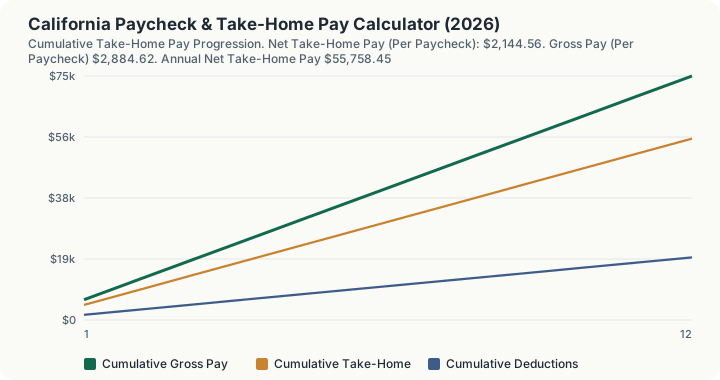
California's nine brackets are the widest ladder in the country, but a $75,000 salary sits low on it, and the cumulative totals show a state line far smaller than the reputation suggests.
Step 7 -- Two months of cumulative pay. The schedule's first row shows $6,250.00 of cumulative gross against $4,646.54 of cumulative take-home. Row two doubles both: $12,500.00 gross, $9,293.08 take-home, with $3,206.93 accumulated on the deduction side.
Step 8 -- The full year. By month twelve the schedule reaches $75,000.00 of cumulative gross and $55,758.45 of cumulative take-home, adding $4,646.54 every month without variation.
Step 9 -- What the year actually withheld. The cumulative deduction column closes at $19,241.55. That column carries the $3,500 pre-tax 401(k) contribution alongside the tax, so tax alone is $19,241.55 - $3,500 = $15,741.55, an effective total tax rate of 20.99% on $75,000.00 of gross pay.
Step 10 -- Why the monthly increment never changes. Each month adds the same figure to every column. The engine settles FICA on the annual wage before it splits anything: Social Security applies to the first $184,500, and the additional 0.9% Medicare applies above $200,000 for a single filer. The annual result is then divided evenly by twelve. That means the familiar mid-year raise, the one that arrives when Social Security withholding stops, is not modelled here at any salary. At $75,000 it would not happen regardless.
Three Edges On The Salary Axis, One Of Them California's Own
The twelve rows are a proration, so the edges are elsewhere. California is the one page in this family where a state bracket boundary sits close enough to the default salary to be worth walking, and it is the 8% to 9.3% step.
The California 8% to 9.3% step at $76,224 of gross salary
Schedule X moves from 8% to 9.3% at $72,724 of taxable income, which with the default $3,500 pre-tax deduction is $76,224 of gross salary.
At $75,000 of salary, state withholding is $119.39 per bi-weekly check; at $76,000 it is $122.46. The thousand cost $3.07 per check, which is 8% spread over 26 periods.
At $77,000, across the boundary, state withholding is $125.93 per check. The same thousand now costs $3.47, and every thousand above it costs $3.58: the state line reaches $154.54 per check at $85,000 and $208.20 at $100,000, a straight 9.3% ramp.
The lower boundary behaves the same way. State withholding runs $74.03 per check at $60,000 of salary, $76.34 at $61,000 (a 6% thousand) and $79.39 at $62,000, because $61,042 of gross is where the 6% band ends.
The federal edge that lands at $70,000 of gross salary
At $69,000 of salary. Take-home is $1,996.83 per check, federal withholding $218.46, state $100.93. Annual net is $51,917.45.
At $70,000, at the boundary. Take-home is $2,024.65 per check, federal withholding $223.08, state $104.00. Annual net is $52,640.95; that thousand added $723.50.
At $71,000, past it. Take-home is $2,048.63 per check, federal withholding $231.54, state $107.08. Annual net is $53,264.45, and the identical thousand adds only $623.50.
The federal step costs $100.00 of annual take-home, four times what the California 8-to-9.3 step costs on the same $1,000, which is worth holding next to the state's headline reputation.
The Social Security wage base at $184,500
At $184,000 of salary, annual net take-home is $121,144.86, FICA $541.38 per check.
At $185,000, annual net is $121,766.36, FICA $543.13. That thousand was worth $621.50.
At $186,000, wholly above the base, annual net is $122,418.86 and FICA per check is $543.69, so that thousand was worth $652.50 -- $31.00 more than the one below it, the 6.2% Social Security component having stopped.
The schedule reflects none of this at any salary, because FICA is settled annually before the division by twelve.
The marginal cost of the next $1,000
Annual net take-home is $55,134.95 at $74,000 of salary, $55,758.45 at $75,000 and $56,381.95 at $76,000. Each additional $1,000 of salary is worth $623.50 of annual take-home in California, and costs $376.50 in tax -- the lowest retention of the seven states in this batch's default sweep.
Running the calculator backwards
Sweeping in $500 steps at the default settings, $111,500 is the first salary at which the bi-weekly check reaches $3,000, paying $3,002.22 against $2,990.48 at $111,000. And $148,500 is the first salary whose annual net take-home clears $100,000, at $100,182.11 against $99,886.86 at $148,000. Both are the highest thresholds in this batch, which is the practical form of California's rate schedule.
The pre-tax dollar, priced
At $3,500 of pre-tax deductions, annual net take-home is $55,758.45, state withholding $119.39 per check.
At $10,000, annual net take-home is $51,058.45, state withholding $99.39 per check.
Contributions rose $6,500.00; spendable take-home fell only $4,700.00. The $1,800.00 difference is tax never withheld, the largest such saving of the seven states here, and the whole $10,000 remains the employee's money. California supplies $520.00 of that saving, its 9.3% on the extra $6,500 at this salary.
The Total Effective Tax Rate output falls from 20.99% to 18.59% across that change, because the contribution is excluded from that ratio's numerator, while the Cumulative Deductions column rises, because it counts the contribution as a deduction. Both are on this page and they will never agree.
Common Pitfalls
Multiplying the paycheck by 26. Twenty-six times $2,144.56 is $55,758.56, eleven cents over the engine's $55,758.45. Monthly gives $4,646.54 twelve times, or $55,758.48. The annual figure is computed first, which is why it stays $55,758.45 on every frequency -- weekly $1,072.28, bi-weekly $2,144.56, semi-monthly $2,323.27, monthly $4,646.54.
Reading Cumulative Deductions as tax. The column closes at $19,241.55 against $15,741.55 of actual tax. Quoted as tax that reads 25.66% of $75,000 where the correct figure is 20.99%, overstating the burden by 4.67 percentage points.
Budgeting from this net figure and forgetting SDI. State Disability Insurance is withheld from California wages, is not income tax, and appears nowhere in these numbers. The $2,144.56 here is higher than the corresponding line on a real California stub for that reason alone.
Reading 13.3% as a rate that applies to a salary. It applies above $1,000,000 of taxable income. At $75,000 the state took $15,741.55 of combined tax across the whole year, of which the California portion accrued at 9.3% on the top of the range.
The Joint Schedule Cuts California's Line By Nearly Half
California's bracket array for married joint filers is the single array doubled at every rung, and the filing status selector now chooses between them. At $75,000 with a $3,500 pre-tax election on a bi-weekly schedule, California withholding is $119.39 per check for a single filer and $61.07 for a married joint filer, a drop of $58.32, or 48.8%, which is the largest state-line movement of any calculator in this group in both dollar and percentage terms. Federal withholding falls from $265.38 to $162.31 over the same switch. Together they move the net paycheck from $2,144.56 to $2,305.95 and annual take-home from $55,758.45 to $59,954.64, a gain of $4,196.19. The reason the state saving is so large here is how far the doubling moves the wage down the ladder: a $71,500 taxable base sits in the single 8.00% band, which runs from $57,542 to $72,724, but in the joint 4.00% band, which runs from $52,528 to $82,904.
What This Does Not Account For
- No State Disability Insurance and no Paid Family Leave contribution. Both are real California employee withholdings and neither is modelled anywhere on this page.
- No state standard deduction and no exemption credit. Taxable income is taken as gross less the pre-tax box, so the state line here is an upper bound on real California withholding.
- Bracket vintage. The array is FTB's tax year 2025 Schedule X. California has not published a 2026 rate schedule; its own 2026 Form 540-ES instructions direct estimated-tax filers to the 2025 table.
- No local wage taxes, no W-4 detail. No dependents, multiple-jobs checkbox, extra per-period withholding or other-income entry. Filing status is single or married filing jointly only.
- One pre-tax box, no post-tax box. 401(k), HSA and FSA share one annual field with no employer match and no per-plan limit. Roth contributions, garnishments and post-tax premiums are absent.
- FICA is annual, then prorated. The twelve rows never show the wage-base step at any salary, for the reason in Step 10.
- Two definitions on one page. The effective rate output excludes the pre-tax deduction from its numerator; the Cumulative Deductions column includes it.
Frequently Asked Questions
Does California have a state income tax on paychecks?
Where is the nearest California bracket edge to a typical salary?
What does the next $1,000 of salary actually add?
What is the Social Security wage cap for 2026?
Sources
- Internal Revenue Service (IRS): Publication 15 (Circular E) and Publication 15-T (2026). irs.gov/publications/p15
- Social Security Administration (SSA): 2026 Social Security Wage Base Limit. ssa.gov
- California Franchise Tax Board: 2025 California Tax Rate Schedules, Schedule X (single / married filing separately). ftb.ca.gov