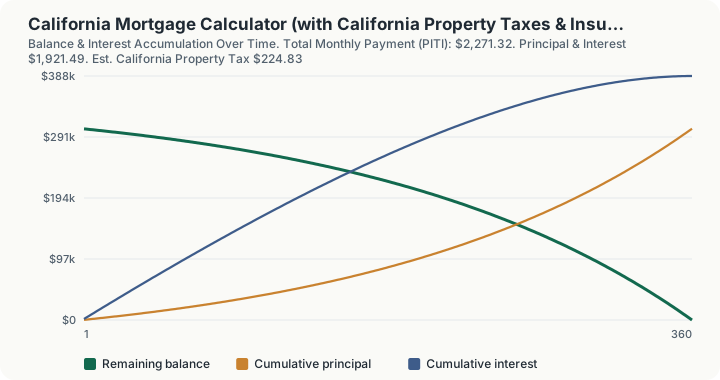
Quick Answer: A $380,000 California home with 20% down, a 30-year fixed loan at 6.5% APR, this calculator's 0.71% property tax assumption, and a $125/month insurance estimate produces a total monthly payment (PITI) of $2,271.32.
Overview
California property tax is governed by Proposition 13, which caps the general tax rate at 1% of a property's assessed value and limits how fast that assessed value can grow, generally no more than 2% per year, until the property changes ownership and is reassessed at current market value. Because so many California homeowners have owned their properties for years under that 2% annual cap, the statewide average effective property tax rate, actual tax paid divided by current market value, runs meaningfully below the 1% statutory base rate. This calculator uses 0.71% as an effective-rate planning estimate applied to the purchase price, which reflects that a new buyer's first-year assessed value will typically equal the purchase price, close to the 1% base, once voter-approved local add-ons like school bonds are layered on.
Those local add-ons matter. On top of the 1% Prop 13 base, California allows voter-approved general obligation bond debt service and, in many newer developments, Mello-Roos Community Facilities District special taxes that fund infrastructure like roads, schools, and utilities in a specific subdivision. Mello-Roos assessments are not tied to Prop 13's cap and can add a noticeable amount to a property tax bill, sometimes 0.2% to over 1% of home value depending on the district, which is why two nearly identical homes in different California subdivisions can carry very different effective tax burdens.
This tool combines a standard 30-year fixed amortization for principal and interest with the modeled property tax rate and a flat homeowners insurance estimate to produce a single PITI figure, intended as an initial affordability check before a buyer requests a formal Loan Estimate from a California-licensed lender.
How This Is Calculated
- Down payment and loan principal. Loan Principal = Home Price x (1 - Down Payment %).
- Principal and interest. The loan principal amortizes over 360 months:
where P is the loan principal and i is the monthly rate (APR / 12).
- Property tax estimate. Monthly Property Tax = Home Price x 0.71% / 12, using the purchase price as a proxy for the first-year Prop 13 assessed value.
- Insurance estimate. A flat $125/month is added as a homeowners insurance placeholder.
- PITI total. Monthly PITI = Principal & Interest + Property Tax + Insurance.
Worked Example
Using the calculator's baseline inputs, which match its published test vector:
- Home Purchase Price: $380,000
- Down Payment: 20% ($76,000)
- Interest Rate (APR): 6.5%
Step by step: - Loan principal: $380,000 x 80% = $304,000.00 - Monthly rate: 6.5% / 12 = 0.541667% - Monthly principal & interest: $1,921.49 - Monthly property tax: $380,000 x 0.71% / 12 = $224.83 - Monthly insurance estimate: $125.00 - Total monthly payment (PITI): $1,921.49 + $224.83 + $125.00 = $2,271.32 - Total interest paid over 30 years: $387,735.24
If this same buyer purchases in a Mello-Roos district carrying an additional 0.5% special tax, their effective annual property-related cost would rise by roughly $1,900 per year, or about $158/month, on top of the figures shown here, a cost this calculator's statewide baseline does not include since Mello-Roos taxes are set district by district rather than statewide.
What This Does Not Account For
- Mello-Roos special tax districts. Many newer California subdivisions carry a Community Facilities District special tax that is not capped by Proposition 13 and is not reflected in this calculator's 0.71% baseline.
- Prop 13's 2% annual assessment cap over time. This calculator models a snapshot at purchase; it does not project how a buyer's future tax bill will grow more slowly than home value appreciation in the years after purchase, which is one of Prop 13's central long-term effects.
- Reassessment triggers. Certain transfers, new construction, and some parent-child transfers can trigger reassessment outside a normal resale, changing the assessed value base the 1% rate applies to.
- Private mortgage insurance (PMI). Below 20% down, most conventional loans require PMI, which is not added separately even when the low-down-payment scenario toggle is used.
- Closing costs, county documentary transfer tax, and prepaid escrow reserves, which affect cash needed at closing but not the ongoing monthly payment modeled here.
Common Pitfalls
- Assuming next year's tax bill will match this year's estimate exactly. Under Prop 13, the assessed value used for tax purposes typically rises a capped 2% per year after purchase, so this calculator's estimate is most accurate for the first year of ownership.
- Overlooking Mello-Roos or other special assessments when comparing two similarly priced homes in different California subdivisions, since one may carry a meaningfully higher all-in property tax burden than the other.
- Skipping PMI in a low-down-payment scenario, which understates the true monthly obligation for any purchase financed above 80% loan-to-value.
- Confusing assessed value with market value in later years of ownership, since a long-held California property's assessed value is often well below its current market value thanks to the 2% annual cap.
- Not shopping insurance regionally, since California homeowners insurance premiums, especially in wildfire-exposed areas, have risen sharply and can push real costs well above the flat $125/month placeholder used here.
Frequently Asked Questions
Why does this calculator use 0.71% instead of California's 1% Prop 13 rate?
What is Mello-Roos and is it included here?
How much can my property tax bill grow each year under Prop 13?
Is PMI included in the monthly payment shown here?
What happens to my payment if I buy in a higher-cost California market?
Sources
- Consumer Financial Protection Bureau (CFPB): mortgage disclosure and PMI requirements under Regulation Z. ecfr.gov/current/title-12/chapter-X/part-1026
- California Franchise Tax Board, the official state tax authority for California rates, rules and forms. ftb.ca.gov
Also consulted: California State Board of Equalization: Proposition 13 assessed value and tax rate guidance; California county assessor offices: parcel-level assessed value, millage, and Mello-Roos district lookups; California Department of Insurance: homeowners insurance market data.