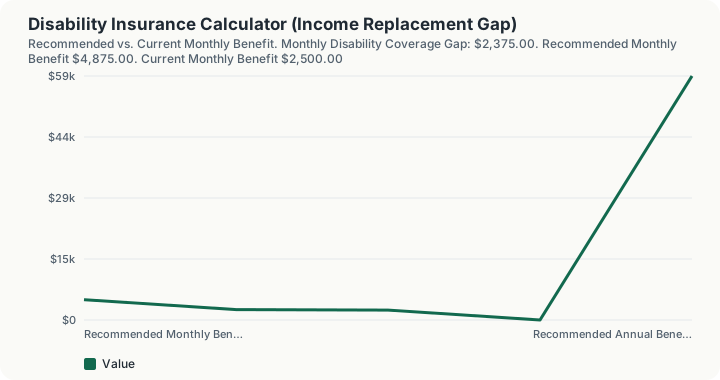
Quick Answer: On $90,000 of gross annual income at the standard 65% replacement target, the recommended monthly disability benefit is $4,875. Against a $2,500 existing monthly benefit, that leaves a $2,375 monthly coverage gap.
Overview
Disability insurance replaces a portion of your income if illness or injury keeps you from working. It is arguably the most under-owned major insurance product relative to its actual risk: the Social Security Administration has historically estimated that roughly one in four of today's 20-year-olds will experience a disability lasting a year or more before reaching retirement age, yet most workers carry far less disability coverage than life insurance.
The standard industry guidance, used by disability insurers' own underwriting guidelines and repeated across financial-planning literature, is to insure 60% to 70% of gross income. That range looks lower than the near-100% replacement people intuitively expect, but it reflects a specific tax mechanic: when an individual pays disability premiums out of pocket with post-tax dollars (rather than an employer paying them, or an employee paying with pre-tax payroll dollars), the resulting benefit is received income-tax-free. A tax-free 65% of gross income can be close to, or even exceed, take-home pay after taxes and work-related expenses disappear during a disability claim.
This calculator computes the recommended monthly benefit at your chosen replacement percentage and compares it against a monthly benefit you already have in force, whether that is an individual policy, an employer group long-term disability plan, or both combined.
How This Is Calculated
- Recommended annual benefit. Gross annual income is multiplied by the target replacement percentage (60-70%, industry standard).
- Recommended monthly benefit. The annual figure is divided by 12, since disability benefits are paid monthly.
- Coverage gap. The recommended monthly benefit is compared against your current monthly benefit from any existing policy. If current coverage falls short, the difference is your monthly gap; if current coverage exceeds the recommendation, the difference shows as a surplus instead.
Worked Example
Using the calculator's default inputs:
- Gross Annual Income: $90,000
- Target Replacement: 65% (mid-point of the standard 60-70% range)
- Current Monthly Benefit: $2,500 (a typical employer group LTD benefit)
Step by step:
- Recommended annual benefit: $90,000 × 65% = $58,500
- Recommended monthly benefit: $58,500 ÷ 12 = $4,875
- Compare to current coverage: $4,875 − $2,500 = $2,375 monthly gap
This household would need to close a $2,375-per-month gap, likely through a supplemental individual disability policy layered on top of the existing employer plan.
Why Employer Group Coverage Often Isn't Enough
Most employer-provided long-term disability plans replace 50-60% of salary, often capped at a maximum monthly benefit (commonly $5,000-$15,000 regardless of income), and the premiums are typically paid by the employer, meaning the benefit is taxable income when received. A higher earner can hit that dollar cap well before reaching 60% of true income, and the after-tax value of a taxable group benefit is meaningfully lower than the same dollar amount from a tax-free individual policy. This is the core reason many financial planners recommend layering an individual, personally-owned policy on top of group coverage rather than relying on group coverage alone.
The Coverage Cliff, and What Each Input Moves
This calculator has a genuine threshold in it, the point where existing coverage meets the recommendation, and the outputs change character as it is crossed.
At $4,874 of current monthly benefit. The engine returns a monthly gap of $1.00 and a surplus of $0.00, and the fully-covered flag reads false.
At $4,875, one dollar later. The gap becomes $0.00, the surplus is still $0.00, and the fully-covered flag flips to true. That is the exact recommendation on the default inputs, and it is where the calculator stops treating the household as underinsured.
At $4,876. The gap holds at $0.00 and the surplus becomes $1.00. Gap and surplus are mutually exclusive by construction: one of them is always zero, and above the threshold only the surplus moves. At $6,000 of existing benefit the surplus is $1,125.00 and the gap remains $0.00.
The baseline, and how far short it falls. On $90,000 of gross income at a 65% replacement target the recommended benefit is $4,875.00 a month, or $58,500.00 a year. Against $2,500.00 of existing group coverage that leaves a $2,375.00 monthly gap, which is 48.7% of the recommendation. Nearly half the target is uncovered on inputs that describe a fairly typical employer benefit.
The replacement percentage, priced. Dropping the target from 65% to 60% takes the recommended benefit from $4,875.00 to $4,500.00 and the gap from $2,375.00 to $2,000.00. Raising it to 70% takes the recommendation to $5,250.00 and the gap to $2,750.00. Each five points of replacement target is worth $375.00 a month, or $4,500.00 a year, on a $90,000 income.
Income, priced. Each additional $1,000 of gross annual income raises the recommended monthly benefit by $54.17 at the 65% target: the engine returns $4,929.17 on $91,000 against $4,875.00 on $90,000. At $150,000 of income the recommendation is $8,125.00 a month and the gap against the same $2,500.00 of group cover widens to $5,625.00.
What the recommendation does not model, and it matters here. The engine multiplies income by the replacement percentage and divides by twelve. It applies no tax treatment at all, and that is the largest single omission: employer-paid group benefits are generally taxable to the employee while benefits from an individual policy paid with after-tax premiums generally are not, so a $2,500 group benefit and a $2,500 individual benefit are not worth the same amount and this calculator treats them as identical. There is also no elimination period, no benefit period, no own-occupation versus any-occupation distinction, no cost-of-living rider, no group policy monthly maximum, and no premium figure anywhere: the page sizes a benefit and never prices it.
What This Does Not Account For
- Own-occupation vs. any-occupation definitions. This calculator does not distinguish between policy definitions of disability; an "own-occupation" policy (pays if you can't do your specific job) is materially more valuable than an "any-occupation" policy (pays only if you can't do any job), at a correspondingly higher premium.
- Elimination periods. Every disability policy has a waiting period (commonly 90 or 180 days) before benefits start. This calculator does not model the emergency-fund gap during that window.
- Benefit period length. Policies pay out for a defined period: a few years, to age 65, or for life. This calculator does not model differences in total benefit period.
- Taxability of the benefit. The 60-70% guidance assumes individually-owned, post-tax-premium coverage that pays tax-free. If premiums are employer-paid or pre-tax, benefits are taxable and the effective replacement is lower than the stated percentage.
- Underwriting and pricing. This tool estimates a coverage need, not a premium quote. Actual disability insurance pricing depends heavily on occupation class, age, health, and the specific policy features chosen.
Common Pitfalls
- Assuming employer group coverage is enough. Group LTD often caps out well below the recommended replacement level for higher earners, and its taxable benefit is worth less per dollar than an individual tax-free policy.
- Confusing short-term and long-term disability. Short-term disability (STD) typically covers a few months; long-term disability (LTD) is the policy type this calculator is sizing, meant to cover extended or permanent disabilities.
- Ignoring the elimination period. A 90-day or 180-day waiting period before benefits begin means you need liquid savings to bridge that gap regardless of how well-sized your monthly benefit is.
- Under-insuring because 65% "feels low." The tax-free nature of individually-owned benefits is precisely why the industry-standard target sits meaningfully below 100% of gross income.
- Not updating coverage after a raise. A coverage gap that didn't exist at your last salary can reappear silently as income grows if the policy's benefit amount isn't increased to match.
Frequently Asked Questions
Why does the industry recommend only 60-70% income replacement instead of 100%?
Is my employer's disability coverage taxable?
What if I'm self-employed with no employer coverage?
Does this calculator account for Social Security Disability Insurance (SSDI)?
How much does individual disability insurance typically cost?
Sources
- Social Security Administration: Disability statistics and program overview. ssa.gov
- Internal Revenue Service: Publication 525, taxability of disability benefits based on who pays premiums. irs.gov/publications/p525
Also consulted: Council for Disability Awareness / America's Health Insurance Plans: Industry income-replacement guidance for disability insurance; Insurance Information Institute (III): Disability insurance overview and coverage guidance.