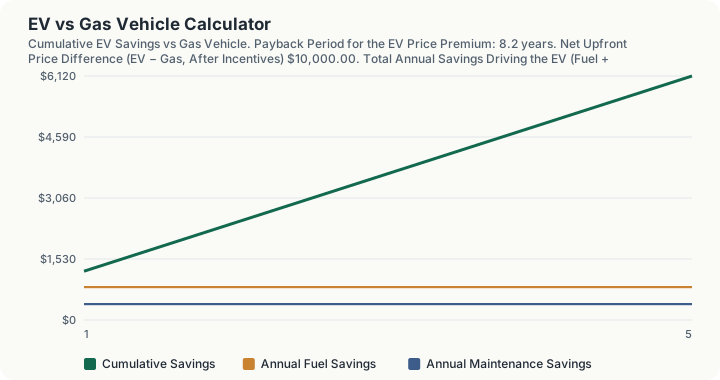
Quick Answer: A $42,000 EV against a comparable $32,000 gas vehicle, with no federal or state incentive, 12,000 miles a year at 30 kWh/100mi and $0.16/kWh electricity versus 30 MPG and $3.50/gal gas, saves $1,224 a year in combined fuel and maintenance costs. That pays back the EV's $10,000 upfront premium in about 8.2 years, so over a 5-year ownership horizon the gas vehicle actually comes out $3,880.00 cheaper overall.
Overview
This calculator compares the full cost of buying and running an EV against a comparable gas vehicle: the net price difference after any tax credits or incentives, then the ongoing fuel and maintenance cost gap, to answer the question that actually matters, does the EV's typically lower running cost repay its typically higher purchase price within the time you'll own it?
The answer depends heavily on three things that vary a lot by buyer: how much you drive (more miles means the EV's fuel-cost advantage compounds faster), your local electricity and gas prices, and, as of 2026, whether any purchase incentive still applies to your specific situation.
Current Federal EV Tax Credit Status (2026)
The federal EV purchase credits, the up-to-$7,500 new-vehicle credit (Internal Revenue Code Section 30D), the up-to-$4,000 used-vehicle credit (Section 25E), and the commercial/leased-vehicle credit (Section 45W), were all eliminated by the One Big Beautiful Bill Act, signed into law on July 4, 2025. Under that law, none of these credits apply to a vehicle acquired after September 30, 2025. The IRS's own guidance confirms that clean-vehicle purchase credits are not available for vehicles acquired after that date, with a narrow exception for buyers who entered a binding written contract and made a qualifying payment on or before September 30, 2025.
This calculator therefore defaults the federal tax credit input to $0. It remains editable only for the rare case where you have documented pre-existing eligibility. Separately, a new federal deduction allows up to $10,000 a year in auto loan interest for new, U.S.-assembled vehicles (not EV-specific), and more than 30 states still run their own EV rebate or tax credit programs, some worth up to $7,500. Enter your state's program amount in the state/local incentive field if one applies to you; this calculator has no way to look that up automatically since it varies by state, income, and vehicle.
How This Is Calculated
- Net upfront price difference. EV price minus the federal credit minus the state/local incentive, minus the gas vehicle's price. Positive means the EV still costs more after incentives; negative or zero means it doesn't.
- Annual electricity cost. (Annual miles ÷ 100) × EV efficiency (kWh per 100 miles) × electricity price per kWh.
- Annual gasoline cost. (Annual miles ÷ gas vehicle MPG) × gasoline price per gallon.
- Annual maintenance savings. Gas vehicle's annual maintenance estimate minus the EV's annual maintenance estimate. EVs have no oil changes, fewer fluids, and regenerative braking that extends brake life, and multiple studies find EV maintenance running meaningfully below gas vehicles (see Sources); this calculator uses editable dollar estimates rather than a fixed percentage.
- Payback period. Net upfront price difference ÷ (annual fuel savings + annual maintenance savings). If the EV has no upfront premium after incentives, payback is immediate. If annual savings are zero or negative, the calculator reports "Never" rather than a misleading number.
- Net cost difference over the horizon. Net upfront price difference minus the total fuel and maintenance savings accumulated over your chosen ownership horizon. This is the number that tells you which vehicle actually costs less by the time you're done owning it, not just whether the EV eventually breaks even.
Worked Example
Using the calculator's default inputs:
- EV Price: $42,000.00 | Gas Vehicle Price: $32,000.00
- Federal Credit: $0 | State Incentive: $0
- Net EV Price After Incentives: $42,000.00
- Net Upfront Price Difference: $10,000.00
Annual driving costs at 12,000 miles/year: - EV: 12,000 ÷ 100 × 30 kWh/100mi × $0.16/kWh = $576.00/year - Gas: 12,000 ÷ 30 MPG × $3.50/gal = $1,400.00/year - Annual fuel savings: $1,400.00 − $576.00 = $824.00 - Annual maintenance savings: $900 − $500 = $400.00 - Total annual savings: $824.00 + $400.00 = $1,224.00
Payback period: $10,000.00 ÷ $1,224.00 = 8.2 years
Over a 5-year ownership horizon: total savings of $1,224.00 × 5 = $6,120.00 against the $10,000.00 upfront premium leaves the gas vehicle $3,880.00 cheaper overall at this specific price gap, mileage, and energy cost combination. A higher-mileage driver, cheaper electricity, or a state incentive would close or reverse that gap; use the scenario buttons to see how.
Carrying The Savings Forward Year By Year
Step 1 -- Year one. $824.00 of fuel savings plus $400.00 of maintenance savings, for a cumulative $1,224.00
Step 2 -- Year two. Another $1,224.00, taking the running total to $2,448.00
Step 3 -- Year five, the end of the ownership horizon. Cumulative savings of $6,120.00
Step 4 -- Set that against the price gap. $10,000.00 - $6,120.00 = $3,880.00 still outstanding
Five years of driving recovers about three-fifths of the upfront premium at these prices, which is the whole reason the payback lands at 8.2 years rather than inside the ownership window. The EV wins on this input set only for a driver who keeps the car well past the horizon entered here, or who changes one of the three variables that move the annual figure: miles, electricity price, or an incentive.
What This Does Not Account For
- Resale/depreciation value differences. EVs and gas vehicles can depreciate at different rates, and that difference isn't modeled here. For a full ownership cost projection including depreciation, use this platform's total cost of ownership calculator.
- Charging infrastructure cost. A home Level 2 charger installation commonly runs $500-$2,000 depending on your electrical panel and installer, a real upfront cost for EV buyers without one already, not included here.
- Public charging premiums. This calculator assumes home charging at your entered electricity rate. Frequent fast-charging away from home is typically priced well above the home electricity rate and would reduce the EV's fuel-cost advantage.
- Insurance cost differences. EV insurance premiums can run higher than comparable gas vehicles in some markets due to repair cost and parts availability; not modeled here.
- Financing cost differences, if the two vehicles are financed at different rates or terms; this calculator compares cash prices net of incentives only.
- Inflation or fuel/electricity price changes over the ownership horizon; annual costs are held flat at your entered rates.
Common Pitfalls
- Assuming the federal tax credit still applies. It was eliminated for vehicles acquired after September 30, 2025. Don't reuse a pre-2025 assumption of "$7,500 off" without verifying your specific situation, most buyers in 2026 should enter $0.
- Forgetting state incentives can still meaningfully change the math. Several states offer credits large enough to fully offset a modest EV price premium on their own; check your state before assuming the EV "doesn't pay off."
- Using national-average maintenance figures instead of model-specific data. The gap between EV and gas maintenance costs varies by vehicle; a gas vehicle known for exceptional reliability can narrow the maintenance-savings advantage considerably.
- Ignoring mileage's outsized effect on payback. Because fuel savings accumulate per mile driven, a driver at 20,000 miles/year reaches payback dramatically faster than one at 6,000 miles/year on the identical vehicles and prices.
- Comparing only the sticker prices. The relevant number is the net upfront difference after incentives, not the list-price gap; skipping the incentive step can make an EV look like a worse deal than it actually is in a state with a strong rebate program.
Frequently Asked Questions
Is the federal EV tax credit really gone in 2026?
Do state EV incentives still exist?
How much less does an EV actually cost to maintain?
What if I drive far less (or far more) than 12,000 miles a year?
Should I still consider an EV if the payback period is long or "Never"?
Sources
- IRS: Guidance on clean vehicle credit eligibility for vehicles acquired after September 30, 2025 (Sections 30D, 25E, 45W). irs.gov
- U.S. Department of Energy, fueleconomy.gov: EV and gas vehicle fuel/energy cost estimation methodology. fueleconomy.gov
- U.S. Department of Energy, Alternative Fuels Data Center. afdc.energy.gov
Also consulted: One Big Beautiful Bill Act (Public Law, signed July 4, 2025): Termination of federal clean vehicle credits; Consumer Reports: Analysis of EV versus gas-vehicle maintenance and repair costs.