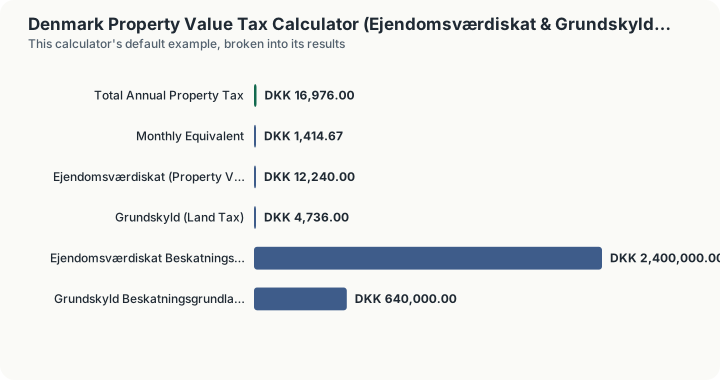
Quick Answer: For a Danish home assessed at DKK 3,000,000.00 (with an assessed land value of DKK 800,000.00) and the national-average 2026 municipal land-tax rate of 7.4‰, the estimated combined annual property tax is DKK 16,976.00 (DKK 1,414.67/month) -- DKK 12,240.00 in ejendomsværdiskat (property value tax) and DKK 4,736.00 in grundskyld (land tax).
Overview
Danish homeowners pay two separate, recurring property taxes: ejendomsværdiskat (property value tax), levied on the full assessed value of your home by the Danish state, and grundskyld (land tax, sometimes called "ejendomsskat" in everyday speech), levied on the assessed value of just the land underneath it by your municipality. Both were substantially overhauled by the Ejendomsskattelov (Property Tax Act), which took effect 1 January 2024 alongside a new nationwide round of property assessments -- replacing a system that, for over a decade, had frozen many owners' tax bills to outdated valuations from as far back as 2011.
This calculator applies the reformed law's 2026 formula to a given property assessment: a shared 20% "forsigtighedsprincip" (cautionary principle) discount reduces both taxes' bases to 80% of the assessed value, reflecting the built-in uncertainty margin in the new valuations; ejendomsværdiskat then applies a two-rate progressive structure, while grundskyld applies a single municipal rate. The result is the steady-state annual tax a property would owe once the new law is fully phased in -- useful for evaluating a purchase, estimating ongoing carrying costs, or understanding how your two most recent assessment notices (ejendomsværdi and grundværdi) translate into an actual bill.
Denmark's currency is the Danish krone (DKK), and every figure in this calculator is denominated in DKK.
How This Is Calculated
- Beskatningsgrundlag (taxable basis). Both taxes apply to 80% of their respective assessed value -- a flat 20% discount baked into the law itself (the "forsigtighedsprincip"), not an optional relief:
- Ejendomsværdiskat (property value tax). A two-rate structure on the ejendomsværdi beskatningsgrundlag: - 5.1‰ (0.51%) on the portion up to the 2026 progressionsgrænse (threshold) of DKK 9,706,000 (indexed from a 2023-level DKK 9,200,000 grundbeløb, re-indexed every two years to owner-occupied housing values). - 14‰ (1.4%) on any portion above that threshold.
- Grundskyld (land tax). A single municipal rate (grundskyldspromille) applied to the grundværdi beskatningsgrundlag -- no progression bracket:
The rate is set independently by each of Denmark's 98 municipalities, capped at a statutory maximum of 30‰ since the 2024 reform (down from 34‰). The 2026 national average is about 7.4‰, ranging from 3.10‰ in Frederiksberg to 17.70‰ in Varde.
- Total annual property tax. Ejendomsværdiskat plus grundskyld.
Worked Example
Using the calculator's default inputs:
- Assessed Property Value (Ejendomsværdi): DKK 3,000,000.00
- Assessed Land Value (Grundværdi): DKK 800,000.00
- Municipal Land Tax Rate: 7.4‰ (2026 national average)
Step by step:
- Ejendomsværdiskat beskatningsgrundlag: DKK 3,000,000.00 × 80% = DKK 2,400,000.00 (below the DKK 9,706,000 progression threshold, so only the 5.1‰ rate applies).
- Ejendomsværdiskat: DKK 2,400,000.00 × 0.51% = DKK 12,240.00.
- Grundskyld beskatningsgrundlag: DKK 800,000.00 × 80% = DKK 640,000.00.
- Grundskyld: DKK 640,000.00 × 7.4‰ = DKK 4,736.00.
- Total annual property tax: DKK 12,240.00 + DKK 4,736.00 = DKK 16,976.00, or DKK 1,414.67/month.
For a more valuable home -- say DKK 13,000,000 assessed, with a DKK 4,000,000 land value and a 10‰ municipal rate -- the ejendomsværdiskat beskatningsgrundlag (DKK 10,400,000) exceeds the DKK 9,706,000 threshold by DKK 694,000, so that excess is taxed at the higher 14‰ progression rate: DKK 9,706,000 × 0.51% + DKK 694,000 × 1.4% = DKK 49,500.60 + DKK 9,716.00 = DKK 59,216.60 in ejendomsværdiskat alone, plus DKK 32,000.00 in grundskyld, for DKK 91,216.60 total.
What This Does Not Account For
- The permanent per-owner "skatterabat" (tax rebate). Owners who purchased their home before the reform (broadly, before mid-2024) receive an automatic, permanent tax discount ensuring their ejendomsværdiskat never exceeds what they would have paid under the old (pre-2024) rules -- calculated and applied directly by Skattestyrelsen using the owner's specific purchase history. This calculator cannot reproduce that comparison without the owner's actual pre-2024 assessment and tax history, so it shows the full steady-state new-law amount, which may overstate the actual bill for an existing pre-reform owner.
- The annual "stigningsbegrænsning" (increase-limitation) rule for grundskyld. During the 2024-2028 phase-in, an owner's grundskyld increase is capped year-over-year (at 4.75% per year for 2025 onward) even if the fully-phased-in formula above would imply a bigger jump. This calculator shows the fully-phased-in target amount, not any given year's capped transitional bill.
- Dækningsafgift. A separate municipal tax on commercial and public-sector properties (not owner-occupied homes) is out of scope.
- Non-residential and agricultural property rules. This calculator assumes an ordinary owner-occupied home; farms, forests, and commercial properties are assessed and taxed under different rules.
- The pensionist ejendomsværdiskattenedslag. Homeowners who reached retirement age before certain cutoff dates may qualify for an additional discount on ejendomsværdiskat, not modeled here.
- Deferred-payment ("indefrysning") arrangements. Some homeowners can elect to defer part of their property tax increase as an interest-bearing loan against the property rather than pay it in cash each year; this calculator shows the full assessed liability regardless of any deferral election.
Common Pitfalls
- Confusing ejendomsværdi with grundværdi. These are two distinct figures on your assessment notice -- the full property value versus the land-only value -- and each feeds a different tax with a different rate structure. Entering the same number for both will overstate your grundskyld for most homes (since land value is typically a fraction of total property value).
- Assuming your bill matches this calculator exactly if you bought before 2024. The permanent skatterabat and the annual stigningsbegrænsning cap can both make an existing owner's actual bill meaningfully lower than the steady-state figure this calculator produces -- that gap is expected, not an error.
- Forgetting the 20% discount applies to BOTH taxes, not just one. It's easy to remember the "20% off" rule for ejendomsværdiskat and forget it applies identically to grundskyld's land-value base.
- Using an outdated grundskyldspromille. The 2024 reform rescaled municipal rates dramatically (the national average fell from roughly 27‰ under the old system to about 7.4‰ under the new one, because the assessment base itself was rescaled upward at the same time) -- an old pre-2024 rate will overstate grundskyld by roughly 3-4x if plugged into this calculator's new-system formula.
Frequently Asked Questions
Why did my grundskyldspromille look so much lower after 2024 than before?
What is the "forsigtighedsprincip" and why does it exist?
I bought my home in 2022 -- will my actual bill really be lower than this calculator shows?
Does the DKK 9,706,000 threshold ever change?
Is grundskyld capped nationally the same way ejendomsværdiskat is?
Sources
- Skattestyrelsen (info.skat.dk) -- Juridisk Vejledning C.H.4.2.5.1, "Beregningsgrundlag, nedslag og satser for danske ejendomme": official 5.1‰/14‰ ejendomsværdiskat rates, the DKK 9,200,000 (2023) grundbeløb indexed to DKK 9,706,000 for 2026, and the 80% beskatningsgrundlag (forsigtighedsprincip) rule. skat.dk
Also consulted: Skatteministeriet / Vurderingsstyrelsen (vurderingsportalen.dk) -- grundskyld beskatningsgrundlag rules and the 2024 30‰ statutory rate cap; Danish secondary analysis (Stadsrevisionen, CEPOS, Boligsiden) cross-corroborating the 2026 national-average grundskyldspromille (~7.4‰) and the 2026 lowest/highest municipal rates (Frederiksberg 3.10‰; Varde 17.70‰); Lov om kommunal ejendomsskat and the 2023 Ejendomsskattelov (as summarized by EY Danmark, Beierholm, and Martinsen professional-services explainers) for the stigningsbegrænsning and skatterabat transition mechanics.