Quick Answer: Pennsylvania charges a 1% state realty transfer tax plus a typical matching 1% local tax, for a combined 2% in most of the state, though Philadelphia charges a much higher local rate of 3.578%, for a combined 4.578%.
Overview
Pennsylvania's realty transfer tax is a genuine two-part structure everywhere in the state: a 1% state tax under 72 P.S. Section 8102-C applies statewide without exception, and nearly every municipality and school district jointly levies a matching local tax, typically also around 1%, for a standard combined rate near 2% from Erie to the Lehigh Valley. Philadelphia is the major documented exception, and not a small one: its local rate is 3.578% as of July 2025, pushing the combined rate to 4.578%, more than double the rest of the state.
By common custom, Pennsylvania buyers and sellers split the combined tax evenly, though the purchase contract governs the actual allocation and can assign it differently. This calculator models the standard 2% combined rate representative of the typical transaction outside Philadelphia; a Philadelphia-specific sale should budget for the meaningfully higher 4.578% figure instead, since a $380,000 sale generates $7,600 at the statewide rate but roughly $17,396 inside Philadelphia city limits.
How This Is Calculated
Pennsylvania's 1% state rate is matched almost everywhere by a local 1%, split between the municipality and the school district, giving a typical combined 2%. Philadelphia is nothing like typical.
The engine applies the 1% state rate under 72 P.S. 8102-C plus a 1% local figure to the full sale price in exact decimal arithmetic. Both components are flat, so the effective rate reads 2.000% at any price. Philadelphia charges 3.578% locally as of July 2025, for 4.578% combined, which is more than double the baseline above and needs substituting directly for a city closing.
Worked Example
Pennsylvania's transfer tax is two matching one-percent levies stacked on the same base, and the engine adds them in that order.
Step 1 -- The consideration. Contract sale price = $380,000
Step 2 -- The state realty transfer tax. 72 P.S. 8102-C, 1% of the full price: $380,000 x 0.01 = $3,800.00
Step 3 -- The typical local realty transfer tax. Municipality and school district, 1% combined: $380,000 x 0.01 = $3,800.00
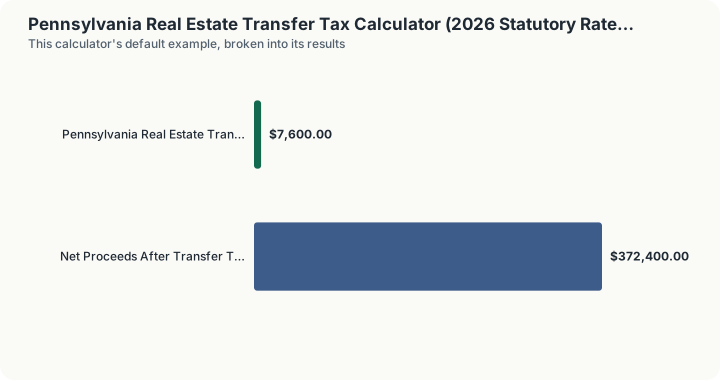
Step 4 -- Total transfer tax due. $3,800.00 + $3,800.00 = $7,600.00
Step 5 -- Net proceeds after tax. $380,000.00 - $7,600.00 = $372,400.00
Step 6 -- The effective rate. $7,600.00 / $380,000 = 2.000%
The calculator's $1,500,000 scenario runs the same two multiplications.
Step 7 -- State portion on the luxury sale. $1,500,000 x 0.01 = $15,000.00
Step 8 -- Local portion on the luxury sale. $1,500,000 x 0.01 = $15,000.00
Step 9 -- Total on the luxury sale. $15,000.00 + $15,000.00 = $30,000.00
Step 3 is the one that carries risk, because it is a typical rate rather than a universal one. Nearly all Pennsylvania municipalities and school districts have enacted the matching 1%, which is why 2% combined is the sensible statewide baseline, but Philadelphia is a large and expensive exception at 3.578% local, or 4.578% combined as of July 2025. On the baseline $380,000 sale, that Philadelphia rate would produce roughly $17,396 rather than the $7,600 in Step 4, so the municipality matters more to a Pennsylvania estimate than almost any other input. Buyer and seller customarily split the total, though the contract governs.
Two Percent, Split In Half, And The City That Breaks It
Pennsylvania's state realty transfer tax is 1%, and nearly every municipality and school district levies a matching local 1%, so the engine applies a combined 2% flat rate with no bracket in it.
The marginal cost of the next unit. Raising the sale price from $380,000 to $390,000 moves the transfer tax from $7,600.00 to $7,800.00. Every additional $10,000 of consideration costs exactly $200.00, and the effective rate output holds at 2.000% at every price. At $1,500,000 the tax is $30,000.00.
The reverse question: what price sits behind a given bill? Multiply by 50. A $7,600.00 transfer tax corresponds to $380,000 of consideration and a $30,000.00 bill to $1,500,000. There is no mansion surcharge, no threshold and no minimum in Pennsylvania's schedule, so the inversion holds exactly at every price.
Net proceeds, and why this rate is worth planning around. On the $380,000 baseline the engine reports $372,400.00 of net proceeds; on the $1,500,000 sale, $1,470,000.00. At 2% the transfer tax is ten times the burden of North Carolina's excise and more than thirteen times Oklahoma's documentary stamp on the same sale, which is why Pennsylvania closings routinely split it between buyer and seller rather than assigning it wholly to one side. The engine subtracts the entire amount from the seller's proceeds and models no split.
Right method against wrong method. The error is applying the 1% state rate alone. That produces half the $7,600.00 the engine reports, because the matching local 1% levied by the municipality and school district is the other half and is charged almost everywhere in the state. A quote built on the state statute alone understates a normal Pennsylvania closing by 1% of the sale price.
Where the engine understates instead, and it is the largest error on this page. Philadelphia's local realty transfer tax is 3.578%, for a combined 4.578% rather than the 2% modelled here. This calculator holds a single statewide average local rate of 1% and no municipal table, so on a Philadelphia sale the $7,600.00 shown for a $380,000 property is materially below the real charge, by more than the entire state portion. Philadelphia also assesses its tax on the property's computed value where consideration falls below it, a rule with no counterpart anywhere in this code path.
What is not computed. Pennsylvania exempts transfers between certain family members, transfers into and out of trusts for the same beneficial owners, and conveyances to governmental bodies; the engine tests for none of them. County recorder fees, title insurance premiums and settlement charges are all separate and absent from every figure above.
What This Does Not Account For
- Philadelphia's significantly higher combined rate. At 4.578% combined, Philadelphia transactions owe substantially more than the 2% statewide-typical rate this calculator models by default.
- Variation among other municipalities. While most Pennsylvania municipalities and school districts levy close to a matching 1% local rate, some may differ slightly; confirm the specific local rate for unusual jurisdictions.
- Exemptions. Pennsylvania law exempts certain transfers, including some transfers between family members, into certain trusts, and specific corporate reorganizations, from all or part of the realty transfer tax.
- Title insurance and settlement fees. These closing costs are separate from the state and local realty transfer taxes modeled here.
- Real estate commissions. Agent commissions are negotiated separately and are typically a significant additional cost at closing.
Common Pitfalls
- Applying the standard 2% rate to a Philadelphia transaction. This understates the actual tax due by more than half; Philadelphia's combined rate is 4.578%, not 2%.
- Assuming the 1% local rate is uniform everywhere outside Philadelphia. Most municipalities and school districts match close to 1% combined, but this can vary, and confirming the specific local rate is worthwhile for large transactions.
- Splitting the tax unevenly without checking the contract. Pennsylvania custom splits the transfer tax evenly between buyer and seller, but this is a negotiable term, not a legal requirement.
- Confusing the realty transfer tax with a mortgage-related tax. Pennsylvania's realty transfer tax applies to the deed conveying ownership, not to any mortgage or deed of trust securing the buyer's financing.
- Forgetting that the local component is a genuine second tax, not a rounding buffer. The local realty transfer tax is a distinct, separately authorized levy, not an administrative surcharge on the state tax.
Frequently Asked Questions
What is Pennsylvania's real estate transfer tax rate?
Why is Philadelphia's transfer tax so much higher?
Who pays Pennsylvania's realty transfer tax, the buyer or the seller?
Are any Pennsylvania real estate transfers exempt from the realty transfer tax?
Does this calculator show Philadelphia's higher rate by default?
Sources
- Pennsylvania Department of Revenue, Realty Transfer Tax (72 P.S. Section 8102-C et seq.); City of Philadelphia Department of Revenue, Realty Transfer Tax. revenue.pa.gov