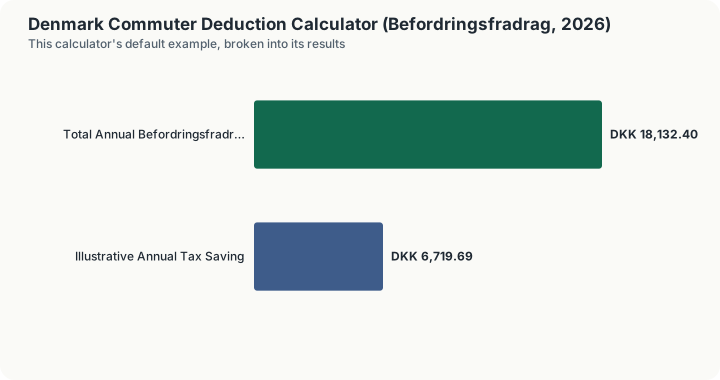
Quick Answer: A commuter driving 50 km round trip per day for 220 working days a year in an ordinary Danish municipality can claim an estimated DKK 18,132.40 in befordringsfradrag (commuter tax deduction) for 2026 -- worth roughly DKK 6,719.69 in illustrative tax savings at a combined bundskat-plus-average-municipal-tax rate.
Overview
Befordringsfradrag is Denmark's tax deduction for the cost of commuting between home and work, available to essentially any employee or self-employed person regardless of how they actually travel (car, train, bicycle, or on foot) -- it's based purely on distance, not actual transport cost or mode. The first 24 km of your daily round trip are never deductible, reflecting an assumption that a "normal" commute is expected to cost something out of pocket; distance beyond that is deducted per kilometer at a rate that steps down the further you travel, except for residents of a fixed list of periphery municipalities and small islands, who get a single higher rate for their entire commute with no step-down.
2026 is an unusually eventful year for this deduction. On top of the routine annual satsregulering (rate indexation), the Folketinget adopted a temporary increase to all three rates, applying to income year 2026 only. The ordinary indexed 2026 rates were DKK 2.28 per km for the 25-120 km tier and DKK 1.14 per km above 120 km; the temporary supplement lifts them to DKK 3.17 and DKK 1.59, with the yderkommune rate at DKK 3.51. This calculator uses the current, post-increase figures. If you are comparing against an estimate made earlier in the year on the original rates, that is the reason for the difference, not an error. Because the increase is explicitly for 2026 alone, do not carry these rates into a 2027 projection.
Denmark's currency is the Danish krone (DKK), and every figure in this calculator is denominated in DKK.
How This Is Calculated
- The 24 km floor. No deduction applies to the first 24 km of your daily round-trip commute -- only kilometers beyond that threshold are deductible.
- Standard distance tiers (2026, post-25-June-2026 increase): - 25-120 km: DKK 3.17 per km. - Above 120 km: DKK 1.59 per km (roughly half the middle-tier rate).
- Yderkommune (periphery municipality) rate. Residents of 25 designated periphery municipalities -- Bornholm, Brønderslev, Faaborg-Midtfyn, Frederikshavn, Guldborgsund, Hjørring, Jammerbugt, Langeland, Lolland, Læsø, Morsø, Norddjurs, Odsherred, Samsø, Skive, Slagelse, Struer, Svendborg, Sønderborg, Thisted, Tønder, Vesthimmerland, Vordingborg, Ærø, and Aabenraa -- or 10 small islands (Bågø, Egholm, Endelave, Hjarnø, Mandø, Nekselø, Orø, Sejerø, Tunø, and Årø) get a single flat rate of DKK 3.51 per km for their entire distance beyond 24 km, with no step-down past 120 km.
- Annual deduction. Daily deduction × working days per year:
- Tax value. Unlike the standard beskæftigelsesfradrag and jobfradrag, befordringsfradrag is a "ligningsmæssigt fradrag" (itemized deduction) that reduces your bundskat and municipal-tax (kommuneskat/kirkeskat) taxable base only -- it does not reduce AM-bidrag, mellemskat, topskat, or top-topskat. This calculator shows an illustrative tax saving using a combined bundskat (12.01%) plus the 2026 average kommuneskat (25.049%) rate, clearly labeled as an estimate.
Worked Example
Using the calculator's default inputs:
- Daily Round-Trip Commute: 50 km
- Working Days Per Year: 220
- Periphery Municipality: No
Step by step:
- Deductible km/day: 50 − 24 = 26 km (entirely within the 25-120 km tier).
- Daily deduction: 26 km × DKK 3.17 = DKK 82.42.
- Annual deduction: DKK 82.42 × 220 working days = DKK 18,132.40.
- Illustrative tax saving: DKK 18,132.40 × (12.01% + 25.049%) = DKK 18,132.40 × 37.059% ≈ DKK 6,719.69.
For a longer 150 km/day commute over the same 220 working days, the deductible distance (126 km) spans both tiers: 96 km at the 25-120km rate (min(126, 120−24) = 96) plus 30 km at the reduced above-120km rate -- 96 × DKK 3.17 + 30 × DKK 1.59 = DKK 304.32 + DKK 47.70 = DKK 352.02/day, or DKK 77,444.40/year. The same 150 km/day commute for a periphery-municipality resident instead applies the flat DKK 3.51/km rate to the entire 126 deductible km with no step-down: 126 × DKK 3.51 = DKK 442.26/day, or DKK 97,297.20/year -- nearly 26% more than the equivalent ordinary-municipality commuter.
What This Does Not Account For
- Actual transport cost or mode. Befordringsfradrag is purely distance-based; it applies the same whether you drive, take the train, cycle, or carpool, and does not require receipts for fuel, tickets, or tolls (a separate, additional bridge/ferry toll deduction exists for certain fixed crossings but is not modeled here).
- The 2026 increase's one-off nature. The 25 June 2026 legislation is explicitly described as a temporary, fuel-price-relief measure for income year 2026 only -- it is not part of the standard annual satsregulering, and future years may revert toward the lower, routinely-indexed rates unless separately re-legislated.
- Bridge and ferry supplements. Commuters who cross certain toll bridges (e.g., the Great Belt or Øresund) can claim an additional fixed daily supplement on top of the standard per-km deduction; this calculator does not include those.
- Actual working days worked. This calculator multiplies a flat per-day deduction by an input working-days figure; it does not separately account for sick days, unpaid leave, part-time schedules, or home-office days where no commute occurred, all of which reduce your actual deductible days below a standard 220-day assumption.
- Combining with other tax calculations. The illustrative tax saving shown here uses a representative combined bundskat + average-kommuneskat rate; your actual saving depends on your specific municipal tax rate and whether you're already below the personfradrag threshold (in which case the deduction may produce no cash saving at all).
Common Pitfalls
- Forgetting the 24 km floor applies before any rate, not per-tier. A 24 km round trip gets zero deduction, not "24 km at 0 kr. plus something at the 25 km mark" -- the floor simply subtracts from the total distance before any rate is applied.
- Assuming the yderkommune bonus only affects kilometers past 120 km. It's the opposite: periphery-municipality residents get the higher (technically "high tier") rate applied to their entire distance beyond 24 km, including what would otherwise be the reduced far-distance tier for everyone else.
- Using last year's rates. Because of the mid-2026 retroactive increase, anyone who calculated their 2026 deduction before 25 June 2026 using the original 2.28/1.14/2.53 kr/km figures understated their eligible deduction -- file (or amend) using the corrected 3.17/1.59/3.51 kr/km rates.
- Expecting the deduction to reduce every tax layer. Because befordringsfradrag only reduces the bundskat/kommuneskat base, high earners paying topskat or top-topskat get no additional benefit against those specific brackets from this deduction -- a common point of confusion when comparing to countries where a single flat marginal rate applies to all deductions equally.
Frequently Asked Questions
Why did my expected deduction jump partway through 2026?
Does it matter how I actually get to work?
Do I need to live in a periphery municipality to benefit from any special rate, or just work in one?
Will the elevated 2026 rates continue into 2027?
Can I combine befordringsfradrag with the standard beskæftigelsesfradrag and jobfradrag?
Sources
- Skattestyrelsen (tax.dk mirror of Juridisk Vejledning) -- C.A.4.3.3.2.2, "Befordringsfradrag ved bopæl i visse yderkommuner," directly confirming the 2026 DKK 3.51/km flat rate for the entire distance beyond 24 km with no reduction past 120 km. skat.dk
Also consulted: Lovguiden -- summary of "Forslag til Lov om ændring af ligningsloven (Forhøjelse af befordringsfradraget for indkomståret 2026)," passed by Folketinget 25 June 2026 with retroactive effect for all of income year 2026 (rate increases of 89/45/98 øre per km across the three tiers); xn--beregnkrselsfradrag-17b.dk -- compiled list of the 25 qualifying yderkommuner and 10 small islands for 2024-2027.