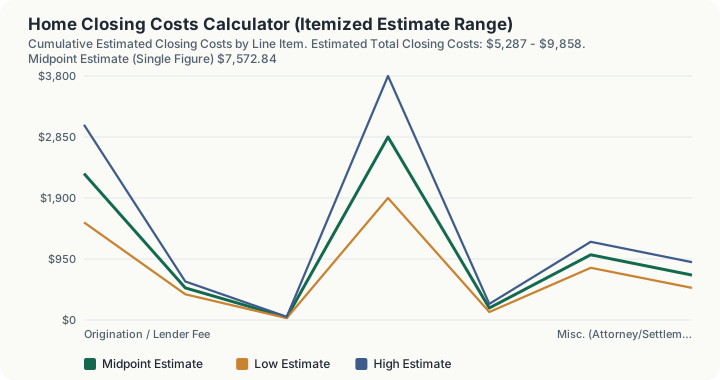
Quick Answer: On a $380,000 home financed with a $304,000 loan, total closing costs typically fall between $5,287 and $9,858 (about 1.4% to 2.6% of the home price for this loan-to-value mix, though the broader industry range cited by Freddie Mac runs 2% to 5% of purchase price across all scenarios), with origination fees alone estimated at $1,520 to $3,040.
Overview
Closing costs are not one fee. They are a bundle of lender charges, third-party service fees, government recording charges, and prepaid escrow reserves, all due at or before the closing table, on top of your down payment. The Consumer Financial Protection Bureau's own closing-cost research has found the median cost near $6,000, with more recent industry data putting the national average closer to $4,500 to $4,700, and Freddie Mac cites a broader typical range of 2% to 5% of the purchase price. None of those figures apply precisely to your transaction, because closing costs vary meaningfully by lender, loan type, property state, and county recording fee schedules.
This calculator does not pretend to know your lender's exact fee schedule, your state's transfer tax rules, or your county's recording fee table. Instead, it builds a reasonable estimate range for each major line item, using published ranges from CFPB and Freddie Mac research, and totals those ranges into a low and high bound plus a midpoint figure for rough budgeting. Every number here is a planning estimate, not a quote. Your lender's Loan Estimate, delivered within three business days of application under the TILA-RESPA Integrated Disclosure rule, is the document with your actual figures.
How This Is Calculated
Each line item is estimated as either a percentage of the loan amount or home price, or a flat dollar range, then summed into a total low and high bound:
- Origination / lender fee: 0.5% to 1.0% of the loan amount, the range Freddie Mac cites for the fee a lender charges to process, underwrite, and fund the loan.
- Appraisal fee: a flat $400 to $600, the typical range for a licensed appraiser's property valuation.
- Credit report fee: a flat $30 to $50, a small but real fee for pulling a tri-merge credit report.
- Title insurance & search: 0.5% to 1.0% of the home price, covering the title search, exam, and the lender's (and often owner's) title insurance policy.
- Recording fees: a flat $125 to $250, charged by the county or municipal recording office to file the deed and mortgage, and one of the most locally variable fees in this list.
- Prepaid escrow reserve: 2 to 3 months of estimated property tax and homeowners insurance, collected upfront to seed your escrow account, using the same table-derived national-average effective property tax rate and $125-a-month insurance placeholder already documented in this platform's mortgage-calculator, for consistency.
- Miscellaneous (attorney/settlement, underwriting, admin): a flat $500 to $900, covering settlement agent or attorney fees (required at closing in some states), underwriting fees, and courier/admin charges.
The low bound is the sum of every line item's low estimate; the high bound is the sum of every line item's high estimate; the midpoint is the simple average of the two totals.
Worked Example
A borrower buying a $380,000 home with a $304,000 loan (20% down):
- Origination fee: $1,520 to $3,040
- Appraisal fee: $400 to $600
- Credit report fee: $30 to $50
- Title insurance & search: $1,900 to $3,800
- Recording fees: $125 to $250
- Prepaid escrow reserve (2-3 months of tax and insurance): $909 to $1,363
- Miscellaneous fees: $500 to $900
- Total estimated closing costs: $5,384 to $10,003, or roughly 1.4% to 2.6% of the home price
- Midpoint estimate for rough budgeting: $7,693.34
A borrower financing a smaller loan relative to price, say 5% down instead of 20%, sees a higher loan amount and therefore a higher origination fee range, since that fee scales with the loan, not the price, while title insurance and the escrow reserve, which scale with price, stay the same. A higher purchase price scales every price-based and loan-based line item up proportionally, while the flat fees (appraisal, credit report, recording, misc.) stay fixed regardless of price, so the percentage-of-price total tends to compress slightly at higher price points.
What This Does Not Account For
- State and local transfer taxes. Many states and counties charge a real estate transfer tax on the sale, calculated as a percentage of price; this varies enormously by jurisdiction (some states charge none, others charge over 1%) and is not included in this estimate. Check this platform's state-specific real estate transfer tax calculators for your state.
- Seller-paid closing costs and lender credits. Many purchase contracts include seller concessions toward closing costs, and many lenders offer a lender credit in exchange for a slightly higher rate; neither is modeled here, since both are negotiated on a per-transaction basis.
- Points and rate buydowns. Paying discount points to lower your rate is itself a closing cost, often 1% of the loan amount per point, and is not included in the ranges above since it is optional and rate-dependent.
- HOA transfer or resale certificate fees, home warranty premiums, and pest inspection fees. These are common in specific markets and property types but are not universal enough to include in a general estimate.
- Loan-type-specific fees. FHA upfront mortgage insurance premium, VA funding fee, and USDA guarantee fee are separate charges tied to specific government loan programs and are not included in this general conventional-style estimate.
Common Pitfalls
- Treating the low end of the range as your actual cost. Ranges reflect real variation across lenders and states; budgeting to the low bound and getting quoted the high bound can create a cash-at-closing shortfall.
- Forgetting the prepaid escrow reserve is real cash due at closing, not a "fee." Unlike origination or title charges, the escrow reserve is your own money being pre-funded into an account, but it still has to be in your bank account on closing day.
- Assuming closing costs scale only with home price. Origination fees scale with the loan amount, so a large down payment lowers that specific line item even at a fixed home price.
- Not shopping title insurance and origination fees. Some line items, particularly title insurance and lender fees, can be shopped or negotiated; government recording fees generally cannot.
- Comparing a Loan Estimate from one lender against a lender credit-heavy quote from another without checking the trade-off rate. A lower closing cost quote paired with a materially higher rate can cost more over the life of the loan; compare the full picture, not just the closing-cost line.
Frequently Asked Questions
Why does this show a range instead of one number?
Is 2% to 5% of the purchase price a reliable rule of thumb?
Do closing costs include my down payment?
Can closing costs be rolled into the loan?
Why is the origination fee based on the loan amount and not the home price?
Sources
- Consumer Financial Protection Bureau: closing cost research and "junk fees" residential mortgage fee assessment, including 2021-2023 median total loan cost trend data. consumerfinance.gov
- Consumer Financial Protection Bureau: TILA-RESPA Integrated Disclosure (TRID) rule and the Loan Estimate / Closing Disclosure requirements under Regulation Z. ecfr.gov/current/title-12/chapter-X/part-1026
Also consulted: Freddie Mac (My Home by Freddie Mac): "What Are Closing Costs and How Much Will I Pay?" guidance citing a 2% to 5% of purchase price typical range and the 0.5% to 1.0% loan origination fee range.