Quick Answer: The Gordon Growth Model values a dividend-paying stock as next year's expected dividend divided by the difference between your required rate of return and the dividend's expected long-run growth rate.
Overview
The dividend discount model rests on a straightforward idea: the fair value of a share of stock equals the present value of every dividend it will ever pay. Since forecasting an infinite stream of individual future dividends is impractical, Myron Gordon and Eli Shapiro developed a simplified closed-form version in the 1950s and 1960s, now known as the Gordon Growth Model, which assumes dividends grow at one constant rate forever. That single assumption collapses an infinite sum into a simple formula that can be computed by hand.
The model is most useful for mature, stable, dividend-paying companies with a long track record of consistent payout growth, think regulated utilities, established consumer staples businesses, and similarly predictable dividend payers. It is far less reliable for young growth companies that pay no dividend at all, or for companies whose dividend policy is erratic or tied closely to cyclical earnings, since a single constant growth rate cannot meaningfully describe either situation.
A key structural feature of the model is what it implies about total return. Because the intrinsic value formula rearranges to show that the dividend yield (next year's dividend divided by price) equals the required return minus the growth rate, the model effectively decomposes an investor's total expected return into two pieces: the cash dividend yield they collect today, and the capital appreciation they expect from the stock price growing in step with the dividend over time.
How This Is Calculated
Step 1: Project next year's dividend from the current dividend.
Step 2: Apply the Gordon Growth formula.
Where: - D₀ is the most recent annual dividend actually paid per share. - D₁ is the dividend expected next year. - g is the expected constant annual growth rate of the dividend into perpetuity. - r is the investor's required rate of return, often estimated using CAPM (see the Cost of Equity calculator).
The formula is only mathematically defined when the required return exceeds the growth rate (r > g). If growth is expected to equal or exceed the required return, the denominator becomes zero or negative, and the model produces no finite, economically meaningful value, since it would imply the stock is worth an infinite (or negative) amount, which is not a sensible real-world result.
Worked Example
Consider a stock currently paying a $2.00 annual dividend per share, expected to grow that dividend 5% per year indefinitely, with an investor requiring a 9% annual return to hold the stock.
Step 1: Project next year's dividend.
Step 2: Apply the Gordon Growth formula.
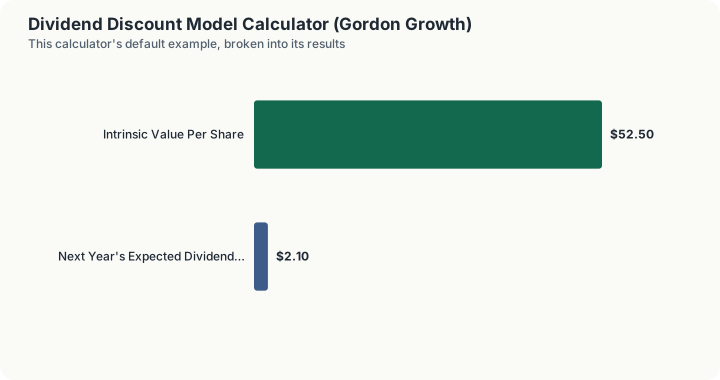
The model estimates the stock's intrinsic value at $52.50 per share. As a sanity check, dividing the projected dividend by that intrinsic value recovers the implied dividend yield:
That 4.00% figure exactly equals the required return (9%) minus the growth rate (5%), which will always hold true by construction. It means an investor buying at this intrinsic value should expect roughly 4% of their total 9% required return to come from the dividend itself, with the remaining 5% expected to come from the share price appreciating in line with the growing dividend over time.
What This Does Not Account For
- Non-constant growth. Many real companies grow dividends unevenly: rapidly early on, then slowing as the business matures. A single constant growth rate cannot capture a multi-stage growth trajectory; a two-stage or multi-stage dividend discount model is better suited for that situation.
- Dividend cuts or suspensions. The model assumes dividends grow smoothly and indefinitely. It has no mechanism for modeling the possibility that a company reduces or eliminates its dividend, which does happen, particularly during recessions or company-specific financial stress.
- Companies that do not pay dividends. The model is entirely inapplicable to non-dividend-paying stocks, including most early-stage growth and technology companies that reinvest all available cash rather than distributing it to shareholders.
- Share buybacks as an alternative capital return. Many companies today return cash to shareholders partly or entirely through buybacks rather than dividends. This model only values the dividend stream and ignores that additional source of shareholder value.
- Extreme sensitivity near the r ≈ g boundary. As the required return approaches the growth rate, the denominator shrinks toward zero and the implied value grows explosively large. Small changes in either assumption near that boundary can produce wildly different valuations.
Common Pitfalls
- Using a growth rate close to or above the required return. This is the single most common modeling error with the Gordon Growth Model. A growth assumption too close to the discount rate inflates the valuation to an unrealistic degree, and a growth rate at or above the required return breaks the formula entirely.
- Assuming perpetual growth at a rate the company cannot sustain. A dividend growth rate that exceeds the company's long-run earnings growth rate is not sustainable indefinitely; eventually the payout ratio would exceed 100% of earnings.
- Applying the single-stage model to a young or rapidly growing dividend payer. Companies that recently initiated a dividend or are still growing it at an unusually fast rate need a multi-stage model that lets growth slow down over time, not a single constant-growth assumption.
- Forgetting that D1, not D0, belongs in the numerator. A common calculation error is dividing the current (already-paid) dividend by (r - g) instead of first growing it forward one year. This understates intrinsic value.
- Treating the output as a precise target price. Like all discounted cash flow-style models, the Gordon Growth Model is highly sensitive to its two key assumptions. Small changes in either the growth rate or required return materially change the intrinsic value, so the output is best treated as a reasoned estimate, not a precise price target.
Frequently Asked Questions
What happens if the growth rate is higher than the required return?
Can this model be used for stocks that do not pay dividends?
How is the required rate of return typically estimated?
Why does dividend yield equal required return minus growth rate?
Is the Gordon Growth Model still used by professional analysts?
Sources
- U.S. Securities and Exchange Commission, Investor.gov, the official authority for the investing this calculator relates to. investor.gov
Also consulted: Gordon, Myron J., "Dividends, Earnings, and Stock Prices," The Review of Economics and Statistics, 1959; Investopedia, "Dividend Discount Model (DDM) Formula, Variations, Examples"; Corporate Finance Institute (CFI), "Gordon Growth Model".