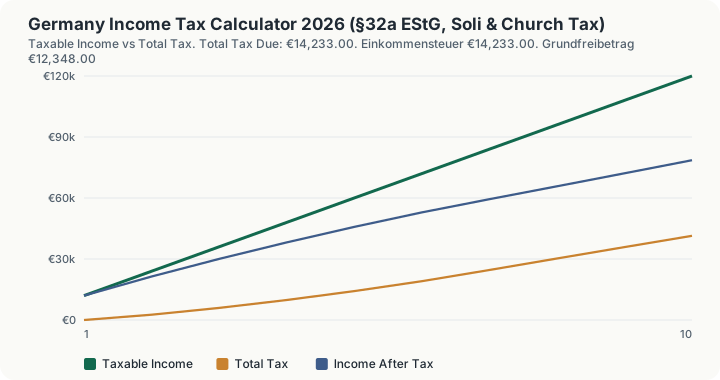
Quick Answer: A single filer with €60,000 of taxable income owes €14,233.00 in 2026: an effective rate of 23.72%. No Solidaritätszuschlag is due, because the income tax falls below the €20,350 Freigrenze. The same €60,000 for a married couple using Ehegattensplitting costs only €8,434, a saving of €5,799.
What does this calculator do?
German income tax is not a bracket table. §32a EStG defines a continuous tariff in five zones, two of which use quadratic formulas, so the marginal rate rises smoothly rather than jumping at thresholds.
- Zone 1: income up to the Grundfreibetrag of €12,348 is tax free
- Zones 2 and 3: quadratic formulas, with the marginal rate climbing continuously from 14% to 42%
- Zone 4: a flat 42% above €69,878
- Zone 5: 45% above €277,825, the Reichensteuer
Two surcharges sit on top, and both are charged on the tax, not on income. The Solidaritätszuschlag is 5.5% of income tax, but only once income tax exceeds a Freigrenze of €20,350 for a single filer, which is why most taxpayers now pay none. Kirchensteuer is 8% or 9% of income tax depending on the state, for church members.
How is this calculated?
Step 1: The §32a tariff. The zone is found from taxable income, then the published formula for that zone is applied exactly. For zone 3, with z being the excess over €17,799 divided by 10,000:
Tax = (173.10 × z + 2,397) × z + 1,034.87
Zone 4 is linear at $0.42x - 11{,}135.63$, and zone 5 at $0.45x - 19{,}470.38$.
Step 2: Ehegattensplitting, for married couples filing jointly: the combined taxable income is halved, the tariff applied once, and the result doubled. Because the tariff is progressive, this is always at least as good as filing separately, and the advantage is largest where one spouse earns much more than the other.
Step 3: Solidaritätszuschlag. 5.5% of the income tax, but only where that tax exceeds €20,350 single or €40,700 married. Between the Freigrenze and the point where the full rate applies, a Milderungszone caps the surcharge at 11.9% of the excess.
Step 4: Kirchensteuer. 8% of the income tax in Bayern and Baden-Württemberg, 9% in the other fourteen states.
Worked Example
€60,000 taxable, single, no church membership:
- Zone 3, since €60,000 is between €17,799 and €69,878
- Einkommensteuer: €14,233
- Solidaritätszuschlag: nil, because €14,233 is below the €20,350 Freigrenze
- Total: €14,233, an effective rate of 23.72%
The same €60,000, married filing jointly:
- Halved to €30,000, taxed once, doubled
- Total: €8,434, €5,799 less than the single filer, purely from the splitting.
€120,000 taxable, single:
- Zone 4, the flat 42% band
- Einkommensteuer: €39,264
- Solidaritätszuschlag: €39,264 × 5.5% = €2,159.52, now above the Freigrenze
- Total: €41,423.52
With church membership at €60,000: €14,233 × 9% = €1,280.97 in Nordrhein-Westfalen, or €1,138.64 in Bayern at 8%.
Two Real Thresholds: the Grundfreibetrag and the Soli Freigrenze
Unlike most pages on this site, the German schedule has genuine discontinuities in it, and the engine implements two of them precisely enough to walk.
At €12,348 of taxable income. The engine returns €0.00 of income tax and reports Zone 1. This is the Grundfreibetrag, the basic allowance, and it is the exact figure the calculator holds.
At €12,349, one euro later. The engine returns €0.00 of income tax and reports Zone 2. The zone label changes and the tax does not, because zone 2 begins at a marginal rate of 14% applied to the euro above the allowance. At €12,500 the tax is €21.00, so the first €152 above the allowance cost €21.
The second threshold is the solidarity surcharge, and it is not on income. The Soli Freigrenze in this engine is €20,350 of income tax, not of income. At €74,960 of taxable income the tax is €20,347 and the surcharge is €0.00. At €74,970 the tax is €20,351 and the surcharge is €0.12. Ten euros of income switch the surcharge on. It then ramps rather than jumping: €0.60 at €74,980, €1.67 at €75,000, €51.65 at €76,000 and €251.57 at €80,000, reaching €1,251.17 at €100,000.
The zone boundaries the sweep crosses. At €17,443 the engine reports Zone 2 with €950 of tax; by €18,000 it reports Zone 3 with €1,083. At €60,000, the baseline, it reports Zone 3, €14,233 of tax and a 23.72% effective rate. At €80,000 it reports Zone 4. At €277,825 it reports Zone 4 with €105,550 of income tax; at €277,826 it reports Zone 5, the Reichensteuer band, with €105,551. The marginal rate above that point is 45%, and the one euro that crosses it costs one euro of tax.
The marginal cost of the next thousand euros. At the baseline, taking income from €60,000 to €61,000 moves the tax from €14,233 to €14,620. That thousand euros costs €387, a 38.7% marginal rate against the 23.72% effective rate the page reports. The gap between those two numbers is the whole of what Germany's progressive formula does.
Church tax and filing status, priced. Setting church membership to yes adds €1,280.97 on the baseline, taking total tax from €14,233.00 to €15,513.97 and the effective rate from 23.72% to 25.86%. Switching to married filing takes the tax from €14,233.00 to €8,434.00, a saving of €5,799.00, because the Splittingverfahren taxes half the income and doubles the result.
What the engine leaves out. It taxes the figure you enter as taxable income and computes nothing before that: no Werbungskosten, no Sonderausgaben, no Vorsorgeaufwendungen, and no social insurance contributions for pension, health, care or unemployment, which together take a large share of a German salary and are not income tax. The ten-row table scales income from one fifth to twice your figure at fixed status, so its first row at €12,000 correctly returns €0 of tax.
What does this calculator not account for?
- Social insurance contributions. Pension, health, nursing care and unemployment insurance are separate and substantial. The German net salary calculator covers those.
- The distinction between gross salary and zvE. The tariff applies to zu versteuerndes Einkommen, which is income after Werbungskosten, Sonderausgaben, the Arbeitnehmer-Pauschbetrag and other deductions. Entering gross salary here will overstate the tax.
- Steuerklassen. The six wage tax classes affect monthly withholding, not the final annual liability computed here.
- Kinderfreibetrag and Kindergeld, and the Günstigerprüfung that determines which is better.
- The Progressionsvorbehalt, under which exempt income such as Elterngeld or Arbeitslosengeld still raises the rate applied to taxable income.
- Capital income, taxed separately at the 25% Abgeltungsteuer rather than under §32a.
- The Milderungszone detail. It is implemented, but the worked examples above sit either side of it rather than inside it.
- Trade tax (Gewerbesteuer) for business income.
What mistakes do people make with this?
- Entering gross salary instead of taxable income. This is by far the most common error. German tax applies to zvE, after deductions and social insurance, which is materially lower than gross pay.
- Looking for tax brackets. There are none in the usual sense. Zones 2 and 3 are quadratic, so the marginal rate rises continuously and no threshold produces a jump in the bill.
- Assuming everyone pays the Soli. Since the 2021 reform it applies only above a Freigrenze of €20,350 of income tax, which corresponds to a fairly high income. Most taxpayers pay nothing.
- Treating church tax as a percentage of income. It is a percentage of the income tax. At €60,000 that is €1,280.97, not 9% of €60,000.
- Underestimating Ehegattensplitting. At €60,000 it saves €5,799. The advantage grows the more unequal the two incomes are.
- Using the 45% rate too early. It only applies above €277,825. The 42% zone starts far lower, at €69,878.
Frequently Asked Questions
What is the Grundfreibetrag for 2026?
Why is there no bracket table?
Do I have to pay the Solidaritätszuschlag?
How much is church tax?
What is Ehegattensplitting worth?
Should I enter my gross salary?
Sources
- Einkommensteuergesetz § 32a, Einkommensteuertarif, as in force from Veranlagungszeitraum 2026 (Grundfreibetrag €12,348), Bundesministerium der Justiz. gesetze-im-internet.de/estg/__32a.html
Also consulted: §32a EStG, Einkommensteuertarif, assessment year 2026, gesetze-im-internet.de/estg/__32a.html; The zone 5 formula 0.45x − 19,470.38 was independently re-confirmed against official sources on 30 August 2026; Solidaritätszuschlaggesetz, 5.5% rate, Freigrenze of €20,350 single and €40,700 joint, and the 11.9% Milderungszone; Underlying figures verified 2026-08-22 and re-checked 2026-08-30.