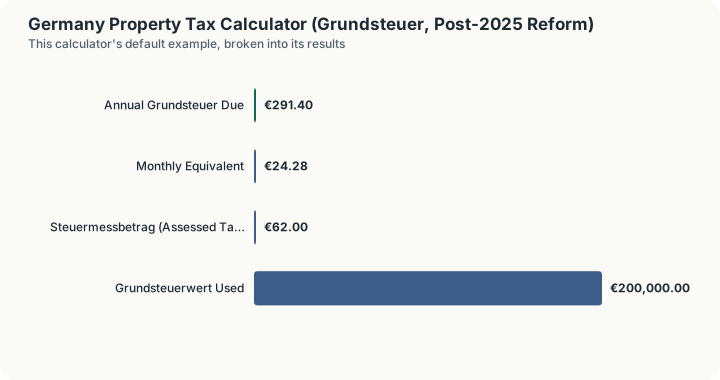
Quick Answer: A residential property in a Bundesmodell state with an assessed Grundsteuerwert of €200,000.00 and a municipal Hebesatz of 470% owes €291.40 per year (€24.28/month) in Grundsteuer -- the assessed Steuermessbetrag of €62.00 multiplied by the local Hebesatz.
Overview
Grundsteuer is Germany's recurring annual property tax, paid every year by whoever owns real property (or, indirectly, by tenants, since it can be passed through as part of Nebenkosten/utility charges under current law, though a change to end that pass-through has been under political discussion). Following a 2018 ruling by the Federal Constitutional Court (Bundesverfassungsgericht) that the old valuation system -- based on property values last assessed in 1935 (East Germany) or 1964 (West Germany) -- was unconstitutionally outdated and unequal, Germany overhauled the entire system. New property values (Grundsteuerwert) were assessed as of 1 January 2022, and the reformed tax has applied since 1 January 2025.
This is a genuinely complex, easy-to-get-wrong change: eleven states use a shared federal formula (the "Bundesmodell"), while five states -- Baden-Württemberg, Bavaria, Hamburg, Hesse, and Lower Saxony -- exercised a constitutional "Öffnungsklausel" (opening clause) to adopt their own, structurally different valuation models entirely. This calculator implements the Bundesmodell formula only: Grundsteuerwert × Steuermesszahl × Hebesatz. It does not attempt to derive your Grundsteuerwert from scratch (that requires official Bodenrichtwert land-value lookups and statistical rent tables specific to your municipality) -- instead, you enter the Grundsteuerwert exactly as assessed on your Finanzamt's Grundsteuerwertbescheid letter, and the calculator applies the tax formula precisely from there.
Germany's currency is the euro (€); every figure in this calculator is denominated in euros.
How This Is Calculated
Germany rebuilt its property tax from scratch for 2025 after the constitutional court struck down valuations that had gone unchanged since 1964 in the west and 1935 in the east. The new Grundsteuer runs value through two fixed multipliers and one that each municipality sets for itself, which is where nearly all the variation between towns comes from. The calculation runs in four steps:
- Start from your assessed Grundsteuerwert. Determined by your local Finanzamt under the Ertragswertverfahren (income-capitalization method, used for most residential property: based on the Bodenrichtwert land value, property area, statistical net cold rent by region and property type, and building age) or the Sachwertverfahren (cost method, used for most non-residential and unusual property types).
- Apply the Steuermesszahl (tax assessment multiplier). Set by federal law at 0.31 per mille (0.00031) for residential property (Wohngrundstücke: single/two-family homes, condominiums, apartment buildings) and 0.34 per mille (0.00034) for non-residential/commercial/unbuilt land.
- Apply any qualifying reductions to the Steuermesszahl, which stack multiplicatively: a 25% reduction for qualifying social/subsidized housing (Wohngemeinnützigkeit), and a 10% reduction for a legally heritage-protected building (Baudenkmal).
- Apply the municipal Hebesatz -- a multiplier set independently by each city or municipality (Gemeinde), expressed as a percentage (e.g. 470% = ×4.70).
Worked Example
Using the calculator's default inputs:
- Grundsteuerwert: €200,000.00
- Property Type: Residential
- Hebesatz: 470%
- Social Housing / Heritage Building: No
Step by step:
- Residential Steuermesszahl: 0.31 per mille (0.00031).
- Steuermessbetrag: €200,000.00 × 0.00031 = €62.00.
- Annual Grundsteuer: €62.00 × (470 ÷ 100) = €62.00 × 4.70 = €291.40/year, or €24.28/month.
If the same property were a legally protected heritage building (Baudenkmal), the Steuermesszahl drops 10% to 0.279 per mille, cutting the Steuermessbetrag to €55.80 and the annual tax to €262.26. If it instead qualified as social/subsidized housing, the 25% reduction brings the Steuermessbetrag to €46.50 and the annual tax to €218.55.
What This Does Not Account For
- The five deviating-model states. Baden-Württemberg (a pure land-value "Bodenwertmodell," ignoring building value entirely), Bavaria (an area-based "Flächenmodell" independent of property value), Hamburg (a "Wohnlagemodell" based on location quality), Hesse (a "Flächen-Faktor-Verfahren"), and Lower Saxony (a "Flächen-Lage-Modell") all use entirely different formulas from the Bundesmodell implemented here. If your property is in one of these five states, this calculator's formula does not apply to it at all -- consult your state's own Grundsteuer guidance.
- Deriving the Grundsteuerwert itself. Computing the Grundsteuerwert from raw inputs (land area, Bodenrichtwert, living area, construction year, statistical net cold rent by Mietniveaustufe) requires official, municipality-specific lookup tables (Anlagen 39-43 of the Bewertungsgesetz) that are not reproduced here; use the value from your actual Grundsteuerwertbescheid.
- Saxony and Saarland's slightly modified Steuermesszahl. Both states used a narrow opening-clause option to adjust the Bundesmodell's non-residential Steuermesszahl slightly differently from the standard 0.34 per mille; this calculator uses the standard federal figures for all Bundesmodell states.
- Revision cycles and future reassessment. Grundsteuerwert values are intended to be reassessed periodically (currently planned every 7 years); this calculator reflects a snapshot value you provide and does not project future reassessments.
- Pass-through to tenants. Landlords can currently pass Grundsteuer through to tenants as part of Nebenkosten (utility/operating cost) statements; this calculator computes the underlying tax only, not its allocation between owner and tenant.
Common Pitfalls
- Using your old (pre-2025) Einheitswert-based tax bill as a reference point. The entire valuation basis changed; an old assessment based on 1935/1964 values bears no fixed relationship to your new Grundsteuerwert-based bill -- some property owners see large increases, others large decreases, depending on how their local land value has moved.
- Applying the Bundesmodell formula in one of the five deviating states. Because 11 states use the shared federal formula and public discussion often treats "the Grundsteuer reform" as one uniform system, it's easy to assume your state uses this calculator's formula when it does not.
- Confusing the Hebesatz with a tax rate on your Grundsteuerwert directly. The Hebesatz multiplies the (already tiny) Steuermessbetrag, not the Grundsteuerwert itself -- a "470%" Hebesatz sounds dramatic but, applied to a Steuermessbetrag that's already a fraction of a percent of the property value, produces a modest annual bill.
- Forgetting reductions stack multiplicatively, not by simple subtraction. A property that is both heritage-protected and social housing gets 0.75 × 0.90 = 0.675 of the base Steuermesszahl, not a flat 35% off.
- Ignoring that Hebesätze vary enormously by city, not just by state. Within the same state, one municipality's Hebesatz can be a small fraction of a large city's -- always confirm your specific municipality's current Hebesatz rather than assuming a state average.
Frequently Asked Questions
What changed in the 2025 Grundsteuer reform?
Why do some states use a completely different formula?
Where do I find my property's Grundsteuerwert?
Where do I find my municipality's current Hebesatz?
Does Grundsteuer apply even if I don't rent out my property?
Why did some homeowners see a big tax increase (or decrease) after the reform, even in the same city?
Can I appeal my assessed Grundsteuerwert if I think it's too high?
Sources
- Multiple independent secondary sources corroborating the Bundesmodell formula structure and the list of five states using a deviating valuation model, consulted after the BMF's own Grundsteuer explainer page returned a 404 error during this research session -- flagged here for transparency. bmf.gv.at
- Federal Ministry of Finance (Germany), the official authority for the national tax authority this calculator relates to. bundesfinanzministerium.de
Also consulted: Bundesverfassungsgericht ruling of 10 April 2018 (1 BvL 11/14 and related cases) -- declaring the pre-reform Einheitswert valuation system unconstitutional; Grundsteuergesetz (GrStG) §15 -- Steuermesszahl für Grundstücke, current consolidated text, for the 0.31‰/0.34‰ base rates and the social-housing (-25%) and heritage-building (-10%) reductions; Bewertungsgesetz (BewG) -- valuation-date (1 January 2022) and Ertragswertverfahren/Sachwertverfahren methodology for the underlying Grundsteuerwert (not independently reproduced in this calculator).