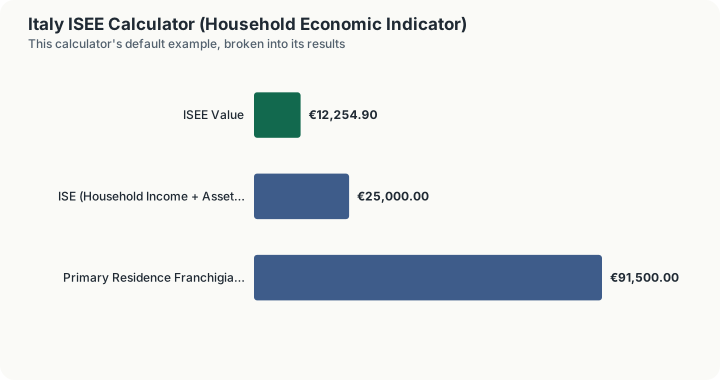
Quick Answer: A three-person household with €25,000 in combined income, €10,000 in savings, and a €100,000 home carrying a €30,000 mortgage produces an ISEE (Indicatore della Situazione Economica Equivalente) of €12,254.90 -- because both the financial-asset and primary-residence franchigie fully absorb this household's modest assets, leaving income as the only component that counts.
Overview
ISEE is Italy's standardized means-tested household economic indicator -- the single number that gates eligibility for a huge range of welfare benefits, university fee reductions, childcare bonuses, and other social programs. It is calculated according to a detailed national methodology (DPCM 5 December 2013, n. 159) that combines household income with a 20% share of net financial and real-estate assets, then divides the result by a household-size-based "scala di equivalenza" to make the figure comparable across families of different sizes.
The real ISEE calculation, run through INPS's official DSU (Dichiarazione Sostitutiva Unica), is genuinely intricate -- it pulls dozens of income and asset sub-categories from tax and banking records. This calculator implements a deliberately simplified but mathematically faithful version of the core formula: it captures the franchigie (deduction thresholds), the 20% asset quota, and the scala di equivalenza exactly as the regulation defines them, while consolidating income and asset inputs into single figures you supply directly. Every simplification is disclosed below.
How This Is Calculated
Step 1 -- Financial-asset (patrimonio mobiliare) franchigia:
Step 2 -- Primary-residence franchigia (net of any mortgage), using the 2026 figures:
Which franchigia applies depends on the benefit. For the five measures the 2026 reform covers (Assegno di inclusione, Supporto per la formazione e il lavoro, Assegno unico, Bonus asilo nido, Bonus nuovi nati):
For every other use of ISEE, university tuition banding and school services included, the ordinary DPCM 159/2013 figure still governs, with no metro-city variant and with the addon running one child later:
Any other real estate (second homes, land) counts at its full net value -- no franchigia applies.
Step 3 -- ISE (Indicatore della Situazione Economica) and ISEE:
The scala di equivalenza is fixed by household size: 1.00 (1 member), 1.57 (2), 2.04 (3), 2.46 (4), 2.85 (5), plus +0.35 for each additional member beyond 5.
Worked Example
Using the calculator's default inputs -- €25,000 household income, €10,000 in financial assets, a €100,000 home with a €30,000 mortgage, household size 3:
- Financial-asset franchigia = min(€6,000 + €2,000×2, €10,000) = €10,000 (capped). Net financial assets = max(0, €10,000 − €10,000) = €0.
- Home equity = €100,000 − €30,000 = €70,000. Applying for one of the five reformed benefits, the primary-residence franchigia (standard, not metro) = €91,500 -- well above the €70,000 equity, so net home value = €0.
- ISE = €25,000 (income) + 20% × (€0 + €0) = €25,000.
- Scala di equivalenza for a 3-person household = 2.04.
- ISEE = €25,000 ÷ 2.04 = €12,254.90.
Switch the same household to the "any other benefit" setting, which is what a university uses, and the franchigia drops to €52,500. Now €17,500 of the home equity counts, its 20% quota adds €3,500, ISE rises to €28,500, and the ISEE becomes €13,970.59 instead of €12,254.90. Same family, same house, two valid figures.
Now compare a different household: €20,000 of income, no financial assets, the same €100,000 home but no mortgage, in a standard (non-metro) comune, household size 2. Home equity is the full €100,000, which exceeds the €91,500 franchigia by €8,500 -- that excess counts toward patrimonio, pushing ISE to €21,700 and ISEE to €13,821.66. The same household in one of the 14 città metropolitane (€120,000 franchigia) fully absorbs the €100,000 home value, leaving ISE at just the €20,000 income figure and ISEE at €12,738.85 -- a concrete illustration of how much the 2026 metro-city franchigia increase can lower a household's ISEE.
What This Does Not Account For
- Detailed per-category income rules. DPCM 159/2013 has specific treatment for employment income, self-employment income, pensions, foreign income, and more, each with its own adjustments. This calculator takes a single already-net household income figure instead.
- The scala di equivalenza maggiorazioni. The regulation adds +0.5 for a household member with a serious disability/non-self-sufficiency, +0.2 for a single working parent with minor children, and +0.2 for households with 3+ minor children -- none of these are modeled here; this calculator implements only the base household-size table.
- Deriving real-estate values internally. This calculator takes your primary residence's IMU-style value as a direct input (use this platform's IMU calculator to derive it from a raw rendita catastale) rather than computing it from cadastral data itself.
- Non-EU / foreign assets and cryptocurrency. The 2026 reform reportedly introduced new disclosure obligations for cryptocurrency and other digital assets as part of patrimonio mobiliare -- not modeled here.
- The exact boundary of the five-benefit list. The calculator gives you both paths, but it cannot tell you which one a particular office will use for a benefit not named in the reform. Where a local scheme is unclear, ask the erogating body which franchigia it applies before relying on either figure.
- Multiple real estate properties with different mortgage situations, each handled individually rather than as a single combined "other real estate" figure.
Common Pitfalls
- Assuming financial assets and real estate are treated identically. They are not: financial assets get a franchigia based on household size and minors; the primary residence gets a much larger, separate franchigia; and any OTHER real estate gets no franchigia at all -- its full net value counts.
- Forgetting the €10,000 cap on the base financial-asset franchigia. A household of 6 or more does not keep getting an unlimited €2,000-per-member increase -- the base+per-member portion caps at €10,000, though the separate per-minor addon is uncapped and stacks on top.
- Assuming you have one ISEE. Since 2026 a homeowner can have two valid figures at once, because the raised €91,500/€120,000 primary-residence franchigia reaches only five benefits while everything else still runs on €52,500. Quoting the friendlier number at an office that uses the other one wastes an application. Set the benefit selector to match what you are actually applying for.
- Not distinguishing "minors beyond the second" from "dependent children beyond the first." These feed two entirely different franchigie in this calculator (financial-asset franchigia vs. primary-residence franchigia) and are not interchangeable inputs.
- Treating ISEE as a tax calculation. ISEE is a means-testing indicator for benefit eligibility, not a tax -- a lower ISEE generally means MORE access to subsidized benefits, the opposite of how a lower taxable-income figure works for IRPEF.
Frequently Asked Questions
What is ISEE used for?
How is the ISEE formula structured?
What changed with the 2026 reform to ISEE?
Which ISEE figure applies to my university fees?
Does owning my home hurt my ISEE?
Is a second home treated the same as my primary residence for ISEE?
Why does household size matter so much?
Can I calculate my real, official ISEE with this tool?
Sources
- Italian Revenue Agency (Agenzia delle Entrate), the official authority for the national tax authority this calculator relates to. agenziaentrate.gov.it
Caveat: the exact enacted 2026 franchigia text was not independently fetched from Normattiva/Gazzetta Ufficiale this session (only concordant press coverage); the scala di equivalenza maggiorazioni for disability/single-parent/large-family households, and the detailed per-income-category DPCM 159/2013 rules, are disclosed above as simplifications not modeled in this calculator.
Also consulted: DPCM 5 December 2013, n. 159: core ISEE methodology, movable-asset franchigia (Art. 5), and scala di equivalenza base table (Allegato 1) -- primary regulatory text corroborated via concordant secondary sources; 2026 primary-residence franchigia increase (€91,500 standard / €120,000 metro): reported consistently across multiple independent 2026 press sources (orizzontescuola.it, diritto.it, fiscoetasse.com, grifofinance.com, simulamutuo.it) as part of the Legge di Bilancio 2026 (L. 199/2025); Scope of the raised franchigia: Patronato INCA CGIL and laleggepertutti concordantly limit it to five measures (Assegno di inclusione, Supporto per la formazione e il lavoro, Assegno unico e universale, Bonus asilo nido, Bonus nuovi nati), with every other use of ISEE staying on the ordinary DPCM 159/2013 franchigia of €52,500. Both paths were implemented as a benefit selector on 2026-08-28; L. 199/2025, art. 1, comma 208: the same provision restates the €2,500 per-child addon as applying to each cohabiting child "successivo al primo", where DPCM 159/2013 art. 5 comma 2 had it run from each child "successivo al secondo". Corrected in this calculator on 2026-08-28; a two-child household now receives one €2,500 addon where it previously received none.