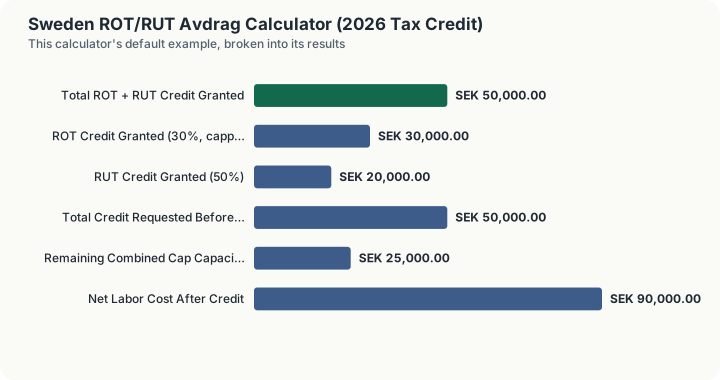
Quick Answer: SEK 100,000 of ROT (renovation) labor cost plus SEK 40,000 of RUT (household service) labor cost generates a combined SEK 50,000 tax credit -- 30% of the ROT labor (SEK 30,000) and 50% of the RUT labor (SEK 20,000) -- comfortably within both the SEK 50,000 ROT sub-cap and the SEK 75,000 combined annual cap, leaving SEK 25,000 of combined cap capacity still available this year.
Overview
ROT and RUT are two of Sweden's most widely used tax credits (skattereduktion), applied directly at the point of invoice rather than claimed later at tax filing. ROT covers labor on Reparation, Ombyggnad, and Tillbyggnad -- repair, rebuilding, and extension work on a home you own. RUT covers Rengöring, Underhåll, and Tvätt -- cleaning, maintenance, and similar household services, which in practice extends to gardening, moving help, and childcare in the home. Both credits apply only to the LABOR portion of an invoice, never to materials, parts, or supplies -- a distinction that trips up almost everyone the first time they use either credit.
The mechanism is unusually convenient by international standards: instead of paying the full invoice and later claiming a deduction, the contractor deducts the credit directly from what they bill you, then claims it back from Skatteverket themselves. You simply pay less upfront. But because the credit is delivered this way, it's capped per person per calendar year, and it's easy to lose track of how much of your annual cap you've already used across multiple jobs or contractors -- which is exactly what this calculator tracks.
How This Is Calculated
- Raw credit per category. Each category's labor cost is multiplied by its own rate.
- ROT sub-cap. ROT credit alone cannot exceed SEK 50,000 per person per year, regardless of how much labor cost you have.
- Combined cap. ROT and RUT credit together (after any ROT sub-cap reduction) cannot exceed SEK 75,000 per person per year. If the sum would exceed this, the calculator allocates ROT first up to its own granted amount, then fills the remaining combined capacity with RUT.
- Prior credit used this year. Both caps are reduced by any credit already granted this calendar year from other jobs or contractors, since the caps are annual totals, not per-invoice limits.
- Net cost. Total labor cost (ROT plus RUT) minus the total credit actually granted.
Worked Example
Using the calculator's default inputs (SEK 100,000 ROT labor, SEK 40,000 RUT labor, no prior credit used):
- ROT credit raw: 100,000 × 30% = SEK 30,000 (well under the SEK 50,000 ROT sub-cap).
- RUT credit raw: 40,000 × 50% = SEK 20,000.
- Combined requested: 30,000 + 20,000 = SEK 50,000 (under the SEK 75,000 combined cap).
- Total credit granted: SEK 50,000 -- nothing lost to either cap.
- Total labor cost: 100,000 + 40,000 = SEK 140,000. Net cost after credit: 140,000 − 50,000 = SEK 90,000.
- Remaining combined cap capacity this year: 75,000 − 50,000 = SEK 25,000.
A Larger Renovation That Hits Both Caps
A homeowner doing SEK 200,000 of ROT labor and SEK 100,000 of RUT labor in the same year:
- ROT credit raw: 200,000 × 30% = SEK 60,000 -- but capped at the SEK 50,000 ROT sub-cap.
- RUT credit raw: 100,000 × 50% = SEK 50,000.
- Combined would be 50,000 + 50,000 = 100,000, exceeding the SEK 75,000 combined cap. ROT is granted its full SEK 50,000 (already at its own sub-cap), leaving only 75,000 − 50,000 = SEK 25,000 of combined capacity for RUT.
- Total credit granted: 50,000 + 25,000 = SEK 75,000 (the full combined cap). SEK 25,000 of RUT credit is lost this year -- the homeowner pays full price for that portion of the RUT labor.
What This Does Not Account For
- The temporary 2025 ROT rate. For part of 2025 the ROT rate was lifted to 50% and the two credits were counted against separate ceilings. Both changes have lapsed. This calculator models the ordinary 2026 position: ROT at 30%, RUT at 50%, one shared SEK 75,000 ceiling with a SEK 50,000 ROT sub-limit inside it. Work invoiced during the temporary window is not calculated correctly here.
- Materials, parts, and equipment costs are entirely excluded from both credits by law and from this calculator -- only enter the labor portion of any invoice.
- The per-person, not per-household, nature of the cap means a couple who both own the home each get their own SEK 75,000 combined cap; this calculator computes for one person at a time.
- Which specific services qualify under ROT or RUT (there are detailed category lists and exclusions, e.g. new construction generally does not qualify for ROT) is not modeled -- this calculator assumes you've already confirmed your specific job qualifies.
- The contractor must be F-skatt registered and report the work correctly for the credit to actually apply; this calculator assumes that administrative requirement is satisfied.
- Household income and total tax liability are not checked -- the credit is technically limited to your total tax liability for the year, though this rarely binds for typical wage earners with meaningful annual tax bills.
Common Pitfalls
- Including materials in the labor-cost input. This is the single most common ROT/RUT mistake -- always use only the labor line of an itemized invoice, never the total invoice amount.
- Forgetting the cap is per calendar year, not per job. Multiple smaller jobs across different contractors in the same year all draw from the same shared annual cap.
- Assuming ROT and RUT are interchangeable. They have different rates (30% vs. 50%) and ROT has its own SEK 50,000 sub-cap within the shared SEK 75,000 total -- RUT alone can use the full SEK 75,000, but ROT alone tops out at SEK 50,000.
- Not tracking credit used with other contractors this year. If you forget to account for a prior job's credit, you may find a later contractor's invoice unexpectedly doesn't get the full discount because the cap is already partially used.
- Assuming the credit reduces your tax bill later. In the normal case, you see the benefit immediately as a lower invoice, not as a refund or deduction at tax filing.
Frequently Asked Questions
Can I use both ROT and RUT in the same year?
Does the credit apply automatically, or do I have to claim it?
What happens if my contractor isn't F-skatt registered?
Do materials ever qualify for any part of the credit?
If I don't use my full cap this year, does it carry forward?
Sources
- Skatteverket: official ROT/RUT guidance confirming the SEK 50,000 ROT sub-cap and SEK 75,000 combined annual cap per person, and the labor-only scope of both credits. skatteverket.se
Also consulted: ROT at 30% and RUT at 50% of the labour cost for income year 2026, re-verified 2026-08-28 across several independent Swedish sources reporting the return to ordinary levels after the temporary 2025 measures lapsed; Skatteverket, quoted directly: "Rot och rutavdrag ar skattereduktioner som raknas ihop och ar hogst 75 000 kronor per person och ar", confirming that the two credits share one ceiling in 2026 rather than having separate ones.