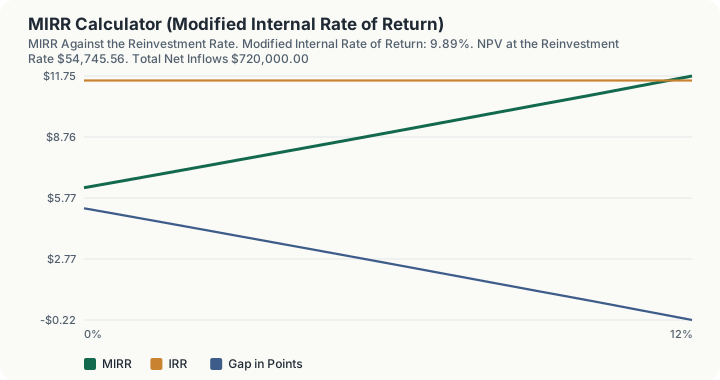
Quick Answer: A $500,000 project returning $120,000 a year for six years has an IRR of 11.53%, but a MIRR of 9.89% once you say out loud that the cash coming back is reinvested at 8% rather than at the project's own return. The 1.64 point gap is not a rounding difference or a different formula for the same thing. It is the size of an assumption IRR makes silently on your behalf.
What does this calculator do?
Internal rate of return is the discount rate at which a project's net present value is zero. It is the most quoted number in corporate finance and it contains a hidden assumption that almost nobody states: that every dollar the project pays out is immediately reinvested, until the project ends, at the IRR itself.
For an 11% project that assumption is mildly optimistic. For a 30% project it is fantasy. If you had somewhere reliable to earn 30%, you would put the original capital there and skip the project.
MIRR removes the assumption by replacing it with two rates you supply:
- a reinvestment rate, at which cash received is actually put to work, and
- a finance rate, at which money funding any outflows is discounted.
Because both rates are stated rather than inferred, MIRR is a single number with no ambiguity, and it can be compared across projects of different length and shape. IRR cannot always claim either property.
The gap between the two measures is the useful output of this page. A large gap tells you the IRR is being carried by an assumption rather than by the project.
How is this calculated?
- Build the cash flow series. The initial investment is entered as a positive number and placed at time zero as an outflow. Each of the following years receives the annual inflow. In the final year, any closure cost you enter is subtracted from that year's inflow, so a large enough closure cost turns the last flow negative.
- Discount every negative flow to today at the finance rate. Each outflow is divided by (1 + r_fin)ᵗ for the year $t$ it occurs in. With the whole investment at time zero, $t$ is nought and the present value of the outflows is simply the investment itself, which is why the finance rate has no effect until there is an outflow later in the life.
PV_neg = ∑_(CFₜ < 0) CFₜ/((1 + r_fin)ᵗ)
- Compound every positive flow forward to the final year at the reinvestment rate. Each inflow is multiplied by (1 + r_rei)^(n − t), so an inflow in year one compounds for five years in a six year project and the final year's inflow does not compound at all.
FV_pos = ∑_(CFₜ > 0) CFₜ × (1 + r_rei)^(n − t)
- Take the geometric root of the ratio. MIRR is the single annual rate that grows the present value of the outflows into the future value of the inflows over the project's life.
MIRR = (FV_pos/(−PV_neg))^(1/n) − 1
- Compute the ordinary IRR on the same series for comparison. This is done separately, by numerical root-finding on the rate that sets net present value to zero. The calculator also reports whether the series changes sign more than once, which is the condition under which several rates can satisfy that equation.
- Compute net present value at the reinvestment rate. The reinvestment rate is used here as the discount rate, giving a money figure alongside the two percentage ones.
The table sweeps the reinvestment rate from 0% to 12% and recomputes MIRR at each, holding IRR constant, because IRR does not depend on the reinvestment rate at all.
Worked Example
A $500,000 investment returns $120,000 at the end of each of six years. Interim cash goes into a deposit account earning 8%.
Step 1: Compound each inflow to year six at 8%. The year one payment compounds for five years, the year two payment for four, and so on:
$120{,}000 \times (1.08^5 + 1.08^4 + 1.08^3 + 1.08^2 + 1.08 + 1) = 120{,}000 \times 7.335929 =$ $880,311.48
Step 2: Take the ratio to the investment. $880{,}311.48 / 500{,}000 =$ 1.760623
Step 3: Take the sixth root and subtract one. $1.760623^{1/6} - 1 = 1.098865 - 1 =$ 9.89%
Step 4: Compare against the ordinary IRR. The rate that sets NPV to zero on the same flows is 11.53%, so IRR overstates the achievable return by 1.64 percentage points.
Where does that 1.64 points come from? Entirely from step 1. IRR implicitly compounds those same six payments at 11.53% instead of 8%, which produces a terminal value of roughly $968,000 rather than $880,311.48. The extra $88,000 is money the project never generates and the deposit account never pays. It exists only inside the arithmetic.
Now push the reinvestment rate down to what cash actually earns in a current account:
Step 5: Reinvest at 2% instead. $120{,}000 \times 6.308121 = 756{,}974.52$, and (756,974.52/500,000)^(1/6) − 1 = 7.16%
Step 6: Note what did not move. The IRR is still 11.53%. Nothing about the project changed, and IRR cannot see the difference between cash earning 8% and cash earning 2%, because it never asked.
The boundary case makes the relationship exact:
Step 7: Set the reinvestment rate to the IRR itself. At 11.53%, MIRR returns 11.53% and the gap closes to 0.00 points.
That is the whole argument in one line. IRR is MIRR with the reinvestment rate silently set to the answer. Every other reinvestment rate produces a different and more honest number.
Step 8: The floor case. With no reinvestment at all, the payments simply pile up: $6 \times 120{,}000 = 720{,}000$, and (720,000/500,000)^(1/6) − 1 = 6.27%. That is the worst-case return, and it is nearly half the headline IRR.
So the honest range for this project is 6.27% to 11.53%, and where you land inside it is a question about your treasury policy, not about the project.
What does this calculator not account for?
- Irregular timing. Every flow here is annual and evenly spaced. Real projects pay quarterly, or lumpily. For dated cash flows use an XIRR-style calculation instead.
- Varying cash flows. The inflow is the same every year apart from the optional final-year outflow. Real projects ramp up and decline.
- Tax. All figures are pre-tax. Depreciation shields and the timing of tax payments change the true after-tax series materially.
- Inflation. Use consistently nominal or consistently real figures throughout. Mixing them is the single most common error on this page.
- Risk. Neither IRR nor MIRR says anything about the probability of the cash flows arriving. A 20% MIRR on a speculative venture is not comparable with a 9% MIRR on a contracted revenue stream.
- Project scale. A 30% return on $10,000 beats a 12% return on $10 million on this page and loses badly in reality. Rank by net present value when the choice is mutually exclusive.
- A changing reinvestment rate. One rate applies to all years. Deposit rates move.
What mistakes do people make with this?
- Comparing an IRR from one source with a MIRR from another. They are different measures and MIRR is almost always the lower of the two. Comparing them ranks the projects by which measure was used, not by which project is better.
- Setting the reinvestment rate to the cost of capital by reflex. The cost of capital is what money costs, not what spare cash earns. Those are usually different, and for most companies the reinvestment rate is the lower one.
- Treating MIRR as a decision rule on its own. It is a return measure, and like IRR it can rank a small project above a large one. Net present value decides; MIRR characterises.
- Ignoring the finance rate because there is nothing to finance. It does nothing when the only outflow is at time zero, which is the default here. Add a closure cost and it starts to matter.
- Assuming a higher MIRR always means a better project. Raise the reinvestment rate high enough and MIRR exceeds IRR. That is not the project improving; it is you assuming a better world outside the project.
- Forgetting that MIRR depends on the project's length. Because inflows compound to the terminal year, extending the life changes MIRR even if nothing else moves. Comparing projects of different lengths needs care.
Frequently Asked Questions
Why is MIRR usually lower than IRR?
Which rate should I use for reinvestment?
Does the finance rate matter?
Can MIRR have more than one solution?
Is MIRR the same as the modified rate lenders quote?
When does the choice actually change a decision?
Sources
- U.S. Securities and Exchange Commission, Investor.gov, the official authority for the investing this calculator relates to. investor.gov
There is no statutory or regulatory source for these formulas, and none is invented here. The internal rate of return as the root of the net present value equation, and the modified internal rate of return as the geometric root of terminal value over present value, are standard definitions in financial analysis rather than legal constructs. Where MIRR appears in a spreadsheet function it follows the same three-argument form used here: the cash flow series, a finance rate and a reinvestment rate.
The implementations are calculateMIRR, calculateIRR and calculateNPV in engine/primitives/npv-irr.ts, proven against hand-derived vectors in engine/vectors/npv-irr.test.ts and in this calculator's own vectors.test.ts. Related pages: the IRR calculator for the unmodified measure and its multiple-root problem, the XIRR calculator for cash flows on irregular dates, and the DCF valuation calculator for the net present value decision rule that should outrank both.