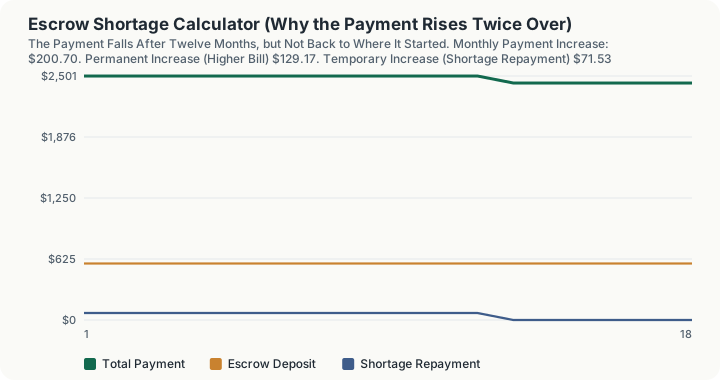
Quick Answer: At the default inputs the monthly mortgage payment rises by $200.70, from $2,300.00 to $2,500.70. Only $71.53 of that is shortage repayment that falls away after twelve months. The other $129.17 is a permanent re-basing of the escrow deposit onto a higher annual bill, so the payment settles at $2,429.17 and never returns to $2,300.00.
What does this calculator do?
An escrow analysis letter is one of the more alarming pieces of post-closing mail a homeowner receives, and the reason it is confusing is that it describes two entirely different changes as one number.
The first change is a shortage: the account is projected to dip below the balance it is supposed to hold, and the servicer collects the difference, normally spread over twelve months. This part is temporary. It stops.
The second change is a re-basing: the monthly escrow deposit is recalculated on the new, higher annual tax and insurance bill. This part is permanent. It never comes off.
The letter states the sum. Homeowners read it as a temporary blip and are surprised a year later when the payment drops by less than they expected, or than the letter's total increase would suggest.
The cushion makes it worse. Under RESPA a servicer may hold a cushion of up to one-sixth of the year's disbursements, which is two months of deposits. Because the cushion is defined as a fraction of the annual bill, a tax rise raises the required cushion too, and that increase is itself part of the shortage now being collected.
How is this calculated?
shortage = max(0, cushion months × (new annual bill)/12 − projected low-point balance)
Δ payment = (new annual bill)/12 − (old annual bill)/12 (permanent) + shortage/(repayment months) (temporary)
Step 1: Find the old monthly escrow deposit by dividing the annual bill the current payment was built on by twelve.
Step 2: Find the new annual disbursement by adding the new property tax to the new insurance premium.
Step 3: Find the new monthly escrow deposit by dividing that by twelve.
Step 4: Compute the required cushion as the cushion months multiplied by the new monthly deposit. Anything above two months is flagged as exceeding the RESPA ceiling in 12 CFR 1024.17.
Step 5: Compute the shortage as the required cushion less the projected low-point balance, floored at zero. A negative projected balance is reported as a deficiency rather than a shortage.
Step 6: Spread the shortage over the repayment window to get the monthly repayment slice.
Step 7: Compute the permanent increase as the new monthly deposit less the old one.
Step 8: Add the two to get the total payment increase the letter states.
Step 9: Split it into shares so you can see how much survives the twelve months.
Step 10: Isolate the cushion effect by comparing the cushion the old bill required against the cushion the new bill requires. That difference is shortage created by the bill increase alone, not by any under-collection.
Worked Example
Principal and interest of $1,850. Last year's tax and insurance bill was $5,400. The new property tax is $5,100 and the new insurance premium is $1,850. The projected low-point balance is $300, the cushion is two months, and the shortage is spread over twelve months.
Step 1: The old monthly escrow deposit. $5,400 / 12 = $450.00
Step 2: The old total payment. $1,850.00 + $450.00 = $2,300.00
Step 3: The new annual disbursement. $5,100 + $1,850 = $6,950.00
Step 4: The new monthly escrow deposit. $6,950 / 12 = $579.17
Step 5: The required cushion at two months. $579.17 x 2 = $1,158.34
Step 6: The shortage. $1,158.34 - $300.00 = $858.34
Step 7: The monthly shortage repayment over twelve months. $858.34 / 12 = $71.53
Step 8: The permanent escrow increase. $579.17 - $450.00 = $129.17
Step 9: The total monthly payment increase. $129.17 + $71.53 = $200.70
Step 10: The payment during the shortage window. $2,300.00 + $200.70 = $2,500.70
Step 11: The payment after the shortage is repaid. $1,850.00 + $579.17 = $2,429.17
Step 12: How much of the increase is permanent. $129.17 / $200.70 = 64.36%
Step 13: How much of the shortage exists purely because the cushion grew. Old required cushion: $450.00 x 2 = $900.00 New required cushion: $579.17 x 2 = $1,158.34 $1,158.34 - $900.00 = $258.34
Step 14: The cost of the shortage year. $200.70 x 12 = $2,408.40
Nearly a third of the shortage exists for no reason other than that a bigger annual bill demands a bigger cushion. And 64.36% of the payment increase is permanent: after the twelve months, the payment falls by $71.53 and stays $129.17 above where it started.
Carrying The Payment Through The Shortage Window And Out The Other Side
Step 15: Month one under the new analysis. $2,500.70, made up of $1,850.00 of principal and interest, $579.17 of escrow deposit and $71.53 of shortage repayment
Step 16: Month twelve, the last of the repayment window. Still $2,500.70. The shortage instalment is flat, not amortising, because no interest is charged on it.
Step 17: The twelve-month total. $2,500.70 x 12 = $30,008.40, against $2,300.00 x 12 = $27,600.00 under the old analysis
Step 18: Month thirteen, the first month after the shortage clears. $1,850.00 + $579.17 = $2,429.17, a drop of $71.53
Step 19: Eighteen months in total. $30,008.40 + ($2,429.17 x 6 = $14,575.02) = $44,583.42
The relief at month thirteen is real but partial. The payment falls by $71.53 and then stops falling, because the $129.17 of larger escrow deposit is permanent until the tax bill itself changes. Budgeting for the $2,500.70 to disappear entirely is the mistake this schedule is meant to prevent.
What does this calculator not account for?
- The servicer's projected low-point balance is an input, not a computation. A real escrow analysis runs a month-by-month projection of every deposit and every disbursement across the coming twelve months and finds the lowest point. This page takes that figure from your statement and works forward from it.
- Disbursement timing is ignored. A property tax bill paid in November behaves very differently from one paid in two instalments. The low point of an account depends heavily on when money leaves it, and this model does not simulate that calendar.
- Interest on escrow balances is not credited. A minority of states require servicers to pay interest on escrowed funds. Where that applies, the account earns a little and the shortage is slightly smaller than shown.
- The deficiency rules are flagged but not separately modelled. A negative balance is a deficiency, and RESPA permits a servicer to demand repayment on a shorter schedule than the twelve months allowed for a shortage. The calculator identifies which one you have and still spreads it over the window you enter.
- Surpluses are not refunded here. Where the account exceeds its target by $50 or more, RESPA generally requires a refund within 30 days. This page floors the shortage at zero and does not compute the refund.
- Mortgage insurance and HOA dues are not separated out. If your servicer escrows for them, fold them into the annual figures you enter.
- No re-analysis is modelled. The payment shown is the one that follows this analysis. Next year's bill will move again.
What mistakes do people make with this?
Paying the shortage as a lump sum and expecting the old payment back. Clearing the $858.34 in one payment removes the $71.53 slice. It does nothing about the $129.17. The payment goes to $2,429.17 either way.
Spreading the shortage further to fix the problem. Doubling the window to 24 months halves the repayment slice and drops the increase from $200.70 to about $164.93. The shortage itself is unchanged at $858.34. You are pacing it, not shrinking it.
Blaming the servicer for the increase. Where the annual bill genuinely rose, most of the increase is arithmetic on your tax assessment and your insurer's renewal. The account being low is a separate and usually smaller matter. Run the scenario with a healthy balance and the payment still rises $129.17.
Treating a cushion above two months as normal. RESPA caps the cushion at one-sixth of annual disbursements. The calculator flags anything above two months as outside that ceiling, which is worth querying.
Confusing a shortage with a deficiency. A shortage is a positive balance below the target. A deficiency is an account that actually went negative. The repayment rules differ, and the label on your letter matters.
Frequently Asked Questions
Why did my payment go up by more than the shortage divided by twelve?
Will my payment go back down after twelve months?
Should I pay the shortage in a lump sum?
What is the cushion for, and is two months legal?
My bill did not change but I still have a shortage. Why?
Can I cancel the escrow account instead?
Sources
- 12 CFR 1024.17 (Regulation X, RESPA), escrow accounts. The one-sixth-of-annual-disbursements cushion ceiling, the shortage and deficiency definitions, and the general requirement that a shortage of one month's deposit or more be collected over at least twelve months, all come from this section. Available at the Electronic Code of Federal Regulations: ecfr.gov/current/title-12/chapter-X/part-1024/subpart-B/section-1024.17
Everything else on this page is arithmetic. There are no statutory dollar tables in this calculator: every figure comes from the annual bills, balances and windows you enter.