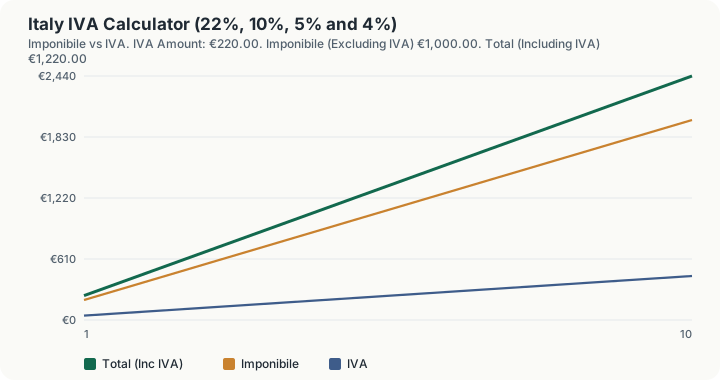
Quick Answer: Adding the ordinary 22% rate to a €1,000 imponibile adds €220.00, giving €1,220 total. The scorporo, removing IVA from a €1,000 gross price, gives €180.33, not €220, because the tax is 22/122 of the total. At 22%, Italy has the highest ordinary VAT rate of the four largest eurozone economies.
What does this calculator do?
Italian IVA has four rates, set by DPR 633/1972. The ordinary 22% applies unless a supply appears in Tabella A. The three reduced rates are 10% (Part III), 5% (Part II-bis) and 4% (Part II).
Which rate applies is a matter of law rather than choice: the goods and services are enumerated in the Tabella. Broadly, 4% covers staple foods, books and newspapers and prima casa purchases; 5% covers certain social and health services and some foodstuffs; 10% covers many other foods, tourism and building works.
The operation Italians call the scorporo, extracting the IVA from a tax-inclusive price, is where most arithmetic errors happen.
How is this calculated?
Adding IVA:
IVA = Imponibile × rate; Totale = Imponibile × (1 + rate)
Scorporo, removing IVA from a gross total:
IVA = Totale × rate/(1 + rate)
At 22% that fraction is 22/122, which simplifies to 11/61. At 10% it is 10/110, at 5% it is 5/105 and at 4% it is 4/104.
Step 1: Take the rate from your selection. 22%, 10%, 5% or 4%. The calculator does not read Tabella A for you; it applies the rate you pick.
Step 2: If adding, multiply the imponibile by the rate. Rounded to the cent, that is the IVA.
Step 3: If adding, add it to the imponibile. That is the total.
Step 4: If removing, multiply the total by rate/(1+rate). That is the IVA contained in the price.
Step 5: If removing, subtract it from the total. That is the imponibile.
Worked Example
A consultant in Milan issues an invoice with an imponibile of €1,000 at the ordinary rate.
Step 1: The rate. Aliquota ordinaria, so r = 22%
Step 2: The IVA on the imponibile. €1,000 x 22% = €220.00
Step 3: The total. €1,000.00 + €220.00 = €1,220.00
The reverse journey is the scorporo, and it is not symmetrical. Suppose instead the €1,000 in hand is already tax-inclusive.
Step 4: The fraction, not the rate. 22 / 122 = 18.03% of the total, which simplifies to 11/61
Step 5: Extract the IVA. €1,000 x (22 / 122) = €180.33
Step 6: The imponibile. €1,000.00 - €180.33 = €819.67
The wrong method, worked by hand rather than by this calculator, for contrast:
Step 7: Deducting 22% of the total. €1,000 x 22% = €220.00, giving an imponibile of €780.00
Step 8: The size of that error. €819.67 - €780.00 = €39.67 too low on a single €1,000 receipt, or nearly €4,000 across €100,000 of gross takings
Step 9: Close the loop. Run the €1,220 total from Step 3 back through the scorporo: €1,220 x (22 / 122) = €220.00, imponibile €1,000.00, exactly the starting point
The same €1,000 imponibile under the three Tabella A rates:
Step 10: At 10%, Part III. €1,000 x 10% = €100.00, total €1,100.00
Step 11: At 5%, Part II-bis. €1,000 x 5% = €50.00, total €1,050.00
Step 12: At 4%, Part II. €1,000 x 4% = €40.00, total €1,040.00
Step 13: The spread the classification decides. €220.00 - €40.00 = €180.00 of tax on one invoice, turning entirely on which part of Tabella A the supply falls in rather than on anything the seller chooses.
The Same Invoice at All Four Rates, Both Directions
The ten-row table sweeps the amount and holds the rate, which shows linearity and little else. The interesting sweep on this page is across the four rates, and it is the one the scorporo error is most visible in.
Adding, on a €1,000 imponibile. Ordinary 22% gives €220.00 of IVA and a €1,220.00 total. Ridotta 10% gives €100.00 and €1,100.00. Minima 4% gives €40.00 and €1,040.00. Each is a straight multiplication and each scales exactly: raise the imponibile to €1,100 at 22% and the IVA becomes €242.00.
Removing, from a €1,000 total, which is where the two methods part company. At 22% the calculator returns €180.33 of IVA and €819.67 of imponibile. That is 22/122 of the gross, which is 18.03%, not 22%. Deducting 22% from €1,000 instead gives €780.00 of imponibile, understating it by €39.67 on a single invoice. At 10% the calculator returns €90.91 and €909.09; the wrong method gives €900.00, understating by €9.09. At 4% it returns €38.46 and €961.54 against a wrong €960.00, understating by €1.54.
The error is not proportional to the rate, it grows faster. From 4% to 22% the rate multiplies by 5.5 and the scorporo error on the same €1,000 gross multiplies by nearly 26, from €1.54 to €39.67. That is why the mistake is tolerable on a book of reduced-rate invoices and expensive on a book of ordinary-rate ones.
There is no threshold in this calculation. No registration band, no small-trader relief and no cap exists in addItalianIVA or removeItalianIVA. The rate is whatever you select, applied to whatever you type, at €10 and at €10,000,000 alike. Which rate is correct is settled by Tabella A of DPR 633/1972 and by the nature of the supply, and the calculator does not classify anything: it will happily apply 4% to a consulting fee.
Marginal cost of the next unit. At the ordinary rate each additional €100 of imponibile carries €22.00 of IVA. In the other direction each additional €100 of gross contains €18.03 of IVA. Those two numbers describe the same transaction and confusing them is precisely the error priced above.
The round trip, as a check. Add 22% to €1,000 and the total is €1,220.00. Remove 22% from €1,220 and the calculator returns exactly €220.00 of IVA and €1,000.00 of imponibile. The two directions reconcile to the cent, which they would not if the removal used a straight percentage deduction.
What does this calculator not account for?
- Which rate applies to which supply. That is determined by Tabella A of DPR 633/72 and is genuinely intricate; the Agenzia delle Entrate publishes rulings on borderline cases.
- The regime forfettario, under which qualifying small businesses and professionals do not charge IVA at all.
- Reverse charge (inversione contabile) in construction, certain electronics and cross-border business supplies.
- Split payment, under which public bodies pay the IVA directly to the Treasury.
- Exempt (esenti) and excluded (escluse) operations, which differ from zero-rating in their effect on input IVA recovery.
- The One Stop Shop and EU distance selling.
- Electronic invoicing and the esterometro, which are compliance mechanics rather than rate questions.
- IVA on property, which has its own regime interacting with registration tax.
What mistakes do people make with this?
- Deducting 22% from the gross instead of doing the scorporo. €1,000 minus 22% is €780, which is wrong by €39.67. The correct imponibile is €819.67.
- Assuming all food is 4%. Only staples get the minimum rate; many foodstuffs sit at 10%.
- Treating the rate as a choice. It is fixed by Tabella A, and applying a reduced rate to a supply that does not qualify is an assessment risk.
- Forgetting the regime forfettario. A business in that regime issues invoices without IVA entirely, so an IVA calculation does not apply to it.
- Confusing esenti with escluse. Both mean no IVA is charged, but they have different consequences for the right to deduct input IVA.
- Applying split payment logic to private customers. It applies to supplies to public administrations, not to ordinary B2C sales.
Frequently Asked Questions
What is the scorporo?
What is Italy's standard VAT rate?
What qualifies for the 4% rate?
Why are there two rates between 4% and 22%?
Does the regime forfettario charge IVA?
Is exempt the same as zero-rated?
Sources
- Agenzia delle Entrate: "Iva, regole generali, aliquote, esenzioni, pagamento: norme generali e aliquote" agenziaentrate.gov.it/portale/iva-regole-generali-aliquote-esenzioni-pagamento/norme-generali-e-aliquote
All figures verified on 30 August 2026
Also consulted: DPR 26 ottobre 1972 n. 633, article 16 and Tabella A: the ordinary 22% rate and the reduced rates of 4%, 5% and 10% in Parts II, II-bis and III.