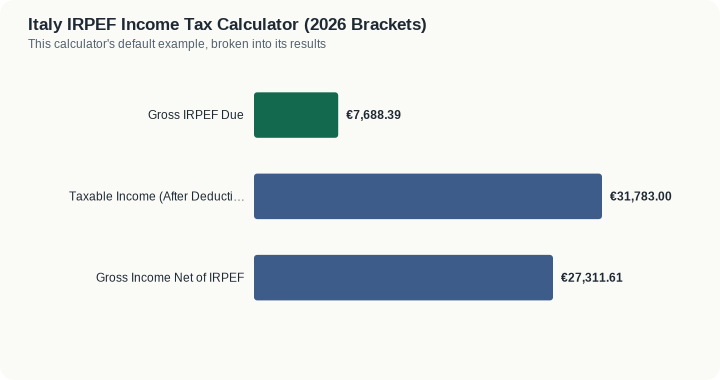
Quick Answer: On €35,000 of gross Italian employment income with a typical €3,217 INPS-contribution deduction, taxable income is €31,783 and gross IRPEF (Imposta sul Reddito delle Persone Fisiche) for 2026 is €7,688.39. The employee tax credits take off €2,646.48, leaving €5,041.91 of IRPEF due, before the regional and municipal surtaxes, which this calculator does not include.
What does this calculator do?
IRPEF is Italy's national personal income tax, administered by the Agenzia delle Entrate, and it applies progressively: each euro of taxable income is taxed at the rate for the bracket it falls into, not at a single flat rate on the whole amount. Starting 1 January 2026, the Legge di Bilancio 2026 (Budget Law, L. 199/2025) made permanent a three-bracket structure that had been trialled experimentally in 2024-2025, and it went a step further by cutting the middle bracket's rate from 35% to 33% for income between €28,000 and €50,000.
This calculator is built for Italy specifically: it computes IRPEF in euros using the current 2026 bracket thresholds and rates, not a generic income-tax model borrowed from another country. It takes your gross annual income, subtracts any deductible expenses (oneri deducibili) you enter, most commonly mandatory INPS social-security withholding, applies the 2026 progressive schedule to what remains and, if you are an employee, subtracts the employee tax credits (detrazioni per lavoro dipendente). The regional and municipal surtaxes are not included.
How is this calculated?
Step 1: Taxable income:
Taxable Income = max(0, Gross Income − Deductible Expenses)
Step 2: 2026 IRPEF brackets, applied progressively (each rate applies only to the slice of income within that bracket):
| Bracket | Rate |
|---|---|
| €0-€28,000 | 23% |
| €28,000-€50,000 | 33% |
| Above €50,000 | 43% |
Gross IRPEF = ∑_bracket (income in bracket) × (bracket rate)
For example, €40,000 of taxable income is taxed as: €28,000 at 23%, plus the remaining €12,000 at 33%, not €40,000 at a single rate.
Step 3: Employee tax credits (only if you choose "employee"). Both depend on reddito complessivo, taken here as your taxable income, which is right when your deductible expenses are only INPS contributions (employee INPS never forms part of employment income):
| Reddito complessivo | Art. 13 TUIR credit |
|---|---|
| Up to €15,000 | €1,955 |
| €15,000 to €28,000 | €1,910 + €1,190 × (€28,000 − income) ÷ €13,000 |
| €28,000 to €50,000 | €1,910 × (€50,000 − income) ÷ €22,000 |
| Above €50,000 | €0 |
The quotient in the formula is cut to four decimal places, as the Agenzia delle Entrate instructions require, and €65 is added when income is above €25,000 and not above €35,000. The 2025 Budget Law (L. 207/2024, art. 1, comma 6) adds a further credit for employees: €1,000 for income above €20,000 up to €32,000, then €1,000 × (€40,000 − income) ÷ €8,000 up to €40,000. The two credits together cannot exceed gross IRPEF; any excess is lost.
IRPEF Due = Gross IRPEF − min(Art. 13 Credit + Additional Credit, Gross IRPEF)
What changed for 2026: the middle bracket was 35% through 2025; the Budget Law 2026 cut it to 33%. At exactly €50,000 of taxable income, this brought gross tax down from €14,140 to €13,700: a €440 saving that is also, not coincidentally, the maximum benefit anyone sees from this reform (see the caveat below).
Worked Example
Using the calculator's default inputs:
- Annual Gross Income: €35,000
- Deductible Expenses: €3,217 (approximating a typical employee's 9.19% INPS contribution)
Step by step:
- Taxable income = €35,000 − €3,217 = €31,783.
- First €28,000 taxed at 23% = €6,440.00.
- Remaining €3,783 (€31,783 − €28,000) taxed at 33% = €1,248.39.
- Gross IRPEF = €6,440.00 + €1,248.39 = €7,688.39.
- Art. 13 credit: (€50,000 − €31,783) ÷ €22,000 = 0.828045, cut to 0.8280; €1,910 × 0.8280 = €1,581.48, plus €65 because €31,783 is between €25,000 and €35,000 = €1,646.48.
- Additional credit: €31,783 is between €20,000 and €32,000, so €1,000.
- IRPEF due = €7,688.39 − €2,646.48 = €5,041.91. That is 15.86% of taxable income. Marginal bracket rate = 33%.
- Gross income net of IRPEF = €35,000 − €5,041.91 = €29,958.09, before INPS and before the regional and municipal surtaxes.
A self-employed person with the same taxable income gets neither credit and owes the full €7,688.39.
Compare a higher earner with €80,000 gross income and €7,352 in deductions (taxable income €72,648): the first €28,000 is taxed at 23% (€6,440), the next €22,000 at 33% (€7,260), and the remaining €22,648 at 43% (€9,738.64), a total of €23,438.64, with a 43% marginal rate. At that income both employee credits are zero, so an employee owes the same.
What does this calculator not account for?
- Regional and municipal surtaxes are excluded. Every Italian region levies an "addizionale regionale" (commonly 1.2%-3.3% of taxable income) and most comuni levy an "addizionale comunale" (commonly 0%-0.9%), both set annually and varying by location and income band. Neither is included in any figure on this page, so your total income tax is higher than the IRPEF shown.
- Other detrazioni. Only the two employee credits are applied. Credits for dependants, the 19% credits for healthcare, mortgage interest and similar expenses, and home-renovation bonuses are not.
- The tax-free sum for employees earning up to €20,000 and the trattamento integrativo. The 2025 Budget Law pays employees with income up to €20,000 a tax-free amount of 7.1%, 5.3% or 4.8% of their employment income, and lower earners can receive the trattamento integrativo of up to €1,200. Both are paid on top of take-home pay, not subtracted from IRPEF, and neither is included.
- Part-year work and other deductions. The employee credits are full-year amounts; they are pro-rated by days worked, and the €690 or €1,380 minimum for part-year work is not applied. If your deductible expenses include items other than INPS, such as pension fund contributions, the law sets the credits on your income before those deductions, so entering them here slightly overstates the credits.
- The >€200,000 sterilization mechanism. For taxpayers with total income above €200,000, the Budget Law 2026 claws back the 33%-bracket benefit by reducing certain 19%-rate deductions by €440: in effect, cancelling the net advantage of the rate cut for very high earners. This calculator does not model that clawback.
- Non-progressive income categories. Some income types (certain capital gains, severance pay under "tassazione separata," some rental income under cedolare secca) are taxed outside the ordinary IRPEF brackets modeled here: see this platform's dedicated TFR, rental-tax, and pension calculators for those cases.
- Self-employment-specific regimes, such as the flat-rate "regime forfettario" (5%/15% substitute tax for qualifying small businesses and freelancers), which replaces IRPEF entirely rather than modifying it.
What mistakes do people make with this?
- Applying the marginal rate to your whole income. Italy's IRPEF is a true progressive/marginal system: only the portion of income inside a given bracket is taxed at that bracket's rate. A €31,783 taxable income is not taxed entirely at 33%: only the €3,783 above the €28,000 threshold is.
- Forgetting the 2026 rate cut only applies between €28,000 and €50,000. Income below €28,000 remains at 23%, and income above €50,000 remains at 43%: the reform did not change the top or bottom brackets, only the middle one.
- Assuming the >€200,000 clawback affects the bracket rate itself. It doesn't change the 33% rate: it separately reduces certain deductions to neutralize the euro-for-euro benefit, a subtler mechanism than a rate change.
- Confusing IRPEF with take-home pay. Regional and municipal surtaxes and INPS withholding still sit between the IRPEF shown and your actual net paycheck, so the "net income" figure on this page is not a final take-home number.
- Mixing up "reddito" (income) and "imponibile" (taxable base). Deductible expenses (oneri deducibili) reduce the taxable base before brackets are applied; tax credits (detrazioni) reduce the tax bill afterward: conflating the two produces the wrong final figure.
Frequently Asked Questions
What are the IRPEF tax brackets for 2026 in Italy?
How much did the 2026 tax reform actually save me?
Is this the same as my take-home pay?
Does IRPEF apply to self-employed income too?
Why is my deductible-expenses default set to a specific figure?
How much is the employee tax credit in 2026?
Are regional and municipal surtaxes really separate from IRPEF?
What income counts toward the IRPEF brackets?
Sources
- Agenzia delle Entrate: "Aliquote e calcolo dell'IRPEF" portal page (agenziaentrate.gov.it), consulted for the underlying bracket-structure framework. agenziaentrate.gov.it/portale/aliquote-e-calcolo-dell-irpef
- Agenzia delle Entrate: Redditi Persone Fisiche 2026, Fascicolo 1, instructions for rigo RN7 (art. 13 TUIR credit formula, four-decimal quotient, +€65 between €25,000 and €35,000). agenziaentrate.gov.it/portale/documents/d/guest/pf1_istruzioni_2026_agg-28-05-2026
- Agenzia delle Entrate: Circolare 4/E of 16 May 2025 on the 2025 Budget Law employee measures (€1,955 credit; additional credit of art. 1, comma 6). agenziaentrate.gov.it/portale/documents/20143/8410823/Circolare+lavoro+dipendente+LB2025+DD+IRPEF+n.+4+del+16+maggio+2025.pdf/36979eaa-9fc5-a4ec-a7aa-136497c53f91
- Legge 30 dicembre 2024, n. 207, art. 1, commi 2, 4 and 6 (Normattiva). normattiva.it/atto/caricaDettaglioAtto
The deduction limits above €200,000 of income and the regional and municipal surtaxes are not modeled; both are disclosed above.
Also consulted: Legge di Bilancio 2026 (L. 199/2025): three-bracket IRPEF structure made permanent and second-bracket rate cut from 35% to 33% for income between €28,000 and €50,000, effective 1 January 2026. Confirmed via multiple concordant 2026 Italian tax-press sources (fiscomania.com, soluzionetasse.com, CGIL Roma e Lazio, sgravi.com, cafinforma.it), all independently agreeing on the exact bracket boundaries, rates, and the €14,140-to-€13,700 figure at €50,000.