Quick Answer: Selling ESPP shares before meeting the two-year-from-offering and one-year-from-purchase holding periods turns more of your gain into ordinary income taxed at your regular rate instead of the lower long-term capital gains rate, which usually costs you real money.
Overview
An Employee Stock Purchase Plan, or ESPP, lets employees buy their employer's stock at a discount, typically through payroll deductions accumulated over an offering period. A tax-qualified ESPP under IRC § 423 caps that discount at 15% and often includes a "lookback" feature, which sets the purchase price using whichever is lower: the stock's price on the first day of the offering period, or its price on the actual purchase date. The lookback provision means the effective discount can end up being much larger than 15% if the stock rose significantly during the offering period, since the discount is applied to the lower of the two prices.
How the eventual gain on those shares gets taxed depends entirely on how long the employee holds them after purchase, and this is where a lot of confusion sets in. The tax code draws a sharp line between a "qualifying disposition" and a "disqualifying disposition," and the two produce meaningfully different tax outcomes for what might otherwise look like an identical sale.
A qualifying disposition requires the shares to be held for at least two years from the start of the offering period AND at least one year from the actual purchase date. Both conditions must be met. If they are, the tax code treats only part of the gain as ordinary income, specifically the lesser of the statutory discount computed off the offering-date price, or the actual gain realized on sale, and the remainder as long-term capital gain, which is taxed at the more favorable 0%, 15%, or 20% federal rates.
Miss either test, most commonly by selling relatively soon after purchase, and the sale becomes a disqualifying disposition instead. In that case, the entire "bargain element," meaning the actual difference between the fair market value on the purchase date and what the employee paid, is taxed as ordinary income, regardless of what happens to the stock price afterward, capped only so it never exceeds the actual gain realized. Any additional gain beyond that bargain element is capital gain, either short-term or long-term depending on how long the shares were held from the purchase date specifically.
The practical upshot is that a disqualifying disposition typically pushes more of the total gain into the ordinary income bucket, taxed at the employee's regular marginal rate, which is almost always higher than the long-term capital gains rate that would otherwise apply to that same slice of gain under a qualifying disposition.
How This Is Calculated
The calculator first establishes the purchase price using the lookback rule:
`
Purchase Price = min(FMV at Offering Start, FMV at Purchase) × (1 − Discount%)
`
Total gain is simply total sale proceeds minus total purchase cost. The calculator then computes both scenarios side by side against that same total gain.
Qualifying disposition: ordinary income equals the lesser of the statutory discount, computed as the offering-date fair market value times the discount percentage, or the total gain realized (so a modest gain never generates more ordinary income than the sale actually produced). Everything above that ordinary income layer is long-term capital gain.
Disqualifying disposition: ordinary income equals the lesser of the actual bargain element at purchase, the purchase-date fair market value minus what was paid, or the total gain realized (the same anti-phantom-income safeguard). Everything above that layer is capital gain, taxed as short-term or long-term depending on whether the shares were held more than one year from the purchase date.
Because both the ordinary income layer and the capital gains layer stack on top of the employee's other income, the calculator determines the actual marginal tax on each layer by computing total tax at two income levels and taking the difference, once against the ordinary bracket table for the ordinary income layer, and once against the long-term capital gains bracket table (stacked on top of ordinary income plus the ordinary ESPP layer) for the remaining gain. This produces the true marginal cost of each layer rather than applying a single flat assumed rate.
Worked Example
An offering period opens with the stock at $40. By the purchase date it has reached $55. The plan carries the maximum 15% discount with a lookback, the employee buys 100 shares and later sells at $70. Single filer, $120,000 of other ordinary income in the year of sale.
Step 1 -- The lookback price. min($40 offering, $55 purchase) = $40.00
Step 2 -- The purchase price per share. $40.00 x (1 - 15%) = $34.00
Step 3 -- Total cost and proceeds. Cost: $34.00 x 100 = $3,400.00 Proceeds: $70.00 x 100 = $7,000.00
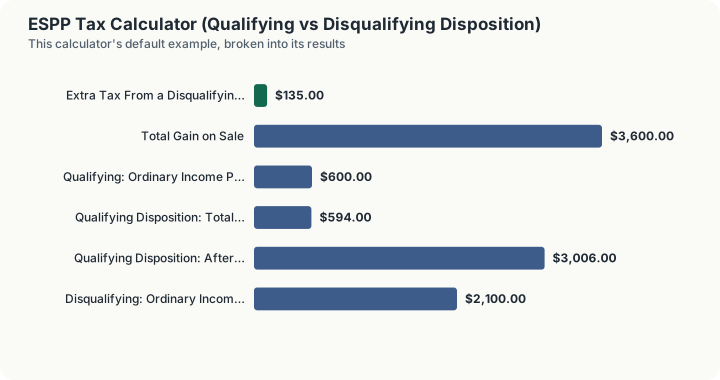
Step 4 -- Total gain, identical under either treatment. $7,000.00 - $3,400.00 = $3,600.00
Everything that follows is about where that same $3,600 lands, not how large it is. The two dispositions divide one number differently.
Qualifying disposition
Step 5 -- The statutory discount, measured off the offering-date price. $40.00 x 15% = $6.00 per share, or $600.00 on 100 shares
Step 6 -- Ordinary income is the lesser of that and the actual gain. min($600.00, $3,600.00) = $600.00
Step 7 -- The remainder is long-term capital gain. $3,600.00 - $600.00 = $3,000.00
Step 8 -- Tax on the ordinary layer, stacked on $120,000. $144.00 (the layer sits inside the 24% bracket)
Step 9 -- Tax on the capital gain layer, stacked above it. $450.00 (inside the 15% long-term bracket)
Step 10 -- Qualifying total. $144.00 + $450.00 = $594.00, leaving an after-tax gain of $3,006.00
Disqualifying disposition
Step 11 -- The bargain element, measured at purchase rather than at offering. $55.00 - $34.00 = $21.00 per share, or $2,100.00
Step 12 -- Ordinary income, capped at the actual gain. min($2,100.00, $3,600.00) = $2,100.00
Step 13 -- The remainder. $3,600.00 - $2,100.00 = $1,500.00, long-term here because the shares were held over a year from purchase
Step 14 -- Tax on each layer. Ordinary: $504.00 Capital gain: $225.00 Total: $729.00, leaving $2,871.00
Step 15 -- The cost of the early sale. $729.00 - $594.00 = $135.00
The whole difference comes from step 5 versus step 11. A qualifying disposition measures the ordinary layer against the $40 offering price; a disqualifying one measures it against the $55 purchase price, and the stock's $15 run-up during the offering period gets taxed as wages instead of as gain.
Step 16 -- Sell under a year from purchase instead. The $1,500 excess is now short-term and taxed at ordinary rates: $360.00 rather than $225.00 Disqualifying total: $864.00 Cost of the early sale: $270.00, double the figure in step 15
Step 17 -- A flat stock: sell at $55, the purchase-date price. Total gain: $2,100.00 Qualifying: $600.00 ordinary, $1,500.00 long-term, tax $369.00 Disqualifying: the $2,100.00 bargain element consumes the entire gain, leaving nothing as capital gain, tax $504.00 Cost of the early sale: still $135.00
Step 17 shows the cap doing real work. The bargain element would have been $2,100 regardless, and here it exactly equals the whole gain, so nothing is left over to tax favourably. The gap between the two treatments stays at $135 because it is fixed by the difference between the two ordinary-income definitions, not by the sale price.
What This Does Not Account For
- The Alternative Minimum Tax. ESPPs generally do not create AMT preference items the way incentive stock options can, but employees with other AMT exposure should still check their full return.
- State income tax, which most states apply to both the ordinary income and capital gain portions, often without the federal distinction between short-term and long-term rates.
- Employer withholding mismatches. Employers frequently do not withhold federal income tax on the ordinary income portion of an ESPP disposition the way they do on regular wages, which can create an underpayment surprise at filing time if not planned for.
- Wash sale rules, which can apply if substantially identical shares are repurchased within 30 days of a loss sale, disallowing the loss.
- The Net Investment Income Tax (3.8%) on the capital gain portion for taxpayers above the relevant MAGI thresholds.
- Concentration risk and diversification considerations, which are financial planning questions distinct from the tax mechanics modeled here.
Common Pitfalls
- Assuming the entire discount is always taxed as ordinary income. Only a disqualifying disposition taxes the full bargain element as ordinary income. A qualifying disposition caps the ordinary income portion at the smaller, offering-date-based statutory discount amount.
- Forgetting the holding period has two separate tests. Both the two-year-from-offering and the one-year-from-purchase tests must be satisfied for a qualifying disposition; missing either one alone makes the sale disqualifying.
- Not accounting for the employer's Form 1099-B cost basis reporting. Brokers are generally not required to include the ESPP ordinary income adjustment in the reported cost basis on Form 1099-B, which means employees often need to manually adjust their basis on Form 8949 to avoid double-taxing the ordinary income portion as capital gain.
- Ignoring the lookback provision's effect on the purchase price. When the lookback applies and the stock rose during the offering period, the effective discount from the actual purchase-date price can be well above the stated 15%, which increases the disqualifying-disposition ordinary income exposure specifically.
- Selling immediately at exercise without modeling the tax difference. A same-day or near-immediate sale is almost always a disqualifying disposition; the calculator's side-by-side comparison shows concretely what waiting to qualify would have saved.
Frequently Asked Questions
What are the exact holding period requirements for a qualifying disposition?
Why is my broker's 1099-B cost basis often wrong for ESPP shares?
Is it always better to hold for a qualifying disposition?
Does a disqualifying disposition affect only the ordinary income portion, or my whole tax bill?
What if the stock price drops and I sell at a loss?
Sources
- Internal Revenue Code § 423, tax-qualified Employee Stock Purchase Plan requirements, including the 15% maximum discount under § 423(b)(6). law.cornell.edu/uscode/text/26/423
- Internal Revenue Code § 421 and § 424, ESPP disposition rules and the statutory holding periods. law.cornell.edu/uscode/text/26/421
- Internal Revenue Service, Publication 525, "Taxable and Nontaxable Income," Employee Stock Purchase Plans section. irs.gov/publications/p525
- IRS Revenue Procedure 2025-32, 2026 ordinary income and long-term capital gains brackets. irs.gov