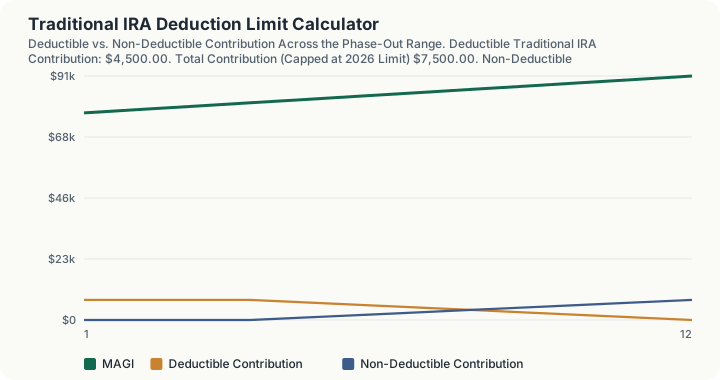
Quick Answer: Your Traditional IRA contribution is fully deductible unless you or your spouse is covered by a workplace retirement plan, in which case the deduction phases out over a specific MAGI range that depends on your filing status.
Overview
A Traditional IRA offers a tax deduction for contributions, but that deduction is not automatic once you or your spouse have access to a workplace retirement plan like a 401(k), 403(b), Thrift Savings Plan, SEP, or SIMPLE IRA. The IRS reduces, and eventually eliminates, the deduction as your Modified Adjusted Gross Income (MAGI) rises through a specific dollar range. Get above the top of that range and you can still contribute to a Traditional IRA, but none of it is deductible; instead it becomes "basis," tracked on Form 8606, that you will not pay tax on again when you eventually withdraw it.
The phase-out ranges are adjusted annually for inflation and differ meaningfully depending on whether you are single, married filing jointly, or married filing separately, and depending on whether it is you or your spouse who has the workplace plan. This calculator applies the 2026 phase-out ranges published by the IRS to your specific situation and shows exactly how much of your contribution you can deduct.
How This Is Calculated
Step 1: Determine whether a phase-out applies at all. If neither you nor your spouse (for Married Filing Jointly) is covered by an employer retirement plan, there is no income limit on the deduction whatsoever, no matter how high your income is. The phase-out only exists to limit "double-dipping" between an employer plan and a fully deductible IRA.
Step 2: Identify the correct phase-out range for your situation. The IRS 2026 ranges are: - Single or Head of Household, covered by a plan: $81,000 to $91,000 MAGI. - Married Filing Jointly, you are covered: $129,000 to $149,000 MAGI. - Married Filing Separately, covered, and you lived with your spouse at any point during the year: $0 to $10,000 MAGI, a narrow range that is not adjusted for inflation. - Married Filing Jointly, you are not covered but your spouse is (the "spousal IRA" rule): $242,000 to $252,000 MAGI, a much higher range that recognizes you personally have no employer plan.
Step 3: Apply a linear phase-out between the floor and ceiling. Below the floor, your full contribution is deductible. Above the ceiling, none of it is. In between, the deductible amount shrinks proportionally as your MAGI moves from the floor toward the ceiling. This calculator applies that proportional reduction using the exact same linear-interpolation logic the IRS worksheet uses.
Step 4: Cap the contribution at the annual IRS limit. For 2026, the limit is $7,500, or $8,600 if you are age 50 or older during the year, reflecting a $1,100 catch-up contribution.
Step 5: Split the contribution into deductible and non-deductible portions. Whatever part of your contribution is not deductible still goes into the IRA; it simply becomes after-tax basis you must track on Form 8606 so you are not taxed on it again at withdrawal.
Worked Example
Consider a single filer with $85,000 in MAGI, covered by a 401(k) at work, age 45, contributing $7,500 for the year.
- Contribution limit: at age 45, the limit is $7,500 with no catch-up. The desired contribution of $7,500 fits exactly within that limit.
- Applicable range: single, covered by a plan, so $81,000 to $91,000.
- Position within the range: $85,000 sits $6,000 below the $91,000 ceiling, out of a total $10,000-wide range.
- Deductible fraction: $6,000 / $10,000 = 0.60, or 60%.
- Deductible amount: $7,500 x 0.60 = $4,500.00.
- Non-deductible amount: $7,500 - $4,500 = $3,000.00, which becomes basis on Form 8606.
This filer can deduct $4,500 of their contribution on their tax return, while the remaining $3,000 still grows tax-deferred inside the IRA but will not be taxed again when withdrawn, since it was already taxed once as ordinary income before being contributed.
What This Does Not Account For
- The IRS rounds the deductible amount to the nearest $10 and guarantees a minimum $200 deduction if any deduction remains at all, rather than allowing it to phase all the way down to a fraction of a dollar. This calculator shows the precise linear-interpolation figure without that final rounding and floor step, which can shift the real deductible amount by a small amount near the edges of the range.
- Roth IRA eligibility isn't calculated, since Roth uses entirely separate MAGI phase-out ranges that are unrelated to employer plan coverage.
- The earned income requirement isn't checked. You (and, for a spousal contribution, your spouse) must have taxable compensation at least equal to the contribution amount; this calculator does not verify that condition.
- SEP or SIMPLE IRA employer coverage nuances aren't modeled, for self-employed individuals who may be considered "covered" through their own employer-style plan even without a traditional W-2 job.
- State tax treatment of IRA deductions is not modeled. Some states decouple from federal IRA deduction rules.
Common Pitfalls
- Assuming that if you are not covered by a plan, your spouse's coverage does not matter. For Married Filing Jointly couples, if your spouse is covered but you are not, your own deduction is still subject to a phase-out, just a much more generous one ($242,000-$252,000) than if you were the one covered.
- Confusing MAGI for IRA purposes with your regular AGI. MAGI for this calculation adds back certain items, such as the student loan interest deduction and the foreign earned income exclusion, that were subtracted to arrive at AGI.
- Not realizing the Married Filing Separately trap. If you file separately and lived with your spouse at any point in the year, the phase-out range collapses to just $0 to $10,000, effectively eliminating most or all of the deduction for anyone with meaningful income, even if your own income alone would otherwise easily qualify for a full deduction under single-filer rules.
- Forgetting non-deductible contributions still need to be tracked. Filing Form 8606 every year you make a non-deductible contribution is what prevents the IRS from taxing that money twice when you eventually withdraw it, and this form is commonly forgotten or lost across years.
- Mixing up "covered by a plan" with "actively contributing." You are generally considered covered for a given year if you are an active participant in an employer plan for any part of that year, even if you personally contributed nothing to it, as long as your employer made a contribution or you accrued a benefit.
Frequently Asked Questions
What if my income is above the phase-out range entirely?
Does contributing to a Roth 401(k) at work still count as being "covered" for Traditional IRA purposes?
Why is the Married Filing Separately range so much narrower than the others?
Is the 2026 contribution limit the same for Traditional and Roth IRAs?
What happens to money I contributed non-deductibly if I later convert it to a Roth IRA?
Sources
- Internal Revenue Service, "IRA Deduction Limits," IRS.gov, and Revenue Procedure 2025-32 for the 2026 cost-of-living adjustments to the phase-out ranges. irs.gov
- Internal Revenue Code Section 219, governing the Traditional IRA deduction and its phase-out for active participants in employer plans. law.cornell.edu/uscode/text/26/219
Also consulted: IRS Newsroom, "401(k) limit increases to $24,500 for 2026, IRA limit increases to $7,500," confirming the 2026 IRA contribution limit of $7,500 and the $1,100 catch-up contribution; IRS Form 8606 instructions, for tracking non-deductible contribution basis.